Combining AI Screening and Human Interviews in a Structured Hiring Loop
How to blend AI screening with human judgment to hire faster without sacrificing quality.
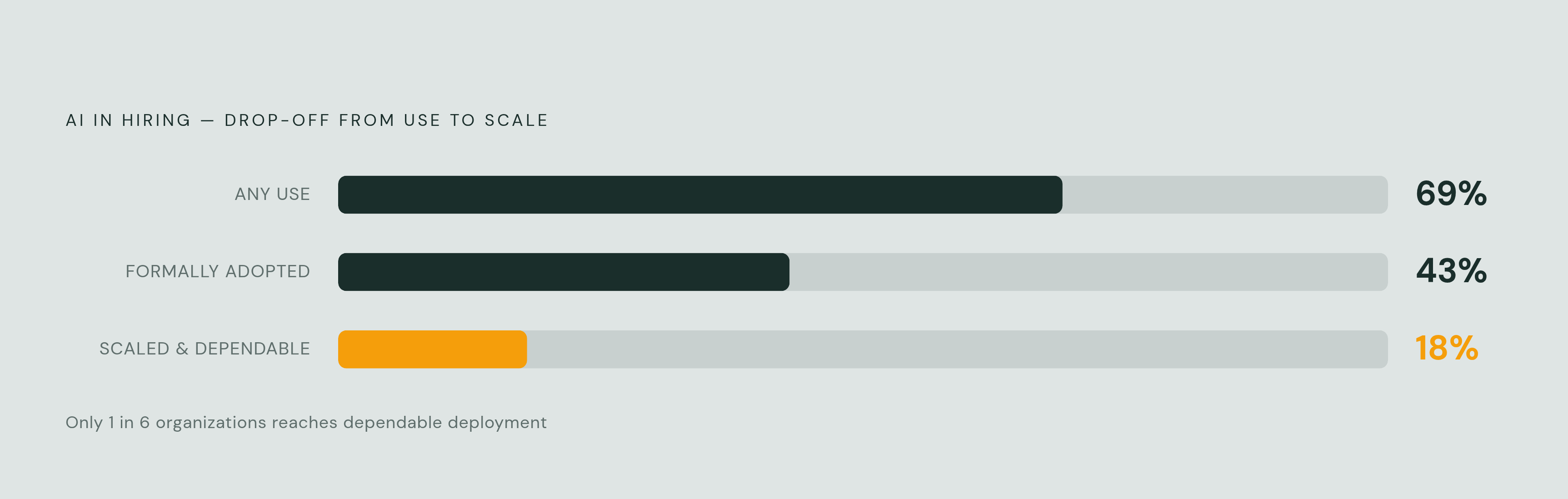
AI adoption in hiring climbed to 43% of organizations in 2025, up from 26% just a year before SHRM 2025 Talent Trends collective.work SHRM National Bureau of Economic Research arxiv.org. That's a majority-adjacent shift in how companies find and vet candidates SHRM 2025 Talent Trends collective.work SHRM National Bureau of Economic Research arxiv.org. But adoption numbers hide a messier truth: 69% of companies use AI somewhere in their hiring process, and only 18% have actually scaled it into something dependable thehirehub.ai. Most of the industry is stuck between piloting and operating, which is a rough place to be when the labor market isn't cooperating.
And it isn't. Job openings are 6.9 million against 4.8 million hires, and the average time to fill a role has stretched to 40 days BLS JOLTS iCIMS arxiv.org. Meanwhile, budgets aren't growing to match the strain: only 30% of companies expect their talent acquisition budget to grow, and just 24% plan to add recruiter headcount pin.com. Teams are being asked to do more work, faster, with the same number of hands on deck, or fewer pin.com.
Here's the paradox worth sitting with. AI adoption is accelerating at the exact moment hiring itself is slowing and teams are shrinking. It means more tools, full stop, unless someone designs how those tools fit together. Add to that a strange new wrinkle: roughly 78% of job applications now contain AI-generated content. Volume is up. Signal quality is down. Both sides of the hiring table are running AI, often pointed at each other.
That's the actual operating environment a hiring loop has to survive: high volume, compressed resources, and degraded signal. Random AI adoption, bolted onto an old process without a plan, doesn't fix that. It just adds noise to noise. What's needed is structure, and that word deserves its own explanation before going further.
What a structured hiring loop actually means
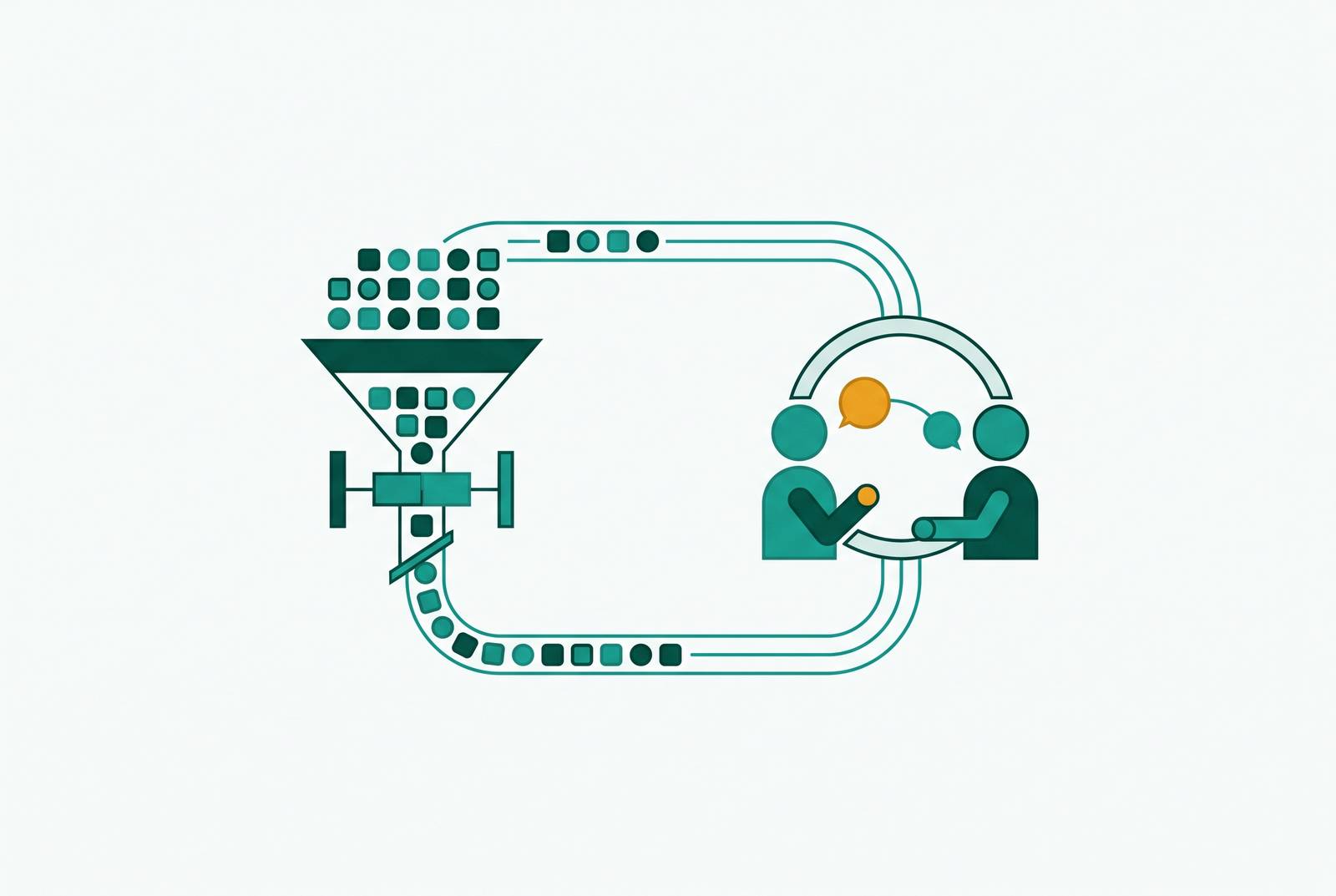
A loop isn't a funnel. A funnel is one-directional and lossy: candidates go in, fewer come out, and nothing that happens at the bottom changes how the top behaves next time. A loop has feedback built in. Each stage informs the one after it, and just as important, what comes out of the final debrief loops back and reshapes the criteria used upstream.
Structured means something specific here. Every stage has a defined owner, defined inputs, defined outputs, and a defined handoff to the next stage. Not "whoever has bandwidth this week handles it." Not "the recruiter figures it out based on what's urgent." Defined, in writing, in advance.
A split between pattern-matching and judgment organizes all of this. AI is reliably weak at judgment: reading an unconventional career path, weighing whether someone will click with a specific team, making a contextual call that depends on nuance a resume can't carry. One recruiting industry prediction for 2026 put it well: the recruiter who thrives is the one who uses AI to accelerate the funnel without lowering the bar, catches it when AI gets a recommendation wrong, and translates signal into a decision a hiring manager actually trusts arxiv.org. That's a description of a deliberate division of labor.
Four stages make up the loop: sourcing and initial screening, AI-led assessment and interview, the human evaluative conversation, and finally debrief and decision. Each one gets its own section below. But the through-line, the place where structured loops either hold together or fall apart, is the handoff between stages. That question determines what travels with a candidate from one stage to the next and who is accountable for acting on it.
What AI handles well: sourcing, screening, and first-pass assessment
Start with sourcing, because that's where the shift is furthest along. Korn Ferry's 2026 Talent Acquisition Trends report, drawing on 1,674 global talent leaders, found 84% plan to use AI in 2026, and 52% plan to add autonomous AI agents into the mix Korn Ferry 2026 Talent Acquisition Trends iCIMS arxiv.org. This isn't an early-adopter category anymore. One 2026 prediction put a number on how far this goes: 90% of sourcing automated by year's end, with recruiter hours once spent hunting candidates (two to four hours a day, by some estimates) collapsing down to minutes arxiv.org.
Why does that work so well? Because sourcing is fundamentally a pattern-matching problem, and AI is built for exactly that. A keyword search finds "data analyst" sitting in a job title. A skills-based AI search finds people who've actually done data analysis work under a different title entirely: business intelligence specialists, research associates, operations analysts who never called themselves analysts at all iCIMS arxiv.org. That distinction affects how candidates with non-analyst titles get found and evaluated in a search. Companies running the most skills-based searches were 12% more likely to make a quality hire, according to LinkedIn's Future of Recruiting 2025 data iCIMS arxiv.org.
First-screen interviews are moving the same direction, especially for high-volume and early-career roles arxiv.org. A five-minute conversational AI interview can assess communication style, directness, how someone responds when asked something they didn't expect arxiv.org. That's real signal a resume simply can't produce arxiv.org. And there's a candidate experience angle that gets missed too often: for a recent graduate who grew up AI-native, an AI screen that actually gives feedback can feel fairer than vanishing into an ATS black hole with no response at all. It's not just an efficiency play for the company. It's a quality-of-experience play for the person on the other end.
The ATS itself becomes invisible to the recruiter, because an AI agent handles the mechanical parts, moving candidates between stages, logging notes, syncing fields, so recruiter attention shifts toward the stages that actually need a human in the room. The measurable upside backs this up. Structured AI-generated assessments cut false positives in hiring by roughly 50% compared to unstructured screening, according to HackerRank. Fewer weak candidates make it to the offer stage in the first place HackerRank.
A 2025 study found that finalist sets built using AI-interview information had final-interview pass rates about 20 percentage points higher than finalist sets built from resumes alone arxiv.org. The lift was biggest for junior and early-career candidates, exactly the population where a resume gives the weakest signal to begin with arxiv.org. But this comes with a real caveat. AI sourcing isn't neutral by default. Tools optimized to pattern-match on credentials will systematically miss strong candidates who don't fit the obvious mold. How well the skills-based matching actually works depends entirely on how the target criteria got defined upstream, before the AI ever ran a single search.
Where AI screening breaks down and creates new risk
Here's where it gets uncomfortable. Call it the AI doom loop: more automated applications feed more automated screening, which erodes trust on both sides, and produces a strange arms race between AI-generated applications and AI-generated rejections. Recruiters feel it. Candidates feel it too, and the frustration compounds on both ends.
Using these as a knock-out filter is a structural bias risk dressed up as diligence, not quality control.
Then there's the fraud problem, which is getting worse, not better. Roughly a fifth of hiring managers report catching outright deepfakes during live interviews, and 74% say they're more worried about fake credentials than they were a year earlier arxiv.org. One industry projection puts the scale of this into stark terms: by 2028, as many as one in four candidate profiles worldwide could be fake arxiv.org. AI screening that leans on self-reported credentials to make its calls is standing on ground that's eroding under it arxiv.org.
The deepest failure mode, though, is quieter than fraud and harder to catch. AI is good at finding candidates who resemble the company's past hires. Which means it systematically undervalues people whose path looks different, non-linear, described in unfamiliar language. This is the default behavior of any system trained on historical data. If exceptional performers at a company have always come from the same three schools or the same three prior employers, a pattern-matching system will keep reaching for that pattern, not because it's malicious, but because that's what pattern-matching does.
What follows from this? AI screening needs something explicit to work against. Not a job description (a notoriously poor proxy for what "exceptional" actually looks like in practice), but tested, specific signals of what the role genuinely requires. Without that upstream definition, AI doesn't correct existing blind spots. It amplifies them. None of this is an argument against AI screening itself. It's an argument for treating the handoff point, the exact moment a screened candidate lands in front of a human, as something that has to be designed on purpose. What evidence travels with that candidate? What does the human evaluator actually need to know about how they got selected in the first place?
Designing the calibration layer that makes the handoff work
Calibration is the hinge everything else swings on. Without it, a structured interview process produces theater, not consistency: scorecards get filled in, sure, but they mean something different to every interviewer holding the pen, and debriefs turn into arguments about interpretation instead of arguments about evidence.
The most stubborn calibration problem is bar drift. Hiring managers under pressure to fill a role fast will unconsciously lower the bar without noticing they've done it. Interviewers who haven't seen a genuinely exceptional candidate in a while quietly reset what "exceptional" even means to them. Periodic recalibration, re-scoring a known strong hire's original interview and comparing the new scores against the old ones, catches this drift before it compounds into something expensive.
One structural rule appears again and again in the research: no talking before writing. When interviewers compare notes verbally before anyone documents a score, the first person to speak disproportionately shapes everyone who speaks after them. Requiring written scorecards before any verbal debrief produces evaluations that are actually independent of each other. It just prevents the noise from drowning out the signal.
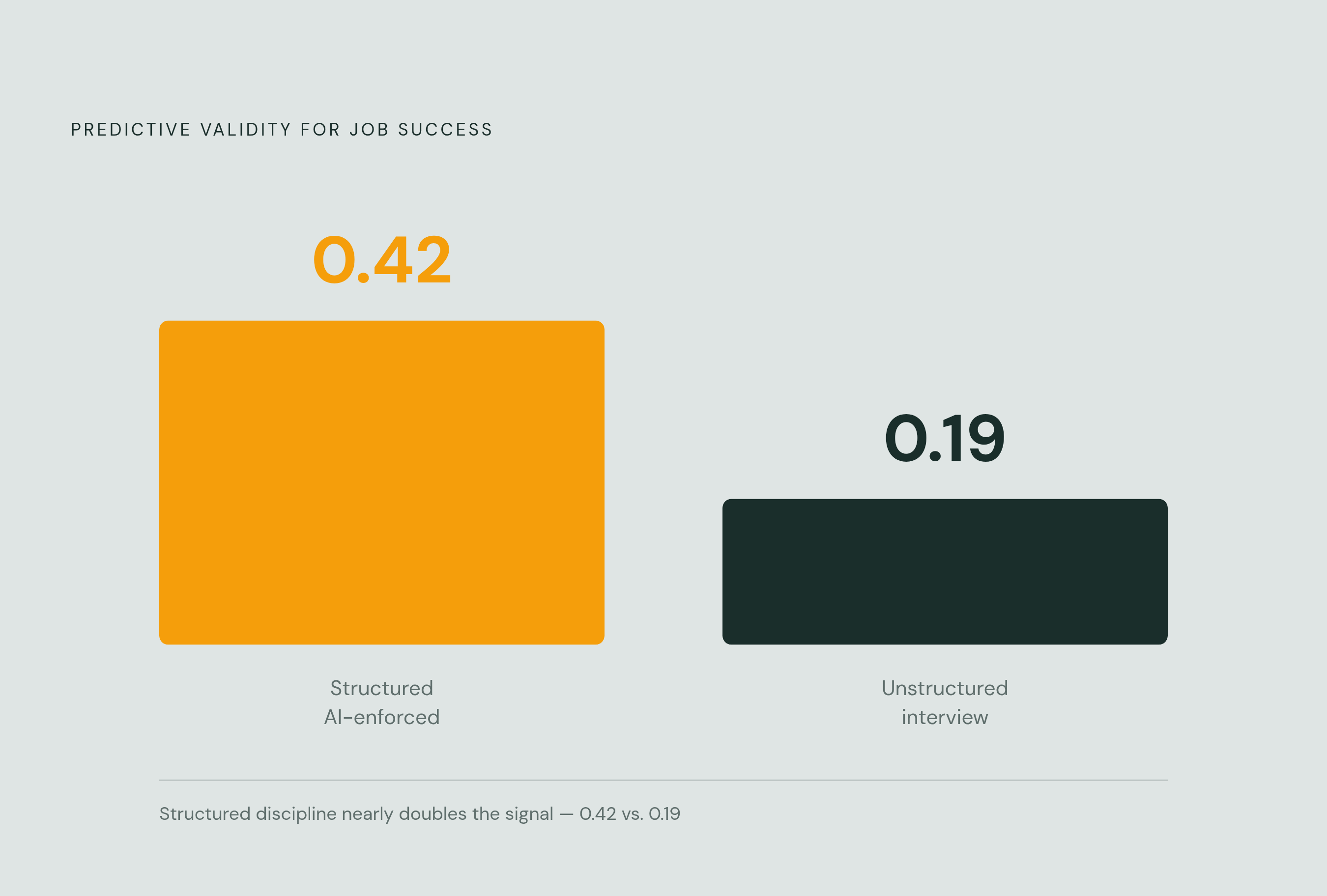
The numbers back this up in a way that's hard to argue with. Structured, AI-enforced interviews carry a predictive validity of 0.42, against 0.19 for unstructured interviews, according to a Wiley meta-analysis. That's nearly double the predictive power for actual job success Wiley meta-analysis. It's coming from the discipline SHRM 2025 Talent Trends National Bureau of Economic Research.
Who should write the rubric in the first place? The best interviewers a company has, the ones who already know what strong performance looks like in this specific context, better than any generic competency framework could tell them. And calibration needs monitoring, not a one-time setup. Four numbers, tracked quarterly, catch drift early: scorecard completion rate, patterns in interviewer disagreement, candidate feedback on the process itself, and pass-through rates by stage, watched for adverse impact. They're a signal something's slipping.
Calibration isn't only a human-side concern. It's the upstream input that determines what AI is even optimizing for. The clearer a team gets about what exceptional actually looks like, the more accurately AI can be pointed at finding it.
What human interviewers are actually for in this loop
So what's left for a human to actually do, once AI has sourced, screened, and assessed? Quite a lot, and none of it is optional. Deciding whether a candidate's unconventional path is a risk or a hidden asset. Reading how someone handles real ambiguity under social pressure, in the moment, not in a scripted response. Judging whether a person's values and working style will actually compound well with this specific team, not teams in general. These all require context that no screening tool carries into the room.
Human interviewers own three things, and all three need to stay firmly in human hands: the evaluative conversations that require genuine relational presence, contextual judgment calls about non-obvious candidates that AI would have missed or discounted outright, and the final hiring decision itself. As roles get more complex and judgment-heavy, this only gets more important, not less. Robert Half data from April 2026 found 49% of business leaders are prioritizing hiring for more strategic roles, which means the human interview stage is carrying more weight, not less, as the easier roles get automated away from the front of the funnel arxiv.org.
The recruiter's job shifts accordingly. Not scheduling (AI owns that now). Not note-taking (AI handles it). Not the first resume pass (AI already screened it). The recruiter's actual job becomes calibration, relationship-building, and decision quality. They're the judgment layer now, not the process layer. One emerging title captures this shift well: an "agent manager," whose job is calibrating the AI sourcing and screening agents, evaluating what they surface, and owning shortlist quality. It's getting elevated into oversight of the system itself.
There's a candidate-facing payoff too. When AI outreach is flooding every candidate's inbox with templated messages, a genuinely human, thoughtful conversation stands out more, not less arxiv.org. It becomes a competitive signal in a market where candidates are comparing offers and experiences against each other arxiv.org. But this cuts both ways: human interviewers shouldn't be re-litigating screening decisions without evidence, asking unstructured questions that produce answers nobody can compare across candidates, or letting the most senior voice in the room collapse everyone else's independent judgment before the debrief even starts. Those are calibration failures wearing a human face.
How to build the debrief and decision stage so it doesn't reverse good upstream work
Post-hoc rationalization lives in the debrief. That's where NBER's research found structured processes cut it down, but only when the debrief itself follows structure, not just the interview that came before it. A tightly structured interview followed by a loose, unstructured debrief still loses most of the gain that structure was supposed to buy.
Sequence affects whether the debrief conversation surfaces independent judgment or just groupthink. Scorecards get submitted independently before anyone opens their mouth in the debrief conversation. The discussion opens with the outlier scores, not the scores everyone already agrees on. The whole point is surfacing disagreement and interrogating it directly, not rubber-stamping whatever consensus was already forming in the hallway beforehand.
Evidence has to be the currency of the conversation, not impression. If an interviewer can't point to a specific moment from the actual conversation to back up a rating, they get asked to go back and revisit it before the decision closes. And the debrief needs to feed back into the AI layer, not just close out the file. Who passed, who didn't, and why: that's the signal that sharpens what AI gets calibrated to surface the next time around. Without that loop actually closing, the AI screening layer stays static, and bar drift becomes invisible to everyone downstream.
The final call, though, has to stay with a human. The system can rank candidates, flag concerns, summarize interview notes. But the hire or no-hire decision is a human judgment with human accountability attached to it arxiv.org. This isn't a philosophical stance for its own sake. As AI hiring legislation continues to take shape, it's a practical and legal necessity too arxiv.org.
Getting this right isn't just about process hygiene, it appears on the balance sheet. Cost-per-hire runs around $4,700 for a standard role and $28,329 for an executive hire iCIMS Employ Inc. benchmarking report arxiv.org. First-year turnover dropped from 23.7% down to 12.1% between 2024 and 2025, based on data covering 6,640 customers iCIMS Employ Inc. benchmarking report arxiv.org. Structured processes appear to be paying off already iCIMS Employ Inc. benchmarking report arxiv.org. A debrief that quietly undoes all the upstream structure throws that gain straight in the trash.
Practical steps for teams building or auditing their hiring loop now
Start with the calibration conversation, not the tool. Before any AI gets deployed at any stage, the hiring manager and recruiter need to agree, in specific and observable terms, what exceptional actually looks like for this exact role. Not a job description pulled from the last posting. Observable behavioral evidence of fit, written down before anyone touches a vendor demo.
From there, map the loop as it actually runs today, not as it's assumed to run. Which stages have a real, defined owner? Which ones are being improvised on the fly because whoever's least busy that week picks it up? Most teams will find the real gap isn't in sourcing or scheduling at all. It's sitting in the handoff between AI output and human review, in the question of what evidence travels forward and who's actually responsible for acting on it.
For teams still running resume-only screening, the case for change is sitting right in the data: finalist pass rates ran roughly 20 percentage points higher when AI interview information got added to the mix, compared to resumes alone arxiv.org. That's the argument for adding a structured AI assessment stage ahead of human interviews, especially for junior and early-career hiring where resumes carry the least signal to begin with arxiv.org.
And build the written-before-verbal rule into the debrief as a hard constraint, not a suggestion. It's one of the highest-leverage changes available, and it doesn't require buying a single new piece of software to put into place.