Evaluating AI Interview Platform Outputs for Decision-Making Reliability
AI interview tools widely adopted, but nobody agrees what makes their decisions reliable.
Sit with that gap for a second. Adoption is basically universal. Value is basically absent. That's not an adoption problem; it's a measurement problem, for nobody's agreed on what "usable output" even means.
The stakes are not abstract, either. A meaningful share of companies let AI reject candidates without human review. So, whatever that AI decided, right or wrong, it became the outcome. No second look, no override, no audit trail unless someone built one in.
Part of the confusion comes from a labeling problem. "AI interview platform" gets stretched over scheduling assistants, async video scoring tools, live copilots, structured calibration systems, and end-to-end platforms trying to do it all. Comparing a scheduling bot to a calibration engine on the same scorecard is like comparing a thermostat to a diagnostic lab. Both measure something. Only one of them is built to be trusted with a decision.
The right frame is to treat AI interview output like any high-stakes measurement system, asking whether you can verify, explain, and improve it over time. That's the lens for the rest of this piece. Not "does the demo look slick," but "can this thing survive an audit."
The four properties that separate usable output from automation theater
Demo polish and feature count, the things vendors lead with, are absent from that list, and neither predicts that output is safe to act on.
Accuracy, in this framing, isn't a model claim. A score with no defined decision behind it is just a number sitting on a screen. It's just a number sitting on a screen, and it doesn't matter how confident it looks.
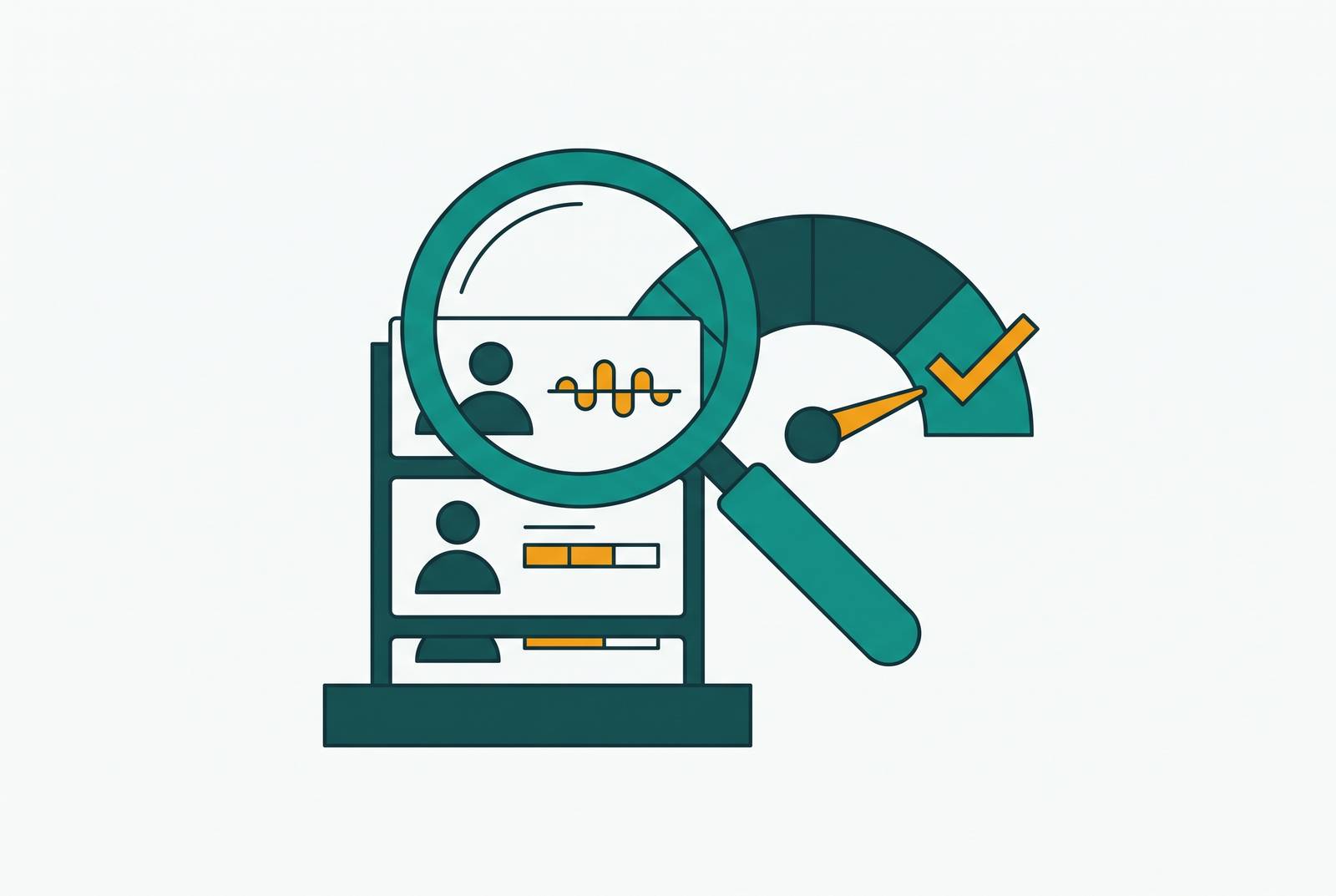
Auditability asks a narrower question: can you see transcript-linked rationale, reviewer overrides, version history, audit logs? If a platform can't produce these, you have to ask what exactly the score is even standing for.
Candidate trust and experience is the one buyers underweight most often, and it shouldn't be. Only about a quarter of applicants trust AI to evaluate them fairly, and most job seekers report unease with AI-led hiring. A distrustful candidate gives worse data, freezing up, hedging, answering defensively. Low trust degrades the very signal the platform measures. Fairness, in other words, is a component of accuracy. It's a component of it. A system that looks accurate on average can still fail badly in the edge cases that matter most.
Recruiter control closes the loop: can a human calibrate scoring, document overrides, and improve the system without losing accountability? Humans decide; systems support.
Use this in a live demo, rather than just nodding along to a vendor's pitch. Bring your own role, not their sample one. Feed it real, messy sample answers, including nervous, rambling ones from strong candidates. Push deliberately on hard parts: ambiguous answers, unverified claims, contradictions. Then score the artifacts the system produces. A vendor's polish shows how well they present, not whether the output survives a real hiring decision. Humanly's guide frames a defensible buying decision as depending on accuracy as a system outcome, auditability, candidate trust and experience, and recruiter control, not demo polish or feature count. Humanly's guide holds that a platform unable to show transcript-linked rationale cannot be calibrated responsibly.
Transcript-linked rationale as the non-negotiable baseline
Some platforms show exactly what drove a score, question, response segment, tone, even response time. Others give a number and a shrug. That gap is the difference between a defensible decision and an assertion you're asked to trust.
What does transcript-linked rationale actually look like on a screen? Each competency signal on the scorecard links to a specific, timestamped, quotable moment in the transcript that a reviewer can click into. Metaview's documentation describes exactly this: the notetaker maps answers against the role's rubric and links each report point to the transcript moment it happened. BrightHire builds its structured interview intelligence around the same transcript-anchored review. That's the concrete model to hold every other platform against.
Why does the absence of this linkage matter so much? Walk through what happens without it. A recruiter gets a score with no way to tell if it reflects the candidate's actual answer, or an artifact of bad wording, bad audio, or quiet model drift. A hiring manager who disagrees can't document an override, since there's no evidence to cite, only gut feeling, defeating half the point of a structured tool. If a rejected candidate ever challenges the decision, legal and compliance teams have nothing concrete to produce, just a floating score with no evidence chain.
Calibration, done properly, is a measurement system: define the decision, control the inputs, audit the evidence behind every output. Transcript linkage is that audit-evidence layer. Without it, there's no calibration, just a guess with a confidence score attached.
How bias in scoring quietly destroys output reliability
Auditability is a transparency problem; bias runs deeper, baked into what the model learned before a recruiter opened the platform. The most-cited study, Wilson and Caliskan's 2024 AIES paper, found language-model resume rankers preferred white-associated names 85.1% of the time versus 8.6% for Black-associated names. Gender bias also appeared: male-associated names beat female-associated names 51.9% to 11.1%, though over a third of comparisons showed no significant difference, a smaller effect than the racial disparity. Stanford HAI's research adds that substantial shares of Black and Asian applicants applied into systems discriminating against their own group, often unknowingly.
Why does this matter at the scale it does? Because these aren't isolated incidents happening at a handful of unlucky companies. Most U.S. employers use AI screening tools, relying on the same small handful of third-party vendors. So a bias pattern in one system isn't contained to one company, it propagates across the market, simultaneously and invisibly, to every user of that vendor.
Amazon's scrapped recruiting tool is the example. It trained on a decade of resumes from an overwhelmingly male workforce. That reflects the model doing what pattern-matching systems do: finding the pattern in training data and repeating it.
Two kinds of errors come out of this, and they are not equally damaging. A false positive (an unqualified candidate flagged as a fit) wastes interview time, but is recoverable. A false negative (a qualified candidate screened out) compounds: it can systematically exclude whole groups, and stays invisible since the candidate never reaches a human unless someone actively audits.
That raises the real question underneath this whole section. What does "accurate" even mean if a platform can pass its own benchmark and still discriminate at scale? A system can look accurate on average while being consistently wrong for the candidates who most need a fair look. Averages hide the failure; only an audit finds it.
Why generic rubrics fail calibration against a defined standard
Teams compare platforms on breadth of features rather than depth of the actual workflow across 2026 procurement decisions. Applied to calibration, that means buying a tool that scores against a generic skills list instead of a rubric the hiring team defines itself.
Think about the difference in the actual question being asked. A generic tool asks whether a candidate matches the job description; a calibrated one asks whether they match what great looks like on this specific team. Those two questions can produce entirely different shortlists from the same applicant pool.
What does a properly calibrated workflow actually look like, step by step? Interviews get scored against a rubric built for the role. Recordings and transcripts stay available for review, not buried once the score is generated. Humanly's best-practice model has review followed by an actual human decision. When pass-through rates shift, drift monitoring logs who changed the rubric and when, avoiding guesswork.
Credentials deserve a harder look here too. A brand-name employer on a resume proves someone was hired elsewhere once, not that they can do this job well. Platforms calibrated against credentials rather than actual work will systematically miss strong candidates who don't pattern-match "who we've hired before."
Calibration isn't a one-time setup task; it's a living standard that sharpens with feedback on how hires actually perform. A platform that can't version rubric changes and show an audit trail cannot support real calibration, however good its scoring model looks alone. Eightfold AI's structured evaluation illustrates the alternative, connecting interview scoring to a broader talent strategy built on fairness, consistency, and skills-based evaluation. The distinguishing design choice isn't the AI itself. The standard it scores against is explicit and adjustable by users, not locked in a black box.
Evidence of work versus credential pattern-matching as a scoring input
Resumes are losing their place as the primary signal in the forward-thinking end of AI hiring. The shift underway favors work samples, role-specific skills, and real execution history, mattering most for candidates who don't fit a familiar resume shape.
Why does this happen? Models trained on historical hiring data favor familiar signals: specific universities, recognizable employers, a tidy upward-climbing title sequence. None of that predicts performance, it predicts who got hired in the past, and a model trained on it will keep recommending the same shape of candidate unless someone intervenes.
So, what does a work-evidence-based platform actually look like in practice, and how would a recruiter tell the difference in a demo? A few concrete signals to check for. Role-specific questions built around actual job tasks, not generic probes that could apply to any title. Technical assessments or work samples scored against defined criteria, not inferred from education. Dynamic follow-ups that push into specifics of what a candidate claims to have built, testing whether the story holds up. Manatal enriches a candidate's profile from more than twenty sources, including LinkedIn and GitHub, before generating a single interview question, giving richer material to build real questions from. TestGorilla sits at the far end of the spectrum, testing skills directly via pre-employment assessments rather than inferring them from a resume.
The reliability payoff is straightforward once you see it. A platform built on credential proxies looks accurate against historical hiring patterns simply because it repeats them. It will also miss the builder without the expected background, the same false-negative problem from a different angle. When evaluating a platform, ask what its question bank draws on, how rubrics get built, and whether you can trace which input drove a score. A vague answer suggests vague scoring.
A structured look at platforms on the market and their supported features
Metaview positions itself as an AI interview intelligence platform focused on structured candidate reports. Its clearest strength is auditability: the scorecard pre-fills from the transcript, with every competency backed by linked evidence and timestamps, likely the most concrete implementation of transcript-linked rationale described earlier. On the operational side, it integrates with over 62 recruiting tools, submits scorecards directly into a couple of major applicant tracking systems, and offers a browser-extension autofill for another. Its Notetaker has a free tier available with a work email, with paid plans priced per agent. A case study with emnify reported a large drop in interviews per hire, a jump in candidate NPS, and meaningful weekly recruiter time saved. It fits best where interview signal drives the hiring call and scorecard auditability isn't optional.
Humanly, whose own 2026 guide supplies much of the evaluation framework used throughout this piece, is built around structured candidate screening with recruiter control as its organizing principle. Its distinguishing property is the full chain (transcript evidence mapped to a rubric, reviewer overrides, audit logs, identity shielding, and drift monitoring) working together rather than as bolt-ons. That combination suits teams treating auditability and recruiter-in-the-loop decisions as requirements, not nice-to-haves. Unstructured roles require real upfront work defining competencies and rubrics before the platform delivers full value.
HireVue shows up across enterprise and high-volume hiring conversations as an AI video assessment platform, listed as best for AI-powered video interview analysis. For platforms in this category, ask directly in a demo how deep the audit logs go and confirm that scores link back to transcript moments, as the earlier baseline requires.
Eightfold AI Interviewer falls into the AI talent intelligence category, built around structured interview workflows. Its differentiator, as covered above, is connecting interview scoring to a broader talent strategy where the standard itself stays explicit and adjustable, not locked in the model.
None of these tools are interchangeable, and none of them should be judged by the same feature checklist. Any evaluation should weigh not which platform has the most capabilities, but which can show its work (transcript, rubric, and audit level) when challenged. SOC 2 Type II, GDPR, and CCPA compliance.