Candidate Experience During an AI-Conducted Interview
Transparency and fit matter more than the technology itself in AI interviews.
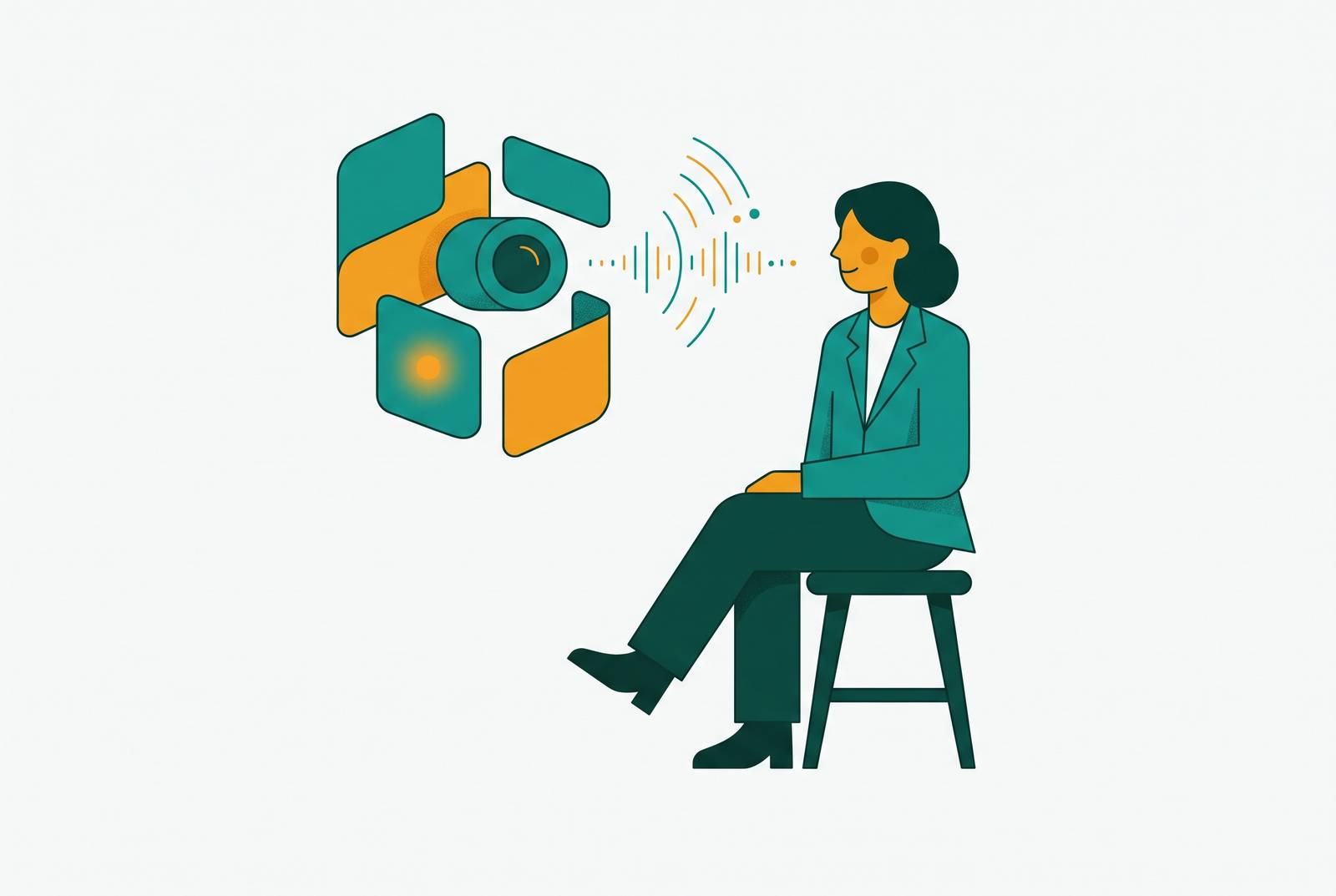
Candidate Experience During an AI-Conducted Interview. It depends less on the technology itself and more on the process being transparent, calibrated to the role, and designed to surface genuine fit rather than credential patterns.
How common AI interviews have become
Bullhorn's GRID Talent Trends Report, based on nearly 2,300 professionals who'd worked with a staffing firm in the past three years, found 92% rated an AI voice interview as good as or better than a live recruiter interview, and 93% of those with a positive experience said they'd work with that firm again Bullhorn's 2026 GRID Talent Trends Report. Get them wrong, and the same candidates walk, often quietly, often without saying why.
Start with scale, because this isn't a niche practice anymore. About 87% of companies use AI somewhere in hiring, and by mid-2026, roughly 80% of high-volume roles are expected to open with an AI screen How to Improve Candidate Experience With AI Interviews in 2026 Greenhouse 2026 Candidate AI Interview Report. SHRM's 2025 Talent Trends survey of 2,040 HR professionals found 51% of organizations now use AI specifically for recruiting, the most common AI application in HR.
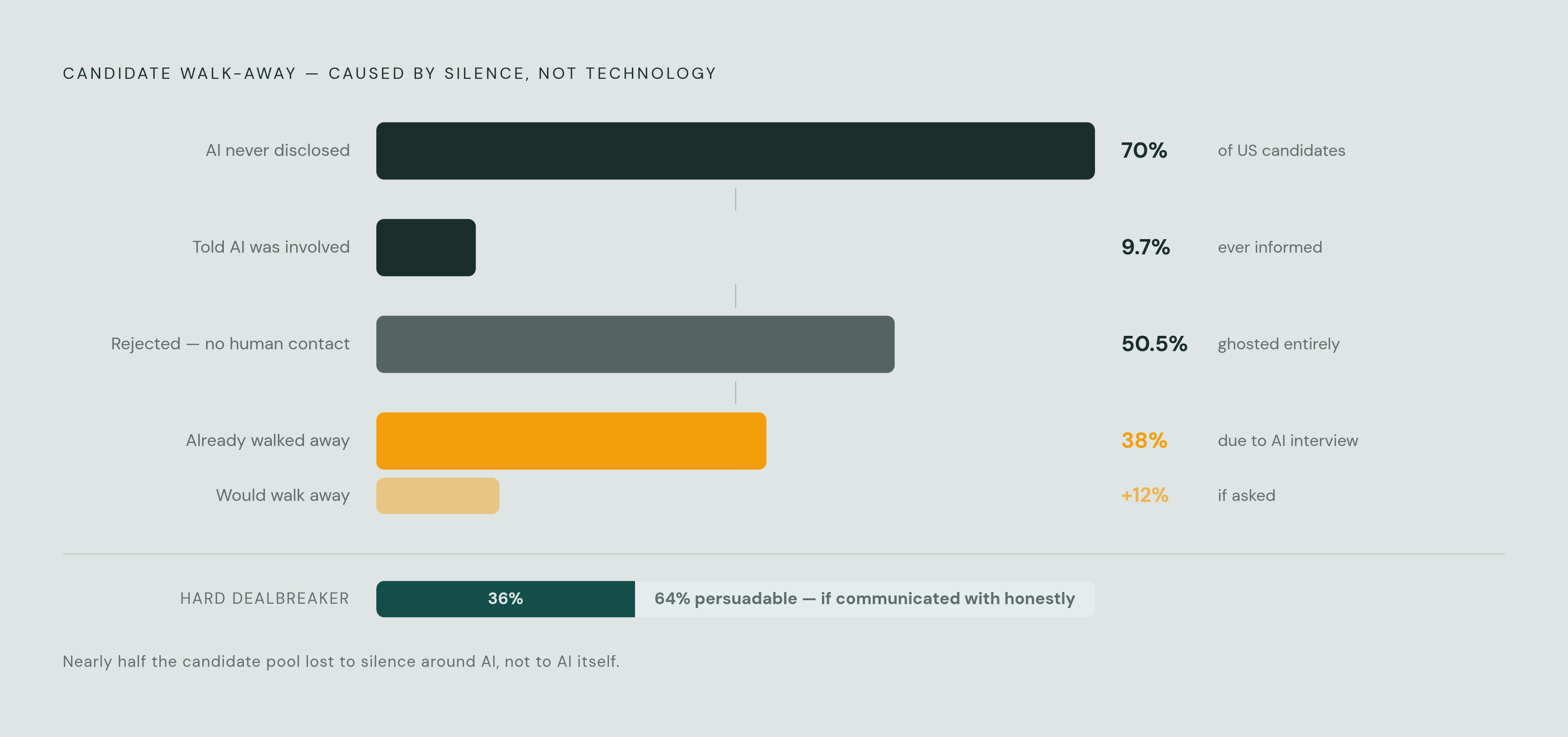
So adoption is real and it's fast. Trust hasn't caught up. Gartner found that only 26% of applicants say they believe AI can evaluate them fairly. More strikingly, 38% of candidates say they've already walked away from a hiring process because it involved an AI interview, and another 12% say they'd do the same given the chance, meaning close to half the pool is one bad screen from disengaging Greenhouse 2026 Candidate AI Interview Report. About 34% report an AI interview left them thinking worse of the employer, meaning companies are damaging their own pipeline one screen at a time staffinghub.com.
But here's a wrinkle: Bullhorn's figures above show the opposite pattern Bullhorn's 2026 GRID Talent Trends Report. That's a wildly different number from Greenhouse's Greenhouse 2026 Candidate AI Interview Report. Why the gap? Greenhouse surveyed job seekers broadly; Bullhorn surveyed people already inside a staffing relationship, where the AI's role was likely better explained. That gap, more than either number, is the real story: adoption is outrunning the conditions that make AI interviews work, which is what the rest of this piece covers.
What AI is doing during the interview (and what it is scoring)
Strip away the branding and there are three formats doing almost all the work right now. Text-chat interviews ask structured questions and use NLP to flag qualified candidates, common in high-volume hiring like retail, hospitality, and call centers. One-way async video or voice interviews have candidates respond to pre-set prompts with no human present, and AI scores the response against a rubric afterward. Hybrid interviews keep a human in the room but let AI transcribe, summarize, read sentiment, or score competencies in the background, increasingly standard for mid-to-senior roles.
None of that is mysterious. It's pattern recognition applied to language.
What separates a real AI interview from a static form, though, is the follow-up Greenhouse 2026 Candidate AI Interview Report. If a candidate gives a thin answer, a well-built system probes deeper, and that second or third question is where the real signal appears. Most candidates don't clock this. They treat the first answer as the whole test.
There's a second scoring dimension people miss almost entirely: consistency across the full interview. The system compares performance throughout, so a candidate who fades after strong early answers gets flagged for the gap. Front-loading prep and coasting doesn't work the way it might in a live conversation with a distracted interviewer.
None of this means the AI is deciding anything Greenhouse 2026 Candidate AI Interview Report. It's producing evidence, and a human still has to weigh it. Across formats, the AI scores relevance to the question, use of concrete examples (STAR structure still performs well), clarity and structure of speech, and keyword or competency alignment with the job description.
Why transparency is the single biggest variable in whether candidates stay or bail
70% of US candidates who went through an AI evaluation say it was never clearly disclosed beforehand, and one in five only found out once the interview had started Greenhouse 2026 Candidate AI Interview Report. That's not a technology problem. That's a communication failure, and it's avoidable.
It gets worse on the policy side. About 80% of US candidates say employer AI policies are vague, rare, or nonexistent, while only 18% say most employers have anything explicit Greenhouse 2026 Candidate AI Interview Report. And the silence extends past the interview: 50.5% of job seekers report being rejected in the past year without a word from a human, and 63.8% of that group assume a machine made the call enhancv.com. Only 9.7% of the full sample say an employer ever told them that AI was involved enhancv.com.
Yet the resistance isn't as absolute as it might look. A JobLeads survey found just over 36% call an AI-conducted first interview a flat dealbreaker, but another 33% say it depends on the role or company. Add those groups up and the majority of candidates are persuadable JobLeads survey. So what's actually driving the walk-away rate? Mostly surprise. Candidates aren't rejecting AI so much as being ambushed by it, and upfront disclosure changes the math substantially.
What should disclosure actually cover? That's not a high bar. It's increasingly not optional, either: disclosure legislation keeps shifting, and staying current is the employer's job, not a nice-to-have.
Bullhorn's data actually backs this up rather than undercutting it. Among candidates who encountered AI through a staffing firm, 69% went through it, and 81% rated the experience positively Bullhorn's 2026 GRID Talent Trends Report. Context and communication, not the underlying technology, look like the real differentiator.
How calibration determines whether the interview questions match the role
Calibration is the difference between a scorecard that gets filled out and one that actually means something. Without it, interviewers or AI systems score identical answers differently, so the outcome depends more on which panel a candidate drew than on their actual quality. Gartner data cited by klearskill.com shows teams using calibration tooling raise inter-rater reliability from a typical 0.55 to 0.78 within six months, arguably the strongest documented lever on hiring quality.
It gets specific to AI interviews here Greenhouse 2026 Candidate AI Interview Report. If the rubric is built off a generic job description instead of a calibrated definition of "exceptional," the system optimizes for credential patterns: familiar schools, brand-name employers, dense keyword matching. None of those are evidence of what someone can actually do.
There's a slower-moving version of this failure too, sometimes called bar drift. Hiring managers under pressure quietly lower standards, and interviewers who haven't seen a strong candidate in months reset their baseline without realizing it. If nobody updates the AI's rubric, that drift gets encoded and repeats indefinitely.
Good calibration, in practice, looks like this: questions pulled from what the job actually requires day to day, not lifted from the posting; a scoring rubric a hiring manager reviews and signs off on before it ever runs; every change to that standard made visible and human-approved rather than slipped in quietly; and periodic re-scoring of interviews from people the company already knows are strong hires, to catch drift before it compounds.
The candidate-experience cost of skipping all this is direct. Genuinely strong candidates get filtered out by questions measuring the wrong thing, and they walk away feeling the process was irrelevant or unfair, rightly.
The newest 2026 tooling category pulls scheduling, transcription, scoring, and calibration analytics into one connected system, since cross-stage signals, like a mismatch between async and live answers, or panel drift over a quarter, only become visible when data lives in one place. Vendor case studies for leading integrated products report time-to-hire cut 22%–31% within a year, though that's vendor-reported and should be treated as directional.
Why AI interviews systematically miss strong but non-obvious candidates
When a rubric is calibrated against credentials instead of actual work, it rewards people good at looking credentialed: the right school, employer sequence, expected keywords. None of that proves someone can do the job. It proves they know how to sound like someone who can.
That's how strong but non-obvious candidates, career switchers, self-taught practitioners, people from less traditional backgrounds who've actually solved the role's problem, fall through: not because they answered poorly, but because the rubric measured the wrong thing.
But what if the same adaptive probing that makes AI interviews unnerving to unprepared candidates is actually the fix here Greenhouse 2026 Candidate AI Interview Report? A system pushing for specific examples, decisions, outcomes, and moments of judgment surfaces real evidence of fit that a resume never could. This only works if the rubric is calibrated to actual work rather than pedigree. The capability exists. Whether it gets used well is a design choice, not a given.
Teams that consistently land top talent build smaller, higher-signal funnels that make it easier to spot an exceptional candidate and move fast. Summaries grounded in concrete examples of impact and judgment cut recency bias and lead to faster, more confident calls.
AI could end up a fairer first screen for new grads and non-traditional candidates simply because it evaluates them at all, rather than dropping their resume into an unopened folder. That fairness, though, rests entirely on what the AI has been calibrated to look for Greenhouse 2026 Candidate AI Interview Report. The real design question isn't "what questions does our AI ask Greenhouse 2026 Candidate AI Interview Report?" It's "what evidence of exceptional does this surface, and has a hiring manager confirmed that?"
What the candidate experiences when the process is designed well
Candidates who know beforehand that AI is running the interview, understand roughly what it's checking for, and get feedback afterward describe a genuinely different experience than those blindsided by it. That distinction is the thread connecting Greenhouse's grim numbers to Bullhorn's rosier ones.
Picture a short AI screen candidates actually like: five minutes, a real evaluation, feedback afterward, confirmation someone looked at the application. Done that way, it reads as respectful; without that context, the same five minutes reads as dismissive Greenhouse 2026 Candidate AI Interview Report.
So what should a candidate reasonably expect from a well-built AI interview Greenhouse 2026 Candidate AI Interview Report? Disclosure upfront covering format, length, what's scored, and who sees the results. Questions that visibly connect to the actual work of the role, because candidates notice immediately when they don't. Follow-up probes that respond to what was actually said rather than firing off a canned script. And a clear sense of what happens next, and roughly when.
For candidates trying to perform well regardless of which platform they land on, a few things matter more than others. Treat follow-up questions as the real interview, since surface answers get probed and depth is the actual signal. Lean on concrete, specific examples, actual decisions, actual outcomes, actual moments that required judgment. Keep energy and detail consistent throughout, since the system watches for drop-off between early and later answers. Resist cramming in keywords at the expense of a coherent story, since NLP scoring increasingly rewards clarity and relevance over keyword density.
There's an accountability piece employers can't skip past here, either. A candidate who has a genuinely good AI interview experience but doesn't advance still deserves a message written by an actual human Greenhouse 2026 Candidate AI Interview Report. Right now, 50.5% of job seekers report being rejected without a word from a person, a failure of experience even when the interview itself was well designed enhancv.com. This outlines what candidates should expect in a well-designed AI interview.
Where human judgment must stay in the loop (and what breaks when it doesn't)
There's a clean way to think about where AI belongs in this process and where it doesn't: pattern-matching versus judgment Greenhouse 2026 Candidate AI Interview Report. AI is strong at anything scored consistently at scale, screening, scheduling, transcription, flagging inconsistency, but weak at reading context, weighing an unconventional career path, or making calls the rubric didn't anticipate.
The stubbornly human slice includes reading a hiring manager's unspoken priorities, talking a nervous candidate through the process, negotiating an offer, and making the final decision, work AI handles poorly and that employers are paying more of a premium for as automation spreads elsewhere. Korn Ferry's Talent Acquisition Trends report, based on 1,674 global talent leaders, found 84% plan to use AI this year and 52% plan to add autonomous AI agents. The direction of travel is obvious. Where "autonomous" actually lands in practice, versus where the candidate-experience and accuracy risks pile up, is a much murkier question.
What actually breaks when human judgment steps out too early? The rubric quietly becomes the decision instead of an input to one, leaving a non-obvious candidate who deserved a second look with no path back in. A candidate who asks a question mid-process that would've changed the whole picture has nobody to ask it to. Bar drift gets baked into the system without a single person noticing. And every rejection the system produces carries legal and reputational risk that nobody actually reviewed.
The right way to split this, for employers building these systems now: AI owns the process, outreach, screening, scheduling, consistency, and it delivers evidence Greenhouse 2026 Candidate AI Interview Report. Humans own the judgment: what "exceptional" means for the role, whether a candidate clears that bar, and whether the bar itself is set correctly. Any change to what the AI is calibrated to evaluate should be visible, documented, and signed off by a person, never a silent background update. That's not just a fairness principle. It's a practical check against the drift that ruins a rubric over time.
Get all of that right, upfront transparency, a rubric calibrated to real work, visible human judgment, and even rejected candidates walk away thinking the process was fair staffinghub.com Bullhorn's 2026 GRID Talent Trends Report. That outcome is what separates Bullhorn's 92% positive rating from Greenhouse's 34% brand-damage number: the technology was never really the variable Greenhouse 2026 Candidate AI Interview Report staffinghub.com Bullhorn's 2026 GRID Talent Trends Report. The conditions around it were staffinghub.com Bullhorn's 2026 GRID Talent Trends Report.
Sources
- How to Improve Candidate Experience With AI Interviews in 2026
- AI interviews in hiring: What candidates actually want – and how to get it right
- 63% of Job Seekers Have Faced an AI Interview. Most Haven’t Had a Good One Yet
- What to Do When 38% of Candidates Are Walking Away From AI Interviews
- Gartner Survey Shows Just 26% of Job Applicants Trust AI Will Fairly Evaluate Them
- AI Interviews in 2026: How Recruiters Use AI & Why Candidates Hate It
- Bullhorn's 2026 'GRID Talent Trends Report' finds 92 percent of candidates rate AI voice interviews as good as or better than human interviews