One AI Hiring Manager That Sources Interviews Assesses and Schedules Is Not a Stack It Is a Replacement
AI that runs the full hiring loop beats fragmented tools that lose judgment at every handoff.
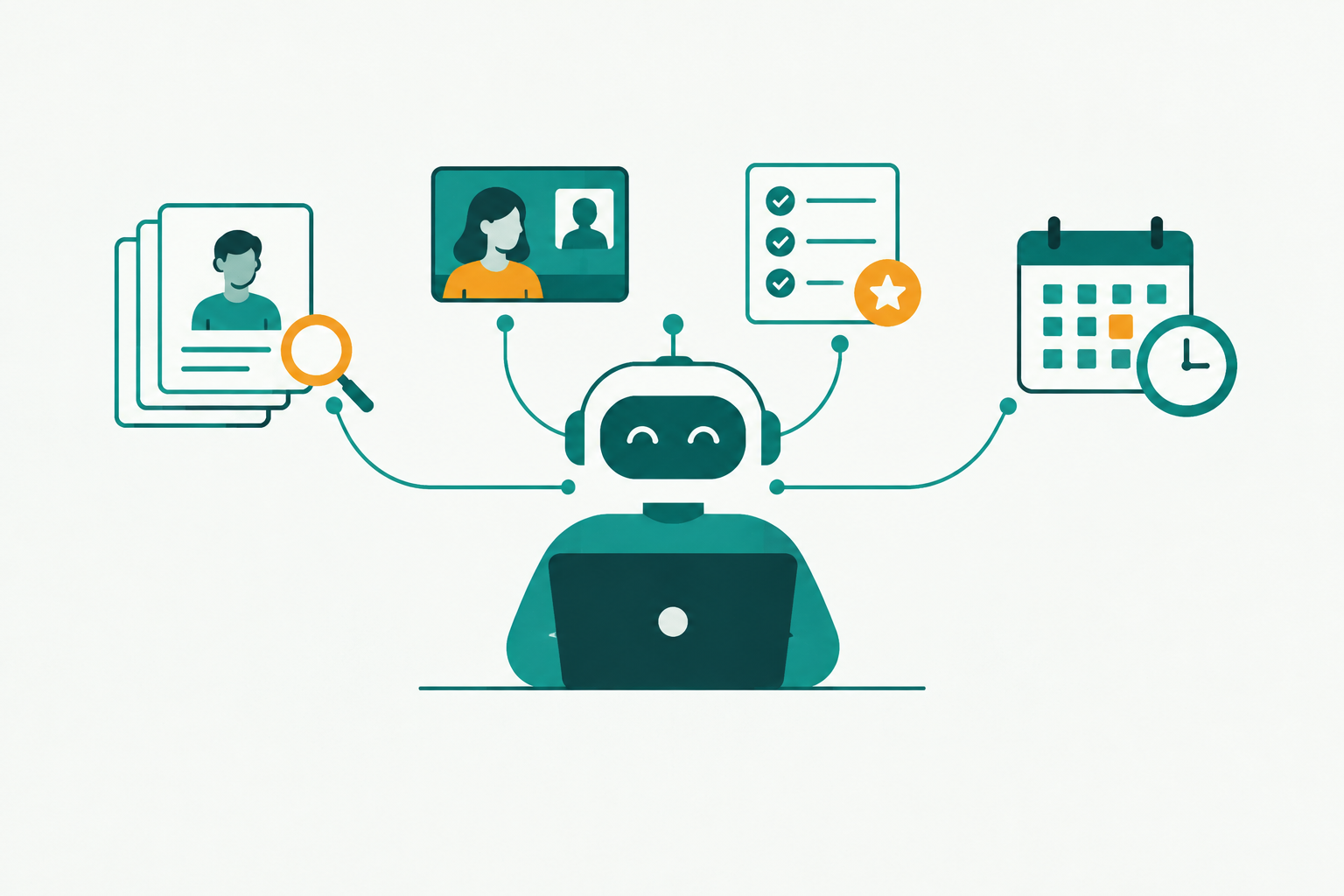
An AI hiring manager that runs the full recruiting loop for startups must source, interview, assess, and schedule against one shared definition of a strong hire. That makes it a replacement for a fragmented recruiting stack. Hiring judgment must guide the whole process and improve with feedback, while humans keep control of the standards and final decisions.
Why the recruiting stack is structurally broken, not just inefficient
The person who knows what exceptional looks like is not the person running the sourcing tool. Between them sits a job description, a set of search filters, and an interpretation of what the company needs. The sourcer optimizes for volume, the screener for recognizable credentials, and the scheduler for calendar fit. Each can perform its task competently. Yet none necessarily holds the hiring manager’s judgment about who will succeed in this particular role.
That separation is the stack’s structural weakness. Discrete tools for sourcing, screening, assessment, scheduling, and coordination receive translated versions of the same intent. Integrations can move records between them, but moving a record does not settle what good looks like. Korn Ferry’s 2026 Talent Acquisition Trends report found that most talent leaders by far plan to use AI in 2026. That growing adoption makes the distinction more urgent, because technically capable tools can execute the wrong definition of fit with greater speed and consistency.
What actually breaks at each handoff point in a standard hiring loop
A hiring manager’s sense of who could do exceptional work becomes a job description built from familiar titles, credentials, and experience requirements. Those details are easier to search than company-specific judgment. But are they evidence of ability, or merely convenient substitutes for it? When sourcing and screening optimize against those substitutes, the job description becomes a filter that can confidently pass the wrong people and reject the right ones.
Sourcing then amplifies the original loss of meaning. Keyword and credential matching favor candidates whose experience fits recognizable categories. Those filters make it harder to find career changers, builders without brand-name employers, and specialists who have left noisy platforms. The next stage receives a candidate pool already shaped by what the sourcing tool could recognize, rather than the full range of people who might do the job well.
Screening judges candidates again but may still lack the context lost along the way. Agreement between AI screening and human review is imperfect, so consistency cannot by itself establish that a screening decision is sound. Meanwhile, applicants use AI to polish resumes, cover letters, and interview responses, making presentation a noisier signal of capability. Speed does not resolve that uncertainty. Delays in scheduling can then cost the team senior candidates who are pursuing other roles, while a separate calendar system knows too little about the role and candidate to understand the stakes.
The false-positive problem that the stack obscures from view
The polished-but-wrong candidate is the visible side of this failure. A brand-name employer, a neatly formatted resume, and AI-polished language can pass credential filters without showing that someone can do the work the hiring manager needs. That candidate reaches an interview and can eventually expose the mismatch. The false positive becomes available for inspection. By contrast, the builder whose meaningful work happened outside recognizable institutions may never reach anyone able to judge it.
That second error is a false negative, and it is harder to learn from. Nobody complains about an interview they never knew they missed. A hiring manager sees only the applicants who survived the filters, so the surviving pool can appear to justify the original search criteria while capable people remain excluded from view. What would tell the team its definition was wrong? Without feedback about those exclusions, the process can keep producing plausible candidates while concealing the stronger alternatives it never surfaced.
This calibration failure occurs when tools optimize for the wrong definition of exceptional, even when their decisions do not establish discrimination. The stack therefore obscures not only lost candidates, but also the evidence that would challenge how it selects them.
Why calibration — not more tools — is the missing piece
Calibration gives the definition of exceptional somewhere to live and a way to change. Instead of freezing intuition into a job description, it turns that intuition into a learnable standard tested through sourcing, interviews, and assessment. Taste is learnable only when its consequences remain visible. Interview outcomes must feed back into sourcing criteria, and changes to the standard must be visible, reasoned, and human-approved.
The talent market must also test that standard. The people a team wants to hire may cost more than it can pay, or few of them may live in the area where it wants to hire. Those findings change who the team can expect to find before it starts reaching out. Separating market intelligence from hiring judgment leaves a team optimizing for a candidate it cannot reach on the terms it can offer.
This is why calibration requires more than connected tools. In the fragmented model, sourcing does not receive interview feedback, assessment does not reshape outreach criteria, and scheduling knows nothing about what the hiring manager learned in recent conversations. A unified system instead makes the shared standard and its supporting evidence part of the same process, so learning does not depend on a person repeatedly translating it between systems.
What AI can handle sourcing, interviewing, assessment, and scheduling as one loop?
A full-cycle AI hiring manager uses the calibrated standard to guide outbound sourcing, so the job description from intake can change as the team learns. That lets the search use evidence of fit beyond familiar keywords and credentials to find people who might be overlooked, including those whom standard filters miss. Interviews then generate structured, comparable evidence attached to each candidate. Scores alone are not the point here. Assessment must trace back to the same standard that shaped the search, so the interviewer is not testing a different idea of excellence from the sourcer.
Mercor offers a concrete case of AI interviews becoming central to a recruiting operation. The company reframed recruiting around AI interviews to place specialist experts and raised a substantial funding round. That is evidence of an architecture operating in practice, rather than merely a theoretical proposal. It is not proof of every full-cycle capability. Interviews can become a central source of hiring evidence rather than an isolated stage summarized for the next tool.
Scheduling completes that operational loop when candidates who clear assessment move forward without leaving the system or requiring a fresh round of coordination. Alpine Home Air shows how much a small team can do with AI-led screening. The case supports a claim about operating capacity. The broader full-cycle distinction is feedback, because interview outcomes can inform the next search, while each hire and rejection adds evidence for refining the shared standard.
The founder and lean-team case, where the stack's cost is most acute
For a founder without an HR team, every handoff creates work that has nowhere else to go. The founder becomes the person who explains the role, interprets screening results, repairs misunderstandings, and restores momentum between stages. Pin’s 2026 analysis found users save 12 hours per recruiter weekly on sourcing and outreach. For a founder doing them personally, however, the competing demand is product and company-building time, so recruiting administration has a direct cost outside recruiting.
An automated screening process can reply in hours while a manual process takes days, and senior candidates who are pursuing several roles may choose not to wait. Speed is only part of the constraint. For LLM and deep-tech roles, a small talent pool, candidates who are hard to find through standard filters, and aggressive competition from large technology companies compound the disadvantage.
A unified system’s market intelligence can help a team see early that its hiring plan will not work. Well-funded AI-native startups have pushed pay for specialists above what many early-stage founders can offer in cash. No automation closes that compensation gap by itself. Learning about it before the search begins is different from discovering it after failed offers, because the constraint becomes part of the hiring judgment rather than an explanation supplied after time has been spent.
Where human judgment must stay in the loop, and what happens when it does not
Running the workflow is not the same as owning the hiring decision. AI should assemble evidence and remove process administration, while humans set standards, build relationships, apply context the system cannot hold, and accept responsibility for the outcome. The final decision must remain with a human. Pew Research Center found that a strong majority of Americans oppose AI making a final hiring decision, and a large share of recruiters also insist on retaining final authority over AI recommendations.
Humans must also have the final say on decisions made before the final offer. A candidate rejected automatically has already received a consequential decision, even if a human later approves the eventual hire. Employers remain liable for discriminatory outcomes from third-party AI hiring tools. A vendor contract does not remove that responsibility. The design implication is human-review checkpoints before any rejection, supported by audit trails and documented adverse-impact monitoring, rather than a nominal human presence at the end of an otherwise autonomous process.
Legal obligations also need precise treatment. The Illinois Artificial Intelligence Video Interview Act is a named part of this landscape, but it has no bias-audit mandate, independent-auditor requirement, or public posting duty. Those distinctions prevent governance recommendations from being confused with the requirements of a particular statute. Good system design has broader responsibilities than that distinction alone. Every change to the hiring standard should remain visible, reasoned, and human-approved, rather than arriving as an unexplained update to a shared model.
Privacy belongs within the same design boundary. Candidate and company data used to run hiring should remain excluded from training material for shared AI models, and an employer’s definition of exceptional is proprietary information. Centralization increases the responsibility attached to that data. It also gives a unified system greater capability to connect decisions with their evidence and approvals than a stack in which accountability is dispersed across vendors.
Why this is a replacement and not a better stack
Adding AI features to separate tools leaves the stack’s central assumption intact, that each stage can be optimized independently and then connected through integration. The argument for a unified hiring manager rejects that assumption. Hiring quality depends on a company-specific standard that changes as evidence accumulates. An API can transfer its written representation. It cannot, by itself, make separate systems interpret that standard consistently or take responsibility for improving it together.
Agentic AI makes a different division of work possible. Korn Ferry’s report found that a majority of talent leaders plan to add autonomous agents to their teams. An agent runs the workflow and brings evidence to a human who makes the decision, while a copilot helps that person do each task faster. Its potential advantage is cumulative learning across searches. That advantage depends on an actual feedback loop and governed changes to the standard.
A replacement therefore has to join judgment, market intelligence, execution, and accountability in one process. If those stay separate, the founder still has to translate between them, however smart each tool becomes. The category changes when that translation is no longer the organizing principle. Where does the company’s definition of exceptional live today, and does the system running its hiring actually hold it?