Why Startups Are Replacing Their Entire Recruiting Stack With One AI Hiring Manager
Context stays intact when sourcing, screening, and ranking flow through one system instead of five.

An AI hiring manager can run a startup’s recruiting loop across sourcing, first-round interviews, technical assessments, ranking, and scheduling, while people retain final hiring decisions and control over the hiring standard. The reason to replace a fragmented stack is that hiring quality depends on keeping judgment, market intelligence, and execution together and preserving context at every handoff.
Why the recruiting stack was built the way it was, and what that design assumed
Sourcing tools were built to find people, applicant tracking systems to track them, and schedulers to handle logistics. Human recruiters used their judgment to connect those steps. Splitting the work this way made sense because each tool could do its own job without having to understand the whole search. What a sourcer found, a recruiter was expected to understand, and what the recruiter understood, a hiring manager was expected to trust.
When teams were hiring few enough people, they could talk through those gaps. A recruiter sitting next to a hiring manager could explain an unusual candidate, make a vague requirement clear, or pass along a change in what mattered most. The stack’s hidden operating assumption was that people would supply the context missing from its tools. Higher volume and faster hiring have made clean handoffs harder to sustain through conversation alone.
Where signal actually dies in a fragmented stack
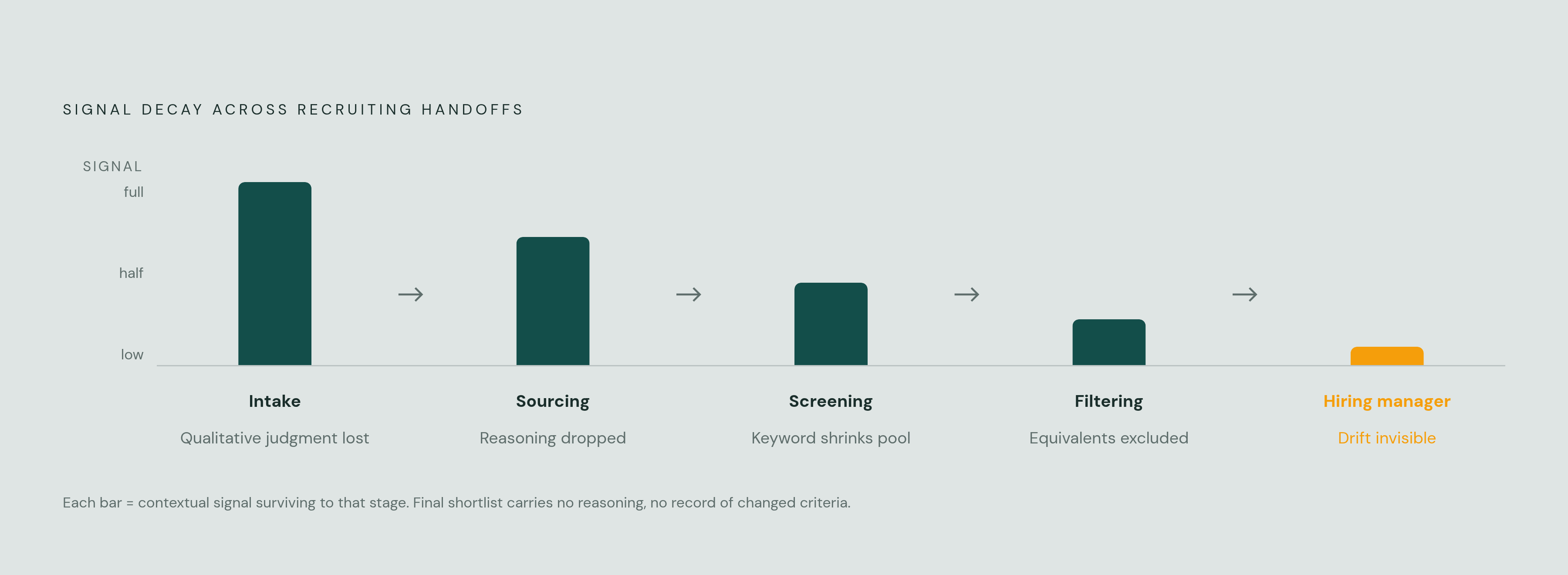
The first loss happens between intake and sourcing. A hiring manager may have a precise sense of what makes someone exceptional, but that sense rarely survives translation into a job description or a boolean search string. The search then runs against a proxy. Credentials and titles stand in for the qualities the manager actually values, even when those qualities would be clearer in what a candidate built. The sourcing tool can execute that search correctly while finding the wrong people.
More context is lost when the candidates found through sourcing move into screening. A person may have been flagged because an unusual career path led to work that closely fits the role. Yet the candidate reaches the ATS without the reasons that made that path worth a look. The screener sees a resume. Without that context, it is easier to spot familiar credentials than less obvious signs that someone can do the work.
Keyword filtering makes this loss especially concrete. A search for “data analyst” can exclude business intelligence specialists, research associates, and operations analysts who have done identical work under different titles. The pool shrinks before anyone evaluates the work. Those exclusions are false negatives caused by a failure of the search, but they may look like a shortage of suitable candidates.
Finally, the hiring manager receives a shortlist without the reasoning behind it. If the standard changed along the way, there may be no record against which to compare the choices. Calibration drift stays invisible until the manager rejects candidates whom the rest of the process treated as strong. Where did the original standard go? Adding AI to sourcing or screening does not resolve that question if the transitions still discard the reasons for each decision.
Why calibration is the hardest thing to hand off, and the first thing that gets lost
Calibration is a shared, precise understanding of what exceptional looks like for a particular role at a particular company. It is also the input the fragmented stack was least equipped to preserve. A job description usually substitutes credentials and years of experience for that understanding. Those requirements describe what success has looked like elsewhere. They may leave out what this person needs to do here.
Without a durable calibration artifact, every participant supplies a private interpretation. A sourcer may favor titles, a screener may favor recognizable employers, and a hiring manager may be looking for evidence that someone can solve the company’s immediate problems. Each can believe they followed the brief. The resulting false positives and missed builders come from different standards operating inside what appears to be one process. Doing the work faster just means more candidates are judged by those different standards.
The standard also changes as the search progresses. A hiring manager’s definition of exceptional may shift after the first three interviews, but a fragmented stack has no dependable way to record and redistribute that shift. The sourcer keeps working to the old version. Free-text notes and verbal feedback leave the next person to reconstruct what changed, while skills evidence, scenario responses, and rubric-mapped scores give the next step something structured to use.
The alternative is an intake grounded in actual success criteria. It asks what problems the person must solve in the first 60 days, what six-month success looks like, and which three skills are non-negotiable. A scorecard can preserve those answers beyond the intake conversation. But the connection to execution is essential. If the system capturing that standard does not also run the search, the team has created a better document without removing the handoff that weakens it.
What happens when hiring plans never get pushed back on by market reality
Even a precise internal standard can describe a candidate the available market will not supply. Sourcing tools may show who exists and what they cost, but that information often lives apart from the intake document. The hiring manager sets the requirement without seeing the constraint. The sourcer discovers the gap later, with no formal mechanism for bringing it back into calibration. What looks like a slow search may really be an untested hiring plan.
Consider a founder whose compensation range and credential requirement would have found five candidates two years ago. The pool has since changed, but the search begins on the old assumptions. The sourcer must either compromise the standard silently or report the problem weeks into the process. Neither response preserves the original agreement about quality. In talent-constrained fields such as AI and ML, the gap between expectations and supply makes that delayed correction especially costly to the search.
Market intelligence therefore needs to be part of calibration, before outreach begins. Its purpose is to show what candidates meeting the stated criteria actually look like and what they cost, while the hiring manager can still make explicit trade-offs. Predictive talent analytics can also help the team plan with past hiring data, attrition signals, and real-time workforce insights, so it can do more than react. But those inputs can shape the hiring standard only when they reach the same system in which that standard is set.
Can one AI hiring manager replace the full recruiting stack, and what stays human
A single AI hiring manager replaces the stack’s repeated translations. In the unified model, intake calibration, outbound sourcing, first-round AI interviews, technical assessments, candidate ranking, scheduling, follow-up, and evidence packaging operate against the same living standard. A set of tools may do all those jobs and still need people to pass context from one tool to the next.
The clearest test is what happens when the standard changes. In a fragmented stack, someone must update the sourcer, the screener, and the ATS filter separately. In a unified system, an approved change updates search, scoring, and outreach together. That shared reference is the advantage. It reduces the chance that one part of the process evaluates candidates against a requirement another part has already abandoned.
People must own the final hiring decision, negotiation, late-stage candidate relationships, and every change to what exceptional means. AI can support calibration without having authority to redefine it. An update to the standard should be visible, reasoned, and human-approved. For a startup without a dedicated recruiter, the model shifts the founder’s work from administering each step to supplying judgment where it cannot be delegated.
That distinction also separates full-loop automation from recruiter-led services supported by AI. Contrario describes its model as “a network of expert recruiters supercharged by vertical AI agents purpose-built for hiring.
Bias remains a concern when the work is automated. Screening more candidates can amplify a flawed standard just as easily as it can apply a sound one consistently. A unified system is more auditable when it records each scoring decision and surfaces the reasoning behind it. That visibility makes the decision process more open to scrutiny than judgments scattered across private notes and disconnected filters.
The compliance reality that makes transparency in a unified system a practical requirement, not a virtue
AI systems that screen, score, or rank candidates face a growing set of rules. Where the reasons for hiring decisions are kept therefore matters both for compliance and for how the system is designed. A fragmented stack disperses decisions across tools, recruiter memory, and notes. Reconstructing the process means joining those pieces afterward. The same lost context that weakens candidate evaluation also makes it harder to explain how that evaluation happened.
Historical hiring data creates a further risk. If earlier managers penalized career interruptions or favored narrow educational backgrounds, a model trained on their decisions can reproduce those patterns at scale. Consistency alone is not a safeguard against discrimination. A documented standard and visible scoring reasons make those patterns available for examination, rather than treating past choices as an unquestioned definition of quality.
A unified system has an architectural advantage when the same engine scores candidates against the same documented standard with a common audit trail. A fragmented process instead leaves separate judgments in the sourcer’s filter, the screener’s assessment, and the ATS keyword match. Each needs scrutiny on its own terms. Unification can make the evidence needed for oversight more coherent. The legal and architectural arguments converge on the need to explain decisions.
Data handling belongs in that same discussion. Candidate and client data used to run hiring should not be used to train shared AI models. Otherwise, data entering a multi-tenant model can propagate one company’s historical biases into another company’s searches. The boundary is between running hiring and training shared models. A system’s ability to preserve a company’s hiring standard should not depend on allowing that company’s past decisions to shape unrelated searches.
How founders and lean teams should think about making the transition
The practical decision starts with where calibration lives today. Founders and lean teams should ask whether the next step in their process can use the actual hiring standard, as well as whether the tools can pass candidate records between them. A document that a sourcer may or may not have read is a weak connection. The transition case is strongest when founders have no dedicated recruiter, sourcing and screening consume a disproportionate share of leadership time, or interviewers visibly apply different implicit standards.
Executive search relies heavily on relationships and soft-skill judgment, while roles that are very new may have no past calibration data to draw on. Both weaken the case for a unified AI loop. So does a hiring manager who cannot commit to structured intake, because the system then has no reliable standard to execute. Consolidation removes process work, but it does not remove the work of deciding what the company needs.
For teams that fit the model, evaluation should follow the handoffs that currently fail. Does the system keep the standard in a form that lasts and can be shared, and bring in market intelligence before sourcing begins? Does it make changes visible and human-approved, and provide candidate names with evidence of fit? These questions test the proposed operating model. A system that cannot answer them may leave the team with fewer tools while still losing just as much judgment.
The transition also requires a deliberate choice about saved time. Time recovered from scheduling and screening should go into calibration, final-round judgment, and candidate relationships. That is the human commitment behind the switch. The useful promise of an AI hiring manager is not hiring without judgment, but a recruiting loop in which the people responsible for judgment have time to exercise it, and their decisions reach every step that depends on them.