What AI-Conducted Interviews Actually Evaluate Versus Human Interviews
AI interviews measure consistency and adaptability where humans measure gut feeling and fatigue.
Human interview accuracy before AI
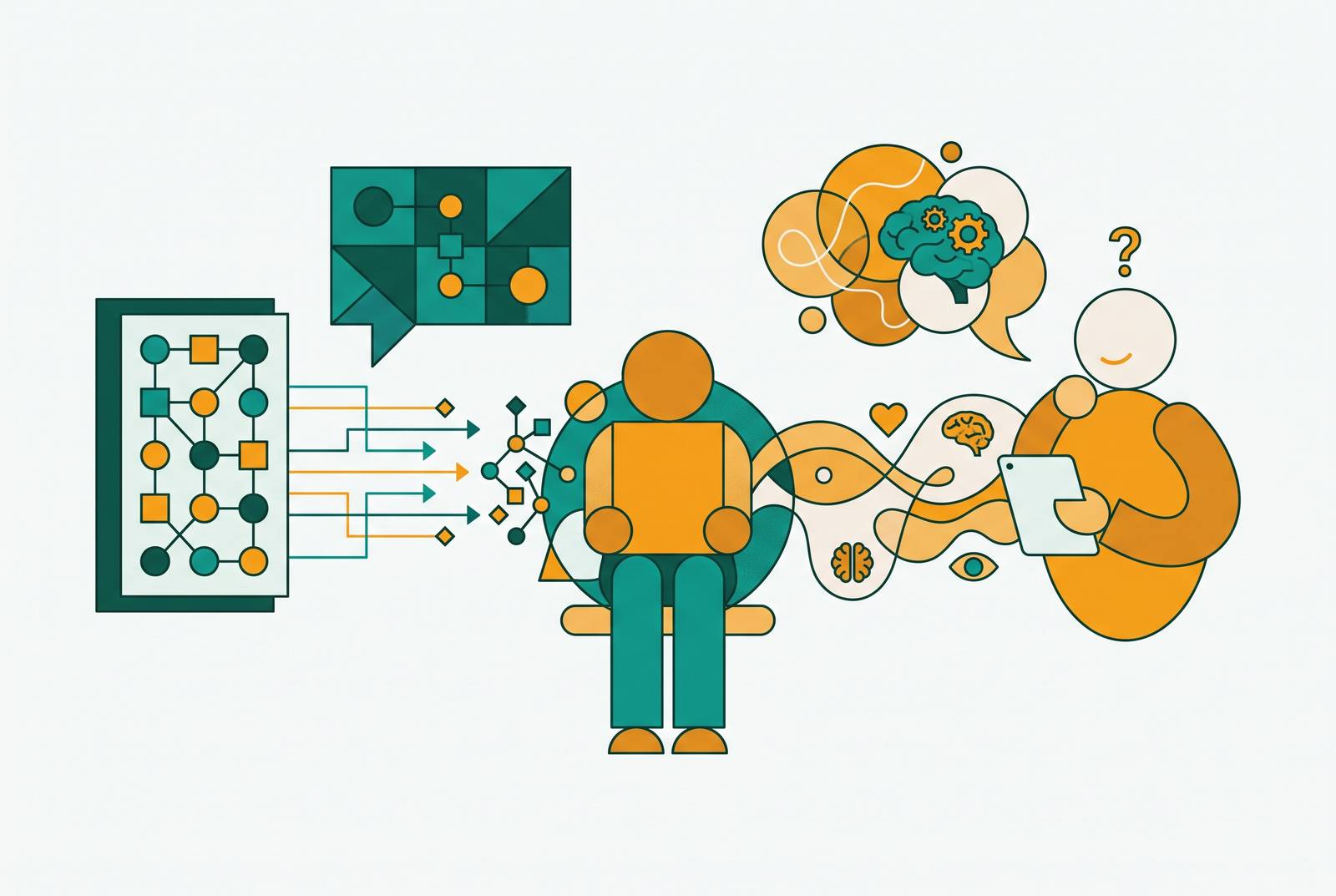
Human interviews have run hiring for more than a century, and almost nobody stops to ask how well they actually work. Looking closely at the numbers makes the answer get uncomfortable fast.
Huffcutt's meta-analysis put structured interviews at a validity coefficient of 0.42, a figure cited in Fabric's analysis of 19,368 AI interviews. That means the interview accounts for roughly 18% of the variance in how someone actually performs on the job. Unstructured interviews, the kind most hiring managers still run, score worse. So the format beats a coin flip, sure. But 18% is nowhere near what most hiring committees think they're getting when they sit across from a candidate for 45 minutes and walk away with a strong gut feeling.
Bias gets talked about constantly. Consistency gets talked about far less, and it might be the bigger problem. A Zippia survey, cited in the same Fabric analysis, found 68% of hiring managers admit that factors unrelated to job performance shape their decisions. The rubric itself doesn't hold steady either. Interviewers skip questions they meant to ask, rephrase things on the fly, and accept a vague answer from candidate six because they're tired, after pushing candidate one for specifics an hour earlier.
That's a structural problem for individual interviewers: the format asks something unreasonable of them. It's a structural problem: the format asks something unreasonable of them. Hold one consistent rubric across eight conversations spread over three days. Ignore how much you like the person. Suppress the impression that formed in the first ninety seconds. Judgment drifts by time of day, by fatigue, by whatever happened in the meeting before this one. No amount of good intent fixes that. The format itself is the weak link, and any system that treats the unstructured interview as the gold standard is building on sand.
What AI interviews are built to measure
Standardization is the whole point. Every candidate gets the same question set, the same rubric, the same scoring criteria, whether they're the first interview of the day or the fortieth. No fatigue effect. No rapport bonus. No leniency depending on when the slot landed on the calendar.
Standardization alone doesn't explain the more interesting part, though. Adaptive follow-up does. Static assessments and pre-recorded video interviews ask a fixed set of questions and stop there. AI interviewers adjust based on what a candidate actually says. A surface-level answer gets probed further. Mention an unusual approach to a problem, and the AI follows that thread. Two candidates can land on completely different follow-up paths while still getting scored against the same rubric, and that combination, adaptive questioning paired with a fixed scoring framework, is something a static tool simply cannot produce.
So what does that combination let AI interviews actually assess? Technical competence, through scenario-based questions and coding exercises. Soft skills too: communication clarity, how someone reasons out loud, how they handle a follow-up they didn't expect. That's behavioral assessment running at a scale no human panel could sustain across a full hiring season.
Vibecoding assessment matters because it's new: it's the practice of evaluating how a candidate collaborates with an AI coding assistant to actually ship software. It's the practice of evaluating how a candidate collaborates with an AI coding assistant to actually ship software: can they direct a model in plain language, review what comes back, refine the prompt, and land on working code? Some engineering teams have begun treating this as its own hiring signal, separate from the traditional algorithmic screen.
Fabric's data across those 19,368 interviews shows scores clustering between 4 and 8 on a 10-point scale. Low scores are rare, and scores above 8 are rare too, leaving most results clustered in the middle of the range. That spread matters. The system is telling candidates apart, not rubber-stamping everyone in the middle.
What the field experiment evidence shows about outcomes
Theory is one thing. What happens when this runs at scale, with real candidates and real offers on the line, is another.
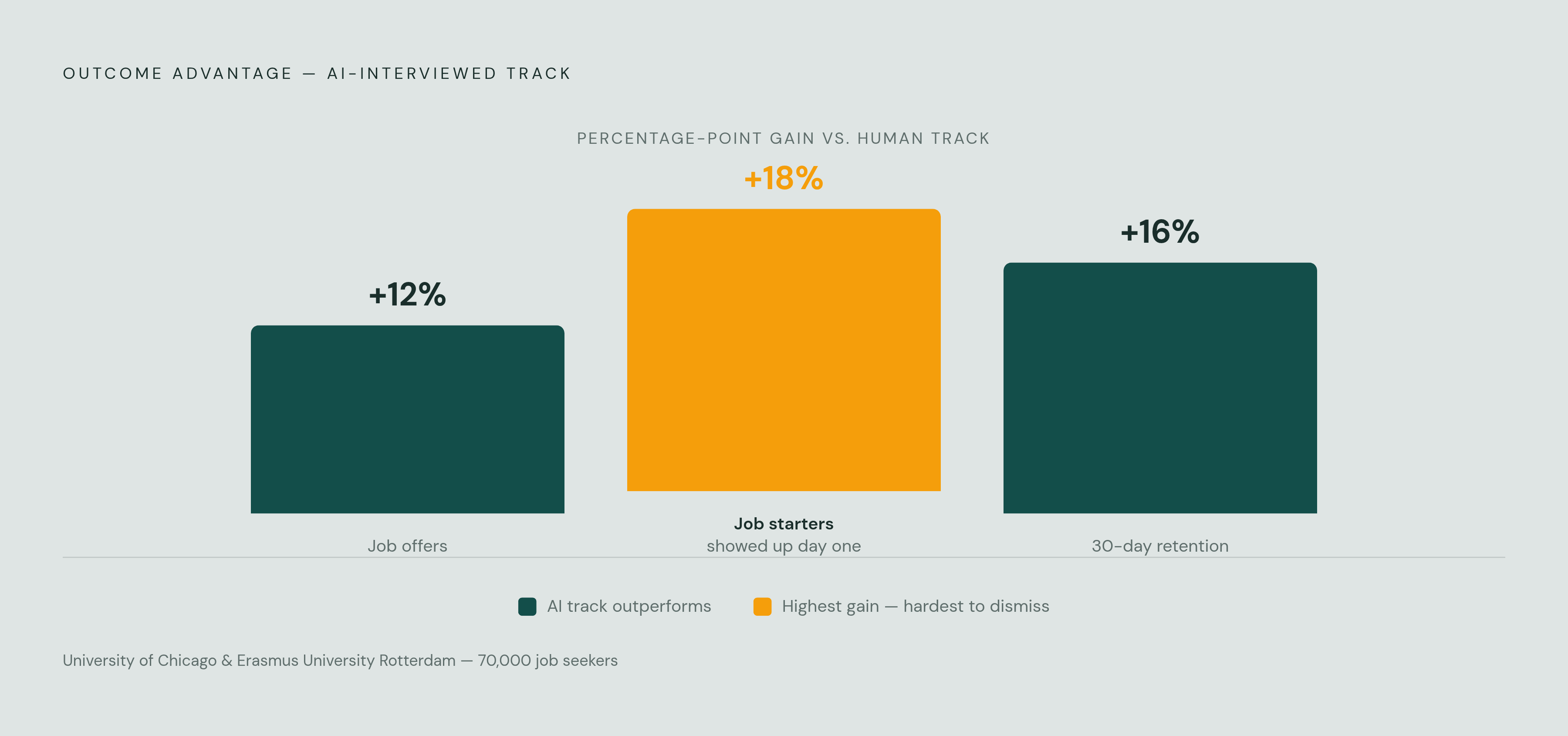
A study from the University of Chicago and Erasmus University Rotterdam, run through a staffing firm, interviewed 70,000 job seekers using both human recruiters and AI, both following a similar format covering career goals, education, and experience. The AI interviews ended up more structured and covered more ground per conversation. Humans made every final hiring call regardless of which method ran the interview, so this wasn't AI replacing judgment. It was AI changing what fed into that judgment, and the results moved in one clear direction.
Candidates interviewed by AI received 12% more job offers, had 18% more job starters (people who actually showed up on day one), and showed 16% higher 30-day retention than the human interview track. That's a pipeline producing measurably better hires, and a faster one. Anyone still arguing that AI interviews are just a cost-cutting downgrade from the "real" thing has to explain those retention numbers away first.
A separate pair of field experiments out of Stanford and micro1 (arXiv:2507.08029), covering 4,323 applications and 1,108 completers, dug into why. The first experiment isolated which information channel made the difference. Recruiters given AI Interview Reports shortlisted candidates who went on to pass a final blind human interview at a 46% rate, compared to 29% for resume-only screening. A 17.5 percentage point gap, from the same recruiters and the same candidates. Only the information going in changed.
Treatment recruiters picked candidates with weaker resumes but stronger AI-assessed skills. The AI report revealed a skill gap the resume never disclosed, visible in gains that weren't spread evenly. For junior candidates, where resumes carry the least signal to begin with, AI Interview Report ratings raised out-of-sample predictive accuracy (AUC) by 0.18. For non-junior candidates, the lift was 0.08. The AI adds the most value exactly where the resume, the traditional screening tool, is weakest to begin with. That's not a coincidence. Resumes are worst at describing exactly the population, early-career candidates without a long track record, that AI interviews turn out to help the most.
Where AI interviews introduce their own measurement failures
None of this makes AI interviews clean. It just moves the failure points somewhere else, and pretending otherwise is how a hiring team ends up trusting a tool it never actually audited.
Bias doesn't disappear. It changes shape. AI removes the variation caused by interviewer fatigue or inconsistent questioning, but it absorbs whatever bias lives in its training data and rubric design. A study from Princeton University and the University of Chicago found that AI tools formed group-based biases during hiring tasks even when trained on neutral data, and were actually more likely to form new biases than humans doing the same task. The fix for human inconsistency introduces a different, and sometimes larger, distortion. That means the rubric can't be a set-it-and-forget-it artifact. It needs standing, ongoing audit, and any team skipping that step is trading one bias for another and calling it progress.
Fraud is the more urgent issue right now, and it's getting worse, not better. Reports suggest a rising share of candidates display signs of cheating during AI interviews. Tools like Cluely and Interview Coder run invisible screen overlays that standard screen-sharing setups miss, though OS-level process monitoring and dedicated proctoring tools can catch them. Detection alone isn't the full answer, though. Chase detection without a verification layer behind it, and false positives start piling up just as fast as the fraud does. The real cause of the cheating headlines is that little evidence exists showing this person can do the job, independent of whether they gamed a screen-share.
Skill inflation is a related but separate issue, one AI actually seems to catch better than resumes do. A random audit of 720 candidates from micro1 vacancies found 21% claimed proficiency in at least one of three required technologies (React, JavaScript, CSS) that the AI assessment rated as "not familiar." Five percent misreported all three. The AI interview catches a gap that a resume screen, or a human skimming that resume, would have walked right past.
There are also places the format underperforms no matter how clean the rubric is: senior leadership evaluation, highly creative roles, and low-volume specialist searches, where the pool is small enough that the calibration overhead outweighs any time saved. Deep cultural fit, leadership presence, how someone navigates real ambiguity in a live relationship: none of that responds well to a rubric, however carefully built.
What human interviews measure that AI structurally cannot
So what's left for the human interview to do? Quite a lot, actually, and most of it is what a rubric can't touch.
Ambiguity, for one. Not the kind with a correct answer sitting behind it somewhere, but the kind where judgment is the only tool available and a candidate has to improvise in real time. Watching how someone handles that tells you something a scored transcript never will. Collaboration and leadership presence work the same way: they show up in the room, in how someone responds to being interrupted or challenged, not in the content of an answer alone.
Motivation and values tend to leak out in conversation, rather than in response to a direct question about them. What does a candidate push back on? What do they ask about, unprompted? Where do they get curious, and where do they get cautious? None of that maps cleanly onto a scoring rubric, and that's exactly the point of asking a human to sit in the room.
Candidate preference complicates the picture in an interesting way. In the 70,000-applicant University of Chicago and Erasmus study, 78% of candidates given a choice actually picked the AI interviewer, citing scheduling flexibility, more consistent treatment, and less social anxiety. That's a real finding, but it describes candidate experience, not the depth of signal a human interview can capture. Those are two separate questions, and a lot of hiring teams collapse them into one and get the wrong lesson out of the study.
What's changing is what the human round gets asked to test. Analysis of a large body of interviews and job postings suggests 2025-era interviews have stopped testing what a candidate knows. They test how someone reasons, communicates, and adapts, in a world where an AI model already knows the answer to almost anything factual. In-person interviews rose from 24% of the process in 2022 to 38% in 2025, a period that coincided with growing concern about AI-assisted cheating. Google brought back onsite rounds. Meta has experimented with AI-assisted interviews. The format is shifting toward testing judgment and collaboration with AI tools, not memory or recall.
The human interview's real advantage is the relational, contextual signal that appears only in a live, unscripted exchange. Increasingly, the human interviewer's job is to verify that whatever the AI measured upstream is actually real, not to re-test what the AI already covered. It's to verify that whatever the AI measured upstream is actually real.
How calibration connects the two formats into a system that works
AI and human interviews are sequential parts of the same process, and the handoff between them is where hiring quality gets made or lost. They're sequential parts of the same process, and the handoff between them is where hiring quality gets made or lost.
Calibration is the mechanism that makes that handoff work. An AI interview's output is only as good as the rubric behind it, and that rubric has to reflect what excellence actually looks like for a specific team and a specific role. Models trained on historical hiring data risk encoding past patterns in ways that may disadvantage unconventional candidates. So calibration can't be treated as a one-time setup step, or the system risks drifting back toward the same bias it was built to remove.
In practice, the hybrid model splits responsibilities cleanly. AI handles first-round structured assessment at scale: consistent, rubric-driven, and it leaves behind an evidence record every candidate can be compared against. Senior human reviewers then use the AI-generated summaries to spot reasoning gaps or bias patterns before running follow-up rounds focused on creativity, collaboration, and leadership presence. Post-interview analytics feed back into calibrating interviewer behavior over time too, alongside candidate outcomes.
Fabric's data shows 60 to 90% alignment between AI and human evaluator scores in hybrid setups. High enough to confirm the AI is picking up something real, not noise. Not so high that it suggests AI and humans are measuring the exact same thing, because they aren't. A system where the two agreed nearly all the time would actually be a red flag: it would mean one of the two formats had gone redundant, and someone should be asking why they're still paying for both.
The recruiter's job shifts accordingly. Volume screening and first-round consistency move to AI. Human judgment concentrates where it actually adds value: reading AI-generated insights, working through complicated candidate motivations, making the final call with real evidence attached instead of a gut feeling from minute one. Any change to the hiring bar, whatever prompts it, should be visible, reasoned, and signed off by a human, not quietly absorbed into a rubric nobody re-checks.