Scorecard Calibration Across Multiple Interviewers for the Same Role
When interviewers apply the same scorecard differently, consistent hiring decisions fall apart.
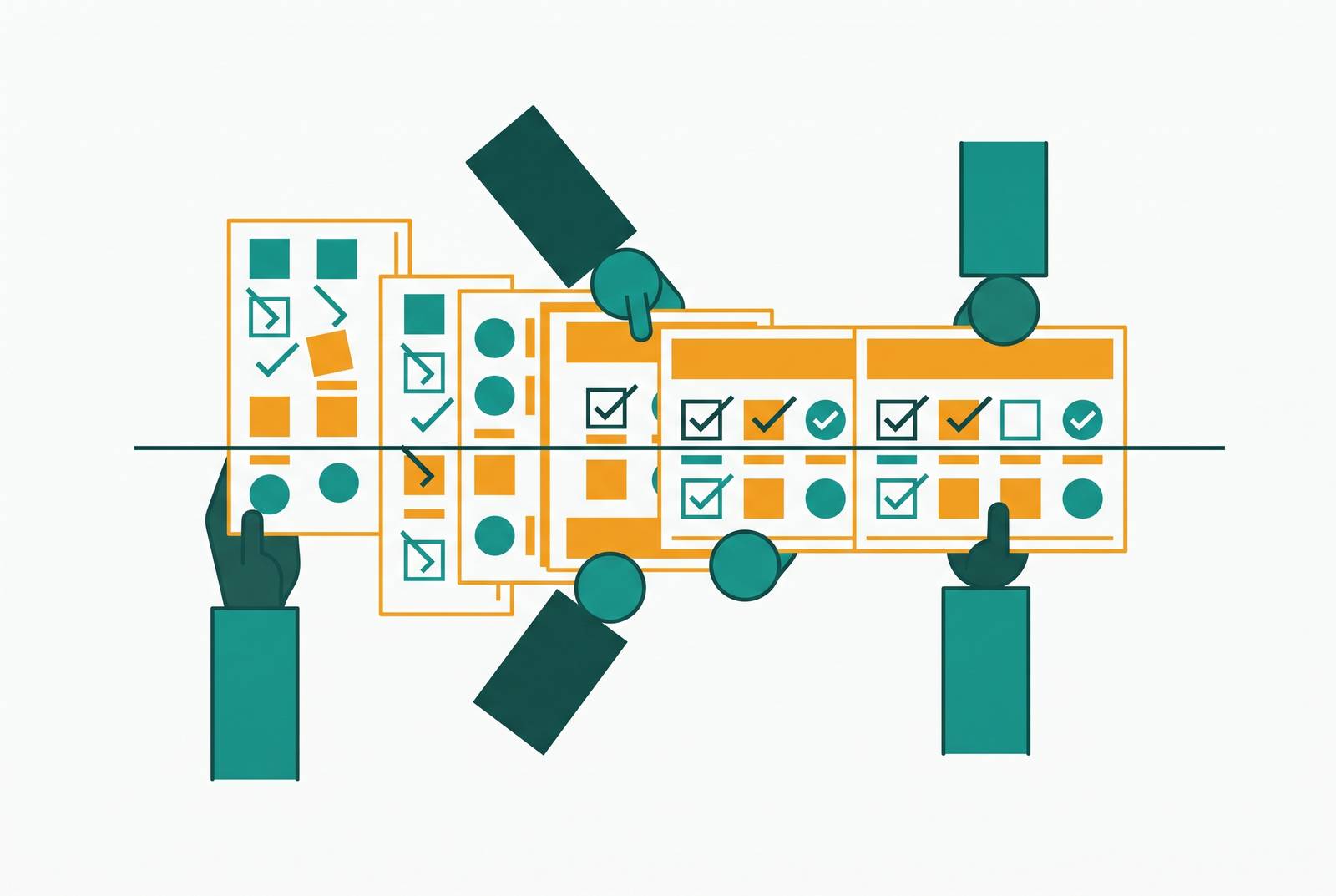
A team rolls out the same scorecard for every interviewer on a panel and assumes the hard part is done, but it isn't. Scorecard calibration breaks down because each interviewer walks in carrying a private definition of what a "3" or a "4" actually means. The form is uniform. The meaning underneath it is not, and inconsistent interpretation of that meaning is where consistent hiring decisions go to die.
Unstructured interviews fail for a related but separate reason: each interviewer chases a different quality entirely, asks different questions, and applies a different bar, which leaves the whole process exposed to halo effect and affinity bias. Scorecards exist to fix that. Structured interviews with behavioral anchors more than double predictive validity compared to unstructured conversations, according to research cited by Pin and Compono drawing on Schmidt and Hunter's meta-analysis. That gain only occurs when the panel is calibrated. A shared standard for what each rating means, absent from a form handed to four interviewers, is what keeps the structure from being cosmetic.
The cost of getting this wrong isn't abstract. One in three companies isn't confident in its own interview process, and one in two has lost quality hires because of it, according to Aptitude Research. Adding the SHRM 2025 average nonexecutive cost-per-hire on top of a 27-day interview-to-offer window reported by NACE in 2024 turns a broken evaluation loop into a six-week, mid-five-figure problem sitting on every open role. It's a line item on every open role, not an abstract process nitpick.
The three specific ways rating drift enters a panel
Rating drift doesn't arrive as one big failure. It enters through three distinct behaviors, and each one undermines the independence a scorecard is supposed to protect in its own way.
The first is treating the scorecard as paperwork filled out after the decision has already been made in someone's head. An interviewer forms a gut impression early, coasts through the rest of the conversation confirming it, then fills out the form to match. The scores stop measuring the candidate and start justifying a conclusion that was reached before the form was ever opened.
The second is a persistent gap between one panelist and everyone else. The gap between one interviewer's scores and the rest of the panel appears across a whole role family, round after round, where one interviewer's scores sit consistently above or below the rest of the panel's. That kind of drift is quiet because it never triggers an argument in any one meeting. It only becomes visible when someone tracks scoring patterns across rounds instead of just within them, and most teams never build that tracking habit.
The third is verbal discussion happening before scorecards get submitted. A hiring manager or the first person to speak shares an opinion, and everyone who scores after that comment is now anchoring to it rather than to the candidate's actual answers. Independent scorecard submission before any group discussion is the structural safeguard against this, according to Pin's debrief guide, and Greenhouse treats a high scorecard submission rate as a signal of a healthy, well-informed hiring process. A simple 24-hour rule, scorecards filed within a day of the interview, keeps memory decay and hallway chatter from creeping into the writeup before it's locked in.
One interviewer's "4" becomes another's "3" for identical candidate behavior: the form is the same, the meaning is not. A team that talks before it scores, fills out forms after the fact, and never checks individual scoring patterns across rounds is running all three problems at once, and they compound. Fixing one without touching the others barely moves the needle.
Why most teams write behavioral anchors wrong
Behavioral anchors are what give a rating scale a shared meaning across a panel, but only when they describe what an interviewer actually saw rather than a trait they're guessing at.
Compare the two versions. A placeholder anchor like "3 = Good communication" tells every interviewer something different, because "good" is doing all the work. A working anchor, per Compono, reads instead: "3 = Explained technical concepts clearly but needed follow-up questions to handle edge cases." That's a specific, checkable observation. Hivemind's 2026 example for Problem-Solving at a 5 works the same way: "Anticipates constraints, outlines scalable solutions, and articulates trade-offs clearly." An interviewer can hold that sentence up against what actually happened in the room and check it.
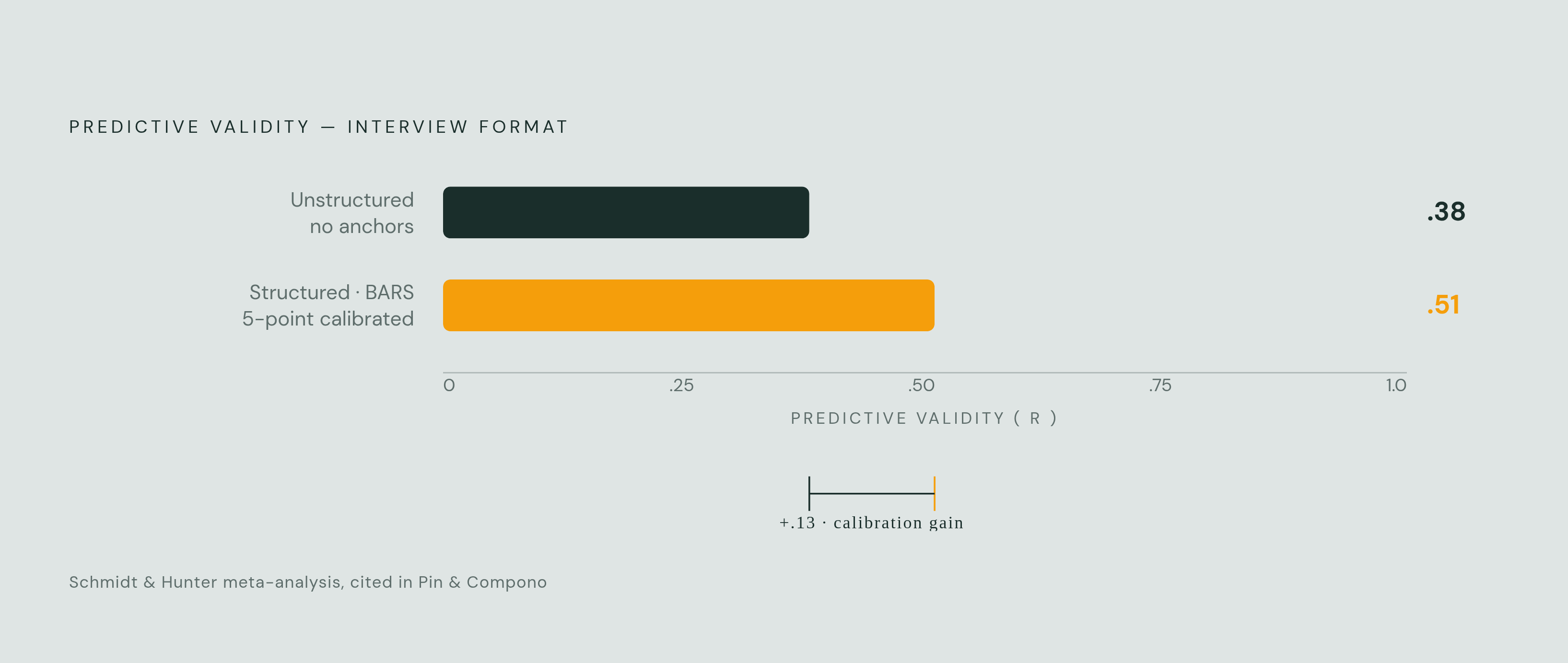
Per Pin and Compono, 5-point BARS-anchored scales outperform 3-point scales and generic excellent/good/fair labels in inter-rater reliability. Structured interviews built this way reach a predictive validity of.51, well above the.38 for unstructured interviews without anchors, per the research Pin cites from Schmidt and Hunter. When a panel lands within 1 point of each other per competency, the anchors are doing their job. When scores regularly split by 2 points or more, the anchors need tightening, or the team needs to sit down and recalibrate.
Trait language asks the interviewer to judge a person. Behavioral language asks them to report what happened. The second mistake is writing a crisp anchor for the middle rating and leaving 1, 2, 4, and 5 blank. That gap pushes every score toward the middle, a pattern known as central tendency bias. Central tendency bias and leniency bias, per Dover, are the two most common rating errors on any panel, and both trace back to anchors that were never finished, not to interviewers doing a bad job.
Resist piling on competencies to cover every possible angle. More categories don't sharpen calibration. They scatter attention across more gaps that need defining, and a panel spread thin across many competencies calibrates worse than one focused on four or five that actually matter.
The pre-interview calibration session
A 30-minute session before the first candidate walks in, where the panel works through the criteria together and scores a mock interview as a group, closes a gap that behavioral anchors alone can't fully seal. Anchors give the panel a shared vocabulary on paper. The calibration session tests whether that vocabulary actually means the same thing to every person reading it.
Differences become visible in a room, before a real candidate's outcome depends on them. Second, the panel scores a mock interview or a past recorded one independently, then compares notes. Wherever the scores diverge, that's exactly where one person's mental model has drifted from the group's.
Timing matters as much as content. Per Pin, the calibration session belongs before the first candidate is ever seen, not slotted in between rounds and not triggered only after a disagreement blows up in debrief. Waiting until a conflict appears means the panel is calibrating live, on a real candidate, with a hiring decision already hanging in the balance.
Per Pin's debrief guide, calibration is the upstream work of getting interviewers to score the same signals consistently before any debrief starts; the debrief itself is the structured meeting where the panel reviews independently-submitted scorecards and decides hire or no-hire. Do the upstream work well, and the debrief turns into a short decision meeting. Without it, the debrief becomes a negotiation the loudest person in the room usually wins.
Calibration quality also puts a natural ceiling on how big a panel should get. Google's internal hiring data, published by former SVP of People Operations Laszlo Bock in "Work Rules!," found that interviewers reached strong predictive reliability on their own. Adding people past that point raised accuracy by only a negligible margin each. More interviewers just means more scores to reconcile, not a better decision. How well interviewers are calibrated moves outcomes.
Grounding the calibration standard in what the role requires
None of this works if the competencies being calibrated aren't tied to what the job actually demands.
Start with a job analysis instead of a job posting. Per Dover and Hivemind, the right starting point is defining measurable outcomes for the role across the first few months and the first year: what this person has to deliver, what would break if they don't, and what actually separates high performers from average ones. Competencies describe how someone gets to success. Outcomes describe what success looks like. Both matter, and outcomes have to come first, because a competency list built without outcome targets is just a list of nice-sounding traits. Per Compono, the job description functions as the foundation for the scorecard, but only when it's treated as a living document that competencies get pulled from, not a static posting nobody revisits once it's live.
Familiar credentials make a poor substitute for this kind of grounding. A scorecard leaning on title and brand-name employers instead of observable behavior produces false precision: a "3" for "relevant experience" might mean three years of doing the actual job, or three years of holding an adjacent title at a recognizable company. What a candidate actually built and delivered predicts performance better than where they happened to build it.
Market conditions belong in this calibration too, and they age fast. A standard built in 2021 for compensation and competitive dynamics that no longer apply will reject viable candidates and set expectations the current market simply can't meet. The research brief notes that AI/ML engineering, security, and revenue operations roles in 2026 draw multiple competing offers, so calibrating what "exceptional" means has to reflect what the market can actually supply, not an idealized version of the perfect hire. Korn Ferry's Talent Acquisition Trends report, surveying a large global sample of talent leaders, found that most plan to use AI this year and a majority plan to add autonomous AI agents to their teams. The hiring landscape a scorecard operates inside has shifted, and a standard frozen in an earlier year won't reflect it.
The stakes scale sharply on small teams. Carta's State of Startup Compensation report found that the median seed-stage team is small, and average Series B headcount fell between 2023 and 2025. On a four-person team, one miscalibrated scorecard on one role, whether it screens out a strong non-obvious candidate or waves through someone whose credentials outshine their actual capability, can reshape where the whole company ends up. There's no cushion to absorb that kind of miss when four people are the entire company.
How the non-obvious candidate gets screened out by an uncalibrated panel
An uncalibrated panel doesn't just produce noisy scores. It systematically filters out strong candidates whose evidence of fit doesn't match what the panel already expects to see, even when the scorecard technically claims to evaluate behavior rather than pedigree.
Weak anchors push interviewers back toward pattern-matching. Does this person look like people the company has hired before? Did they go to a school the panel recognizes, hold a title the panel expects? Affinity bias and the halo effect, per Pin and Compono, are exactly the shortcuts scorecards are built to interrupt, but that only happens when the criteria and anchors force interviewers to weigh actual evidence instead of these proxies. An anchor that says "3 = Explained technical concepts clearly" describes what the interviewer actually observed. A blank one can.
AI-assisted screening can scale this same failure rather than fix it. In one documented AI screening case cited in the research brief, the false negative rate wasn't spread evenly across candidate subgroups, and the model had already been running for months before anyone thought to check its error rates by group. Sourcers used to spend a large share of their time manually filtering out poor matches by hand. AI-powered sourcing moves that filtering earlier in the pipeline, which speeds things up, but if the filter was trained on historical hiring patterns shaped by credential bias, it buries the non-obvious candidate before a human ever gets the chance to look.
This isn't a hypothetical risk sitting in a research paper somewhere. On January 20, 2026, two job applicants filed suit against Eightfold AI, a hiring platform used by companies including Microsoft and PayPal, alleging the platform violated the Fair Credit Reporting Act and California's Investigative Consumer Reporting Agencies Act by generating AI-driven applicant "likelihood of success" scores on a 0–5 scale without disclosure. The case is the clearest live legal test yet of what scorecard-style AI scoring means under consumer protection law. The scoring mechanism being challenged in court is structurally the same thing an uncalibrated human panel does informally in every debrief: rank a candidate against an implicit standard nobody wrote down and nobody agreed on. The scoring mechanism at issue is structurally identical to what uncalibrated human panels do implicitly, now made explicit and legally exposed.