Negotiation Tactics for Multi-Stakeholder B2B Deals
Winning complex deals requires mapping all stakeholders before pricing starts.
A rep spends months building a relationship with a strong champion inside the account. The champion is engaged, responsive, internally respected. Forecast confidence climbs to near certain. Then, days before the signature is supposed to land, a CISO surfaces. So does a finance director, a legal reviewer, and an IT lead, none of whom the rep has ever spoken to, each holding veto power over the deal. The deal doesn't close that quarter. It resets to month one.
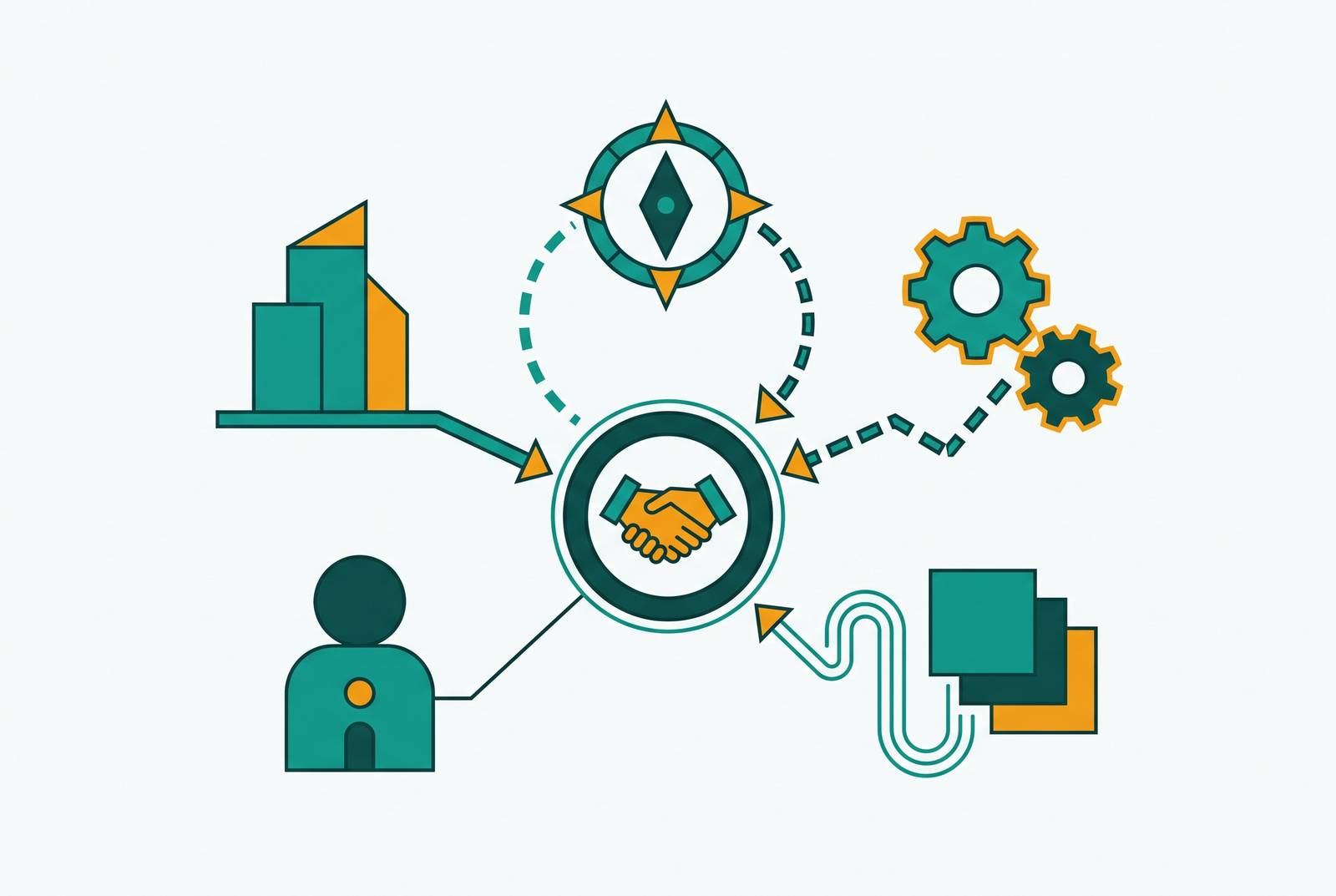
That pattern repeats across enterprise sales because the deal was never a single negotiation to begin with. Treating the champion's approval as the finish line mistakes one conversation for the whole deal. Budget, technical risk, legal liability, data security, procurement cost: each of those sits with a different person, running on a different clock, judged against a different definition of success. The product can be the obviously correct choice and the deal can still die, because nobody resolved the five or six parallel conversations that had to converge before a contract could move.
Mapping the buying committee before the first pricing conversation
Before any pricing conversation starts, the job is to know who actually signs, who influences the signer, who can block the deal outright, and who simply doesn't care either way. Equally important: having a real, reachable contact for each of those people, not just an awareness that they exist somewhere in the org chart.
Every committee tends to contain the same five roles, even when titles differ from company to company. The economic buyer holds the budget and thinks in terms of ROI, strategic fit, and what else that capital could be doing. The champion is the internal advocate, motivated by solving a real problem and by how the win reflects on their own career. The technical buyer, often in IT or security, evaluates integration complexity and whether the implementation will become a burden on their team. Legal and procurement function as contract gatekeepers, focused on liability, data privacy, pricing benchmarks, and contractual protection. They often arrive late with a playbook built specifically for extracting concessions.
Mapping those five roles onto real names is the actual work. A power map lists titles, reporting lines, and working contact details for everyone the champion hasn't yet introduced. The VP of Operations whose existence is known but whose email address isn't on file is the exact bottleneck that keeps a deal single-threaded. It helps to think of this as a grid: authority on one axis, interest level on the other. A stakeholder with high authority and high interest deserves direct, frequent engagement. That grid turns a vague sense of "there are a lot of people involved" into a prioritized list of who to reach and in what order. Finding those people before the pricing conversation starts, rather than after, is what separates a mapped committee from a surprise.
Why single-threaded deals lose (and how multi-threading changes the math)
A deal running through a single point of contact carries a specific signature in the CRM: one active contact, every piece of information flowing through that one person, no direct line to the economic buyer. That pattern is easy to spot in hindsight and just as easy to miss while it's happening, because a strong champion can make a single thread feel like enough.
It isn't, and the reason has as much to do with speed as with risk. Deals with four or more engaged contacts on the buyer side close at materially higher rates than single-threaded ones. When several advocates are pushing a decision forward from different angles at the same time, internal alignment doesn't have to wait for one champion to relay messages between meetings. That's a velocity advantage before it's ever a safety net: more threads mean more simultaneous momentum, not just more insurance against one relationship falling through.
The insurance matters too. A seller with only one contact has no way to verify any of that pressure independently. The fix starts with one question on every first call: "Who else is involved in evaluating solutions like this?" The question only works with systematic follow-through on every name it produces. Contact-data quality, meaning actual reachable people with real titles and real email addresses, is the bottleneck most sales teams quietly tolerate.
Tailoring the conversation to each stakeholder's actual definition of value
One value proposition rarely survives contact with an entire buying committee, because each stakeholder measures value in a different unit, and a message built to resonate with one person can actively work against another.
A CFO or economic buyer thinks in cost savings, revenue impact, payback period, and opportunity cost. The conversation lands when the ROI calculation is specific to that company's numbers, not a generic industry benchmark pulled from a case study. Legal and procurement want clean contracts, documented compliance, reasonable liability terms, and a clear data privacy posture, and the easiest way to win that conversation is to make their job simple.
Procurement in particular deserves a more precise read than most sellers give it. Procurement's job is to reduce spend and reduce risk, measured against targets procurement itself is held to. Treating that function as an obstacle to route around, rather than a role with its own legitimate mandate, is one of the most common unforced errors in late-stage negotiation. None of that is personal, and none of it requires a clever counter-move invented on the spot. What it requires is preparation: knowing in advance what's tradable and what isn't, decided before the time pressure sets in, not during the call when it's hardest to think clearly.
Enabling your champion to win the internal negotiation you cannot attend
The most consequential negotiation in a complex deal often happens without the seller present at all, in a room where the champion is making the case alone. How well that goes depends almost entirely on what the seller gave the champion to work with beforehand.
A fully equipped champion carries a business case document they can present as their own initiative, written in the company's own language. They carry talking points and objection responses built for the specific people they'll face internally, not generic FAQ answers. Credit for the insight matters here too: when the solution is framed as the champion's initiative and their contribution is acknowledged rather than absorbed into the vendor's pitch, their standing with their own leadership improves. Their career is part of why they're championing the deal in the first place, and that's worth respecting.
The mutual action plan deserves separate attention, because it does two jobs at once. Named owners, specific dates, and clear dependencies keep a deal moving after a call ends, since verbal agreements tend to fade within a day. But the same plan also functions as an alignment tool across the whole committee: when an owner misses a date or a dependency stalls, that's a visible early signal of where risk is building, long before it turns into a full stop. A deal with a written action plan and no plan at all are not the same deal, even if both champions sound equally confident on the phone. One test for how real a deal is: if the champion goes on parental leave and the deal dies with them, the deal never really existed. A deal that survives that test has multiple internal advocates, at least one line into finance or the economic buyer that doesn't run exclusively through the champion, and a named executive sponsor who can speak for the deal if the champion goes quiet.
Running parallel negotiation threads without letting any one derail the whole
The core skill in a multi-stakeholder deal is convergence management: keeping several negotiation threads moving at roughly compatible speeds so that one stakeholder's unresolved concern doesn't become a veto that resets the entire deal.
Multiple Equivalent Simultaneous Offers, or MESOs, are one of the more reliable tools for this. Instead of presenting one price and waiting for a yes or no, a seller presents two or three packages that are equal in value to the seller but structured differently for the buyer. Presenting all three at once does something a single offer can't: it reveals which variable the buyer actually cares about, price, cash flow timing, or commitment length, without forcing a binary decision. It also gives different stakeholders on the committee a version of the deal they can individually advocate for.
Anchoring discipline matters just as much. Opening with a position that leaves room to trade, without giving away real margin, sets the tone for every concession that follows. Every concession should be exchanged for something in the same sentence it's offered. A straight discount is the most expensive concession on the table and the easiest one to give away for nothing in return. Concession planning belongs in pre-work. Before any negotiation call, write down every concession that's acceptable, its real cost, and what's required in exchange for it. Under quarter-end time pressure, good trades don't get invented on the spot. The ones already written down are the only ones that get used.
Pacing across all of this is its own discipline, often called the soft close. None of these tactics work in isolation. A deal can look fully closed with the champion while sitting stalled with legal and not yet started with security, and the only way to manage that is to track each stakeholder's thread as its own task with its own status, rather than treating the deal as one undivided unit of progress.
The compliance and security negotiation as a structurally separate late-stage thread
Security and compliance review now functions as its own negotiation inside the larger deal, with its own stakeholders, its own timeline, and its own power to say no. Vendors who treat it as paperwork to knock out at contract stage are losing, consistently, to vendors who start that conversation back at proposal stage.
Inside that review sits a negotiation within the negotiation. A CISO or InfoSec lead evaluates data residency and overall security posture. Legal reviews the data processing addendum line by line. Procurement checks compliance documentation against its own approved-vendor criteria. Those are three separate conversations, run by three different people, judged against three different sets of criteria, and none of them moves on the champion's timeline.
The legal side has gotten more specific. Under GDPR Article 28, any processing of personal data on a controller's behalf has to be governed by a written contract that covers processing scope, sub-processor authorization, data subject rights, breach notification, and deletion at the end of the contract. A master service agreement that skips over those points doesn't satisfy the legal requirement. That is why enterprise buyers now insist on a standalone data processing addendum instead of folding that language into the main contract.
Artificial intelligence has added a new, specific line item to this thread. Enterprise buyers increasingly require explicit prohibitions on using their data to train shared AI models, opt-in consent requirements, and clear coverage of de-identified data. For AI-powered tools, including AI hiring platforms, this question carries particular weight: buyers ask directly whether candidate and client data gets used to train shared models, and a clear, documented answer has become a procurement requirement.
Recovering a deal that has stalled in committee review
A deal stalled in committee is a signal that one or more threads weren't resolved before convergence was attempted, and recovery means diagnosing which thread broke down and re-engaging the right person instead of going back to re-pitch the champion one more time.
Diagnosing the stall starts with identifying exactly which stakeholder's concern is unresolved: budget, technical validation, legal terms, security review, or end-user adoption worries, since the right intervention looks different for each one. From there, the recovery sequence has a consistent shape. The champion needs to name the specific objection and the specific person holding it, because a vague reference to "some committee concerns" isn't a diagnosis anyone can act on. That specificity opens the door to a direct conversation with the blocking stakeholder, framed as helping them evaluate the decision. That conversation needs to bring something genuinely new, an updated business case, a resolved technical concern, revised contract language, rather than a repeat of the original pitch in slightly different words. And the mutual action plan needs to be rebuilt with new owners and new dates that reflect where the deal actually stands, not where it stood a month ago.
Executive escalation can help when a deal has stalled below the level of the economic buyer, but it only works if the seller's executive brings something new to the conversation. A title alone doesn't move a stalled deal. A deal where procurement is still actively running its playbook is a stall, while a deal where the champion has stopped responding and the economic buyer has gone quiet is a loss. Whether the right move is to keep investing in recovery or to cut the sales cycle and move on depends on which one is actually happening.
The deeper lesson sits upstream of all of this. Enterprise deals get decided in discovery, not in the redline call at the end. A deal that needs a heroic recovery effort in committee review was very likely single-threaded from the start, running through one contact instead of four, mapped loosely instead of by name and title. The tactics for recovering a stalled deal are worth having. The framework that makes recovery rarely necessary in the first place is worth building first.