Quota Setting Models for Early-Stage Sales Teams
Build quotas from territory data and pipeline math, not just dividing revenue by headcount.

A founder opens the new comp plan and the number is bigger than last year's, again, with no explanation attached to it. No territory math, no ramp adjustment, just a bigger target and a line about believing in the team. That's the moment this article is about: the quota gets set by taking a revenue goal, dividing it by headcount, and calling the result a plan. Nobody checked whether the territories could support that number. Nobody checked pipeline coverage, or how long a new rep actually takes to start closing deals at full speed. The damage is done before the quarter opens, and reps spend the next three months chasing a number that was never grounded in anything real.
The attainment numbers back this up. Fullcast's 2026 GTM Benchmarks Report describes the worst quota attainment seen in recent history, and QuotaPath's 2024 compensation report found that the overwhelming majority of sales teams missed quota expectations. That's not a story about a slump in individual performance across thousands of reps at once, but a sign of something broken in how the targets get built.
The 2026 pattern makes the case even clearer. On-target earnings went up at the same time quota attainment went down, which rules out the easy explanation that paying people more would fix things. If more money isn't closing the gap, the problem sits upstream of the comp plan entirely, in the planning meeting where the number got invented.
The three structural gaps that make top-down quotas fail
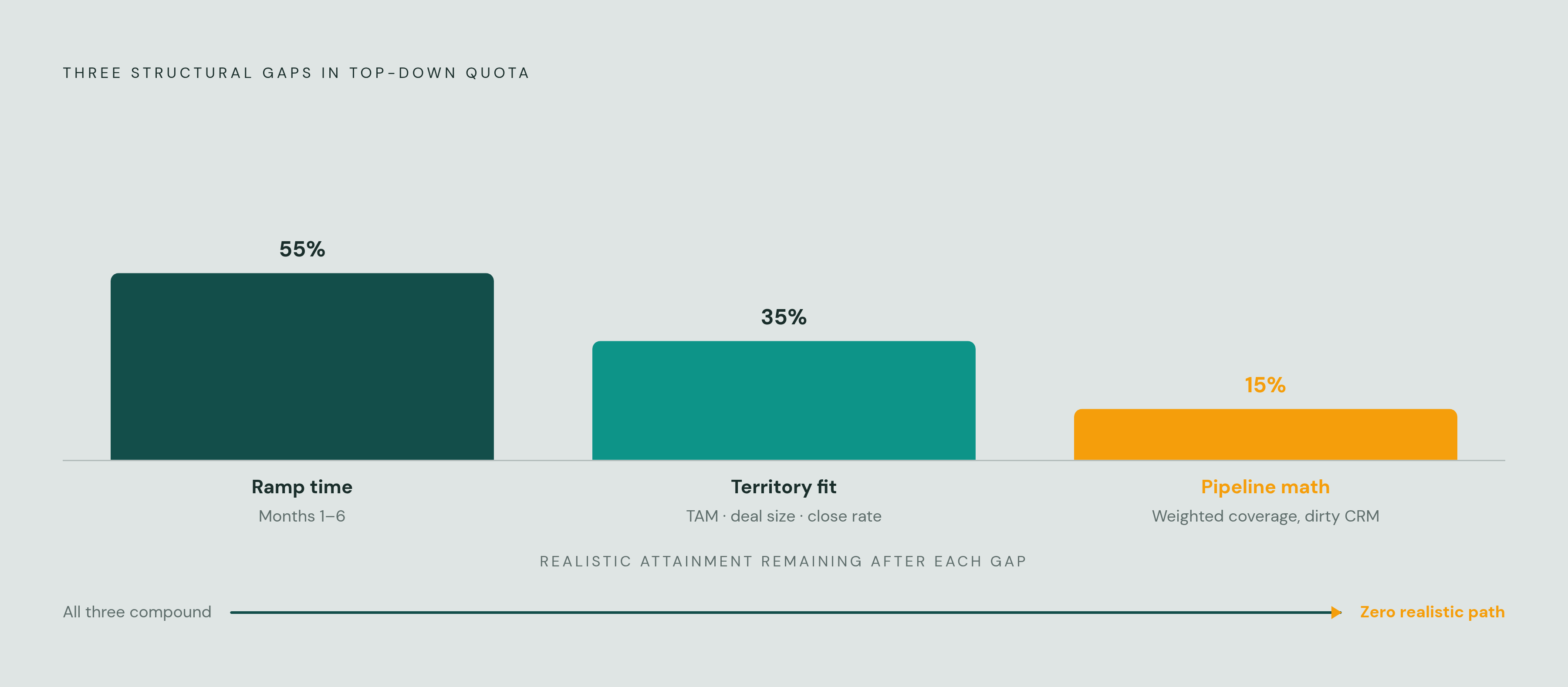
Three specific gaps explain why a quota built by division alone falls apart, and each one stays invisible until a rep is three months into the quarter and badly behind.
The first gap is ramp time. A rep in month two of the job cannot reasonably carry the same number as a rep who's been closing deals for a year and a half. Applying one uniform quota from day one of hire inflates what's realistic, pushes good people out the door, and quietly corrupts the attainment data used to judge the whole team. Good practice sets a ramped quota for the first two to three quarters, scaling up gradually, with full quota expectations starting in the second quarter of a rep's tenure. It's about measuring new hires against something they can actually hit while they learn the product and the territory.
The second gap is territory. Two reps can carry identical quotas and still be in completely different positions: one works a mature market full of warm inbound leads, and the other is building a territory from nothing. Treating those two assignments as equivalent because the number on paper matches isn't fairness, it's a measurement error. Calibrating quotas by territory means looking at total addressable accounts, average deal size in that region, and historical close rates, not to lower the bar but to set a bar that reflects what's actually winnable there.
The third gap sits in the pipeline math itself. The old 3x pipeline coverage rule, where you want three dollars of open pipeline for every dollar of quota, has stopped being a reliable check. Weighted coverage does the job better: multiply each opportunity's value by its stage probability, then divide by quota. That gives finance a number it can actually audit instead of a folk rule passed down from whoever ran sales five years ago. This only works if the CRM data feeding it is honest. If reps inflate stages or leave dead deals sitting open, the weighted coverage number looks healthy while the real pipeline is hollow, and the quota built on top of it is wrong in the exact same way the old quota was wrong.
None of these gaps acts alone. A brand-new rep working a thin, undeveloped territory against pipeline numbers that are quietly inflated has no realistic path to quota, no matter how good the coaching is. Fixing one gap and leaving the other two in place still leaves the rep in a hole.
What a hybrid quota model looks like in practice
The fix is a hybrid model: start with the top-down business target, then validate it against bottom-up data pulled from the CRM before any number gets assigned to a person. Neither direction works alone. A pure top-down number ignores what the territory can actually produce. A pure bottom-up number can undershoot what the business needs to survive. The hybrid approach runs both calculations and treats the gap between them as information, not an inconvenience to paper over.
Walk through the bottom-up side with a concrete example. Start by pulling the trailing win rate by CRM stage, say a rep historically closes 20% of opportunities that reach the proposal stage. From there, calculate the weighted pipeline a rep actually needs: opportunity value multiplied by stage probability, divided by quota. For example, if a rep's quota is substantially higher than the average deal value reaching proposal stage, and only a fifth of those proposals close, that rep needs a weighted pipeline worth several multiples of quota moving through the funnel to have a real shot at the number. Back-calculate from there into how much raw pipeline needs to get generated each month to keep that weighted number full, factoring in how long deals typically sit at each stage.
Then apply a ramp curve for any rep who isn't yet at full productivity, scaling down the expectation proportionally for months one through six or so. Adding it all up across the team solves for a team quota. Every piece of that calculation lives inside the CRM already: stage probabilities, deal sizes, win rates, cycle times. That's what makes the number auditable by finance and believable to the rep looking at it, because it didn't come from a guess, it came from the same data everyone can go look at themselves.
The old habit of anchoring next year's quota to last year's attainment plus some flat percentage keeps punishing reps stuck in weak territories and rewarding reps who happened to land somewhere easy. The account-opportunity method breaks that cycle by starting fresh from what a territory can actually support: total addressable accounts, multiplied by a realistic close rate, multiplied by average deal size.
Role-specific quota design for the first sales hires
At the early stage, with one or two sales hires total, quota design has to split by role, because an SDR and an AE control completely different parts of the sales process and a single quota type can't fairly measure both.
Most SaaS companies put SDRs on activity quotas and AEs on revenue quotas, and that split holds up because each role only controls what it directly touches. An SDR can control how many qualified meetings they book or how many sales-accepted leads they generate in a month, which becomes their primary number. A smart secondary target for an SDR is the total pipeline value passed along to the AE, which keeps the SDR invested in the quality of what they're sending over instead of treating quantity as the whole job. An AE's quota is revenue closed, checked against the weighted-coverage math described earlier so the number reflects what the territory can realistically produce.
Pay structure should mirror that split. SDR comp usually runs base-heavy, weighted toward salary over variable, while AE comp tends to land closer to an even split between base and bonus. That difference isn't arbitrary. It signals what the company believes each role actually controls: an SDR influences activity and lead quality, an AE controls the close, and the pay mix should match where the real leverage sits.
A useful guardrail for SDR bonuses ties a smaller share of the variable bonus to appointments booked, and the larger share to qualified opportunities that actually advance. That keeps an SDR from stacking the calendar with meetings that go nowhere just to hit an activity number, and keeps their incentives pointed at the same outcomes the AE needs.
Hiring order matters here too. At the earliest stage, hire an AE before an SDR. An SDR's job is to feed a pipeline, and there's no pipeline to feed until the sales motion is actually running. Bringing on an SDR too early means measuring activity against a process that doesn't exist yet. On the OTE side, multiples in the 3x to 8x range of base salary are a starting heuristic in compensation planning, but they're a sanity check, not a formula to apply blindly to a specific hire or market. Resourcefulness affects whether this first hire can succeed: someone who's only ever worked inbound leads at a well-known company may struggle the moment the job becomes building a territory from scratch rather than maintaining one that already exists.
The metrics that tell you whether a quota is calibrated or broken
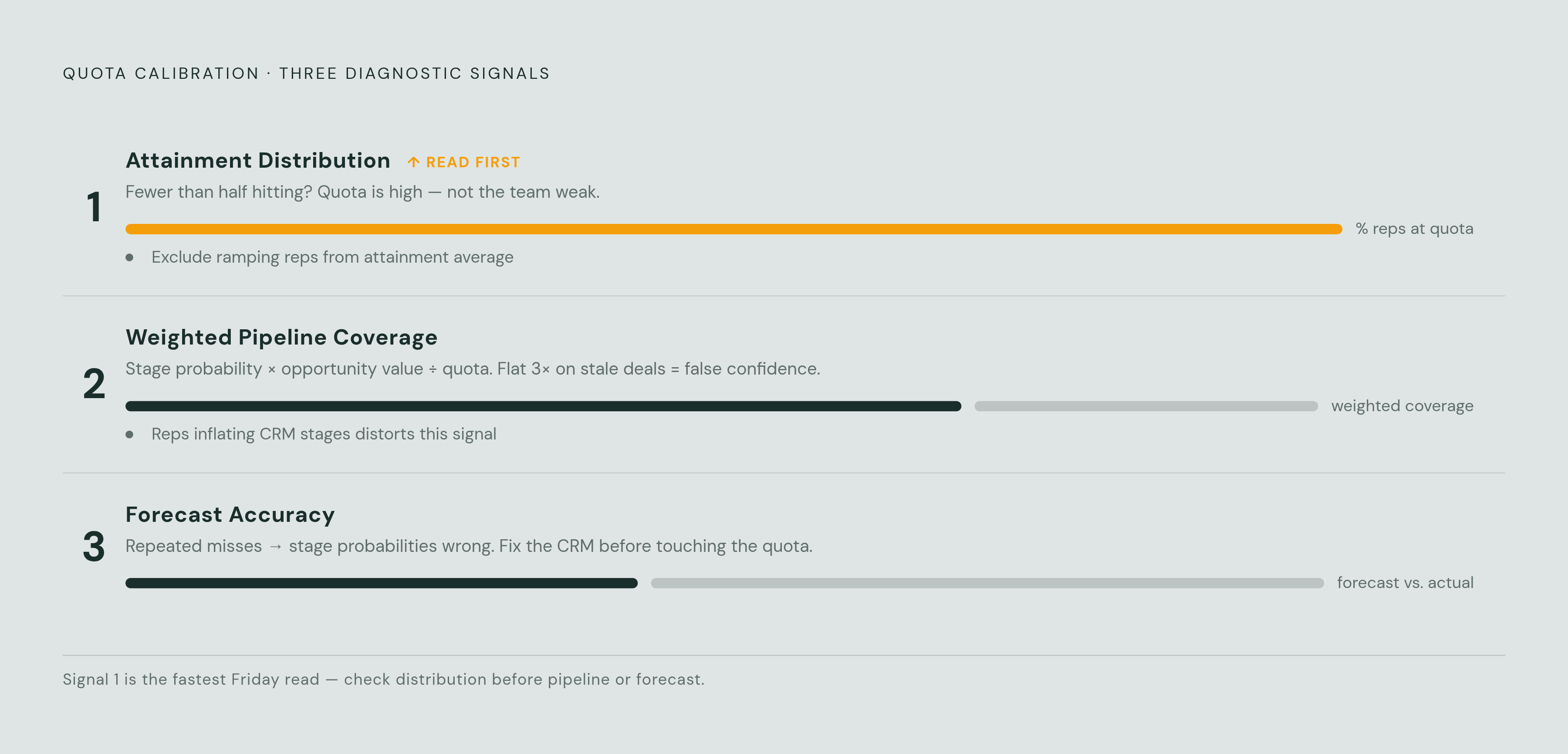
A quota is a hypothesis about what a rep can sell. Attainment distribution is the test result, and the shape of that distribution tells a founder more than the average ever will.
Three signals carry most of the diagnostic weight. The first is attainment distribution itself: if fewer than half the team is hitting quota consistently, that points to the quota being set too high, not to a sudden drop in everyone's skill at the same time. A founder looking at their CRM on a Friday afternoon should check this first, because it's the fastest read on whether the number itself is the problem.
The second signal is pipeline coverage, measured the weighted way: stage probability multiplied by opportunity value, divided by quota. A flat 3x rule applied to a pipeline full of stale, inflated deals produces a worse read than having no rule at all, because it creates false confidence. Weighted coverage forces a look at what's actually sitting in each stage rather than just counting deal volume.
The third signal is forecast accuracy. If forecasts keep landing wrong, quarter after quarter, the stage probabilities baked into the CRM are off, and those need fixing before anyone touches the quota itself. Adjusting a quota on top of broken inputs just moves the error somewhere else.
Two data-quality problems can quietly corrupt all three signals. Reps inflating CRM stages, or leaving dead deals open instead of marking them closed-lost, makes pipeline coverage look healthier than it is and makes a broken quota look achievable on paper. Separately, mixing ramping reps into the same attainment average as fully ramped reps drags the whole team's number down in a way that has nothing to do with whether the quota itself is calibrated. Ramping reps need their own column, tracked apart from the rest, so a new hire's expected early struggles don't get mistaken for a sign the quota is too high across the board.
The target shape to aim for: a solid majority of reps hitting plan, not a small group blowing past it while most of the team quietly checks out. A distribution like that, a few stars and a crowd of people falling short, usually means the quota was set for the stars and applied to everyone else by accident.
Adjusting a quota without breaking rep trust
Quotas that change without explanation teach reps that the number was never real to begin with, and that lesson is expensive. Once a rep decides the target is arbitrary, the quota stops functioning as a behavioral tool at all, no matter how carefully it was calculated the first time.
The fix is to make every adjustment traceable to something specific that actually changed: a territory got restructured, win rates shifted measurably, a cohort of ramping reps graduated into full quota. "We need more revenue this quarter" is not a reason a rep can evaluate, and reps notice the difference immediately.
Timing matters as much as the reasoning. Most companies communicate quotas only after the fiscal year has already started, and late communication signals, fairly or not, that the number wasn't built from real data. Setting the quota before the period opens, and showing the rep the model behind it, the territory's account count, the assumed win rate, the ramp adjustment, turns the number from an edict into something a rep can check for themselves.
Build in a scheduled review point rather than adjusting on impulse. If attainment distribution falls below the target threshold for two straight months, that's the signal to revisit the inputs behind the quota, the territory assumptions, the win rates, the coverage math, not to reach straight for the comp plan as the fix. Document what changed and why every time an adjustment happens. That record is the proof, the next time a number moves, that the quota is still a reasoned figure and not a guess dressed up as math.
Trimming quotas for early-career reps while leaving relief concentrated on elite, tenured sellers feels like a safe short-term move, but it quietly erodes the bench. Junior reps who stop getting stretched stop turning into the senior reps who carry the number five years from now.
None of this is a one-time project. Attainment distribution, pipeline coverage, and forecast accuracy need regular looks, not an annual reset, because each cycle of data makes the next quota more accurate than the last. For a founder building a first sales team without years of attainment history to lean on, that ongoing loop is the closest thing available to a track record, built one calibrated quarter at a time.