Calibration Brief Templates for Early-Stage Engineering Roles
Hiring teams need alignment on what exceptional looks like before sourcing begins.

Two things are happening in engineering hiring right now, at the same time, and neither one is a mistake. Companies are cutting headcount and posting new AI roles in the same quarter, sometimes the same week. That's not confusion: it's a deliberate swap, general engineering capacity going out the door, specialized capacity in a particular technical area coming in through it. It's a deliberate swap: general engineering capacity going out the door, specialized capacity in a particular technical area coming in through it.
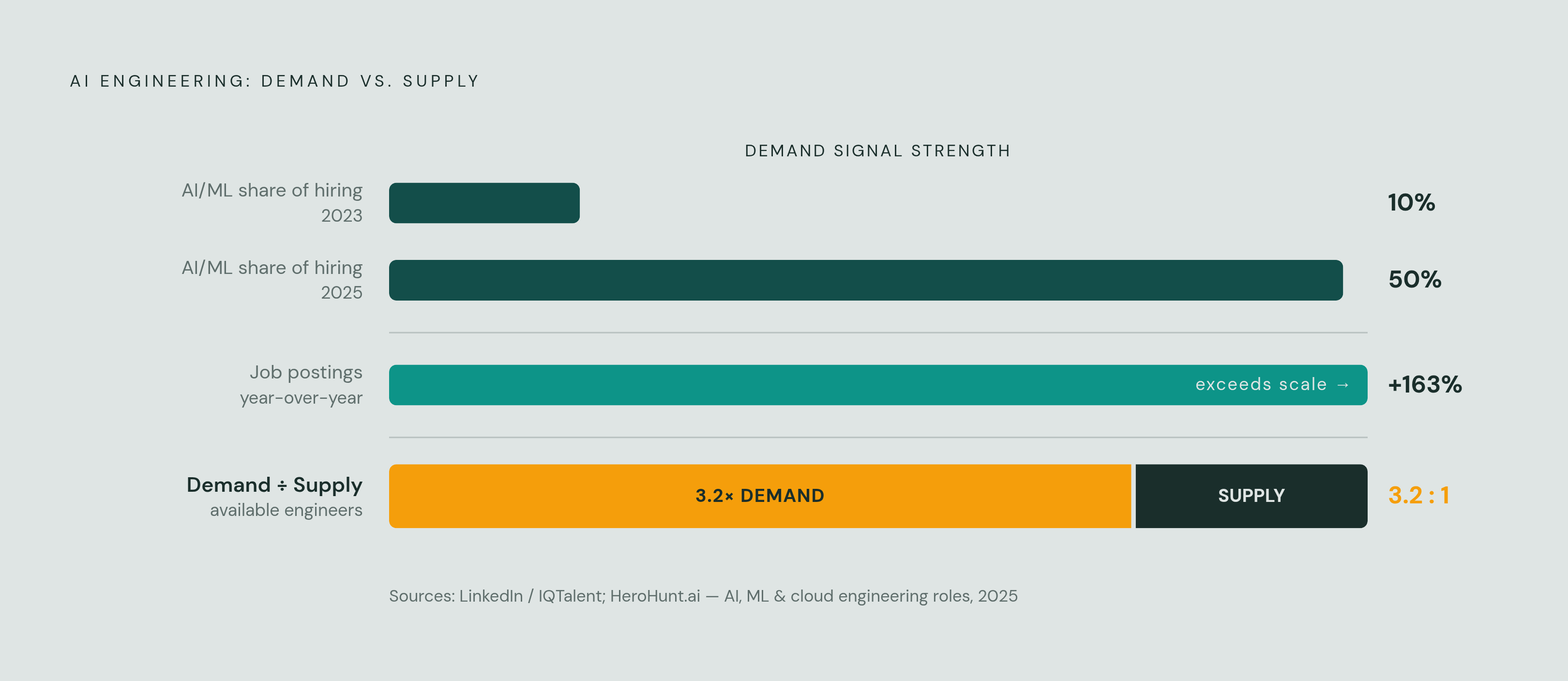
The numbers back this up. Job postings related to that specialized technical area, tracked within a broader region's labor market. Job postings related to that specialized technical area, tracked within a broader region's labor market, grew 74% year-over-year, and the share of AI/ML roles within total tech hiring jumped from 10% to 50% between 2023 and 2025, according to HeroHunt.ai's reporting. LinkedIn's Jobs on the Rise report, cited by IQTalent, lists AI Engineer as the fastest-growing job title in the country, with postings up 163% year-over-year. But postings growing that fast doesn't mean qualified people are growing to match. Supply hasn't kept pace, and that gap is exactly where a founder's hiring plan runs into trouble.
The squeeze isn't even across age groups, either. Stanford's Digital Economy Lab found that employment for 22 to 25-year-olds in the most AI-exposed jobs sits 19% below trend, while experienced workers show no comparable dip. So the entry-level pool, the one early-stage companies often lean on because it's cheaper and more available, is shrinking fastest. And that has a longer tail than any single hiring cycle: cutting new-grad pipelines to protect near-term balance sheets risks a leadership vacuum across the industry within a decade. Today's cost-saving becomes tomorrow's empty bench of senior engineers.
What does this mean for a founder trying to fill an engineering seat right now? The market isn't a generic pool of "engineering candidates" anymore. It's segmented by AI exposure, thin at the entry level, and moving faster than most hiring processes are built to handle. Writing "find a good engineer" into a hiring plan is not really an instruction at all, not in this market. It's a wish. Which raises the real question this piece is built around: if job descriptions and vague seniority labels can't do the filtering anymore, what can?
What a calibration brief is and how it differs from a job description
A job description is written for the outside world. It needs to be findable, legally sound, and appealing enough that the right people click apply. A calibration brief is written for the inside of the company, and it does something a JD structurally cannot: it gets everyone who's going to interview a candidate to agree, in writing, on what "exceptional" actually means for this specific role, at this specific company, twelve months from now.
That question, what does exceptional look like at 12 months, gets skipped constantly. This is a routine failure in engineering hiring, and it's a big part of why so many job descriptions read like they were assembled from a template. They attract candidates who match the template. Not candidates who match the job.
A calibration brief comes before any of the visible hiring machinery. It shapes the sourcing query a recruiter writes, the criteria used to screen resumes, the rubric used in interviews, and eventually the offer decision itself. It's the spec, and everything else gets measured against it. Everything else gets measured against it.
Skipping it causes the failure to appear downstream, usually in a way that resembles a sourcing problem when it is actually something else. IQTalent's analysis describes this: a hiring manager receives 200 AI-scored candidates, rejects the entire batch, and starts over manually. That's not bad sourcing. That's a team that never agreed on what it was looking for in the first place, so no volume of candidates could have satisfied it.
A JD runs on credentials and titles. A calibration brief runs on evidence of actual work and specific signals of fit. A good template makes that distinction structural, not aspirational, by making vague answers hard to write down. Every field should force someone to make a real decision, not fill in a wish list. That template contains several sections, covered below.
The role context section: stage, runway, and the next 12–18 months of work
The brief should open with the business, not the role. What is the company actually building over the next 12 to 18 months, and what specific engineering issue does this hire exist to solve?
Scion Technical's startup engineering hiring guide makes a useful point here: a seed-stage company validating its first product, a venture-backed company scaling an existing user base, and a growth-stage company modernizing an aging platform all say they want "exceptional engineers." But those are three different jobs requiring three different forms of expertise. The calibration brief has to name which scenario is actually true, because the sourcing and evaluation strategy for each looks nothing alike.
Fields to include in this section:
- Current stage: pre-product, post-product-market-fit, scaling, or platform modernization
- Team size this person joins, and the expected team size at 12 months
- The single most important thing this engineer owns, one primary deliverable, not a bulleted list of responsibilities
- What success looks like at 30, 90, and 365 days, described concretely, not aspirationally
- What the company currently can't do well, that this hire is supposed to fix
Why bother with all this detail before a single resume gets looked at? Because without it, hiring teams default to one of two failure modes: hiring for the role they had six months ago, or hiring for the role they imagine having in three years. Both are common at early-stage companies, and both are expensive mistakes to unwind once someone's already on payroll.
Founders resist this section more than any other part of the brief. It feels like internal planning, not recruiting, and there's a pull to skip straight to sourcing. But this is the sourcing filter. A recruiter who can't answer these five questions cannot write an accurate outreach message, and can't tell a strong resume from a mediocre one, no matter how experienced that recruiter is.
The role category section: naming what the engineer will do, not what they will be called
Job titles have gotten slippery. "Senior engineer" At one company means something entirely different than at another, and in 2026, technical hiring in 2026 increasingly maps to six distinct categories, as recruitslab.com's analysis describes:
Applied AI and LLM product engineers ship AI features directly inside a product. Machine learning engineers are accountable for model quality specifically. AI research engineers work upstream, on pretraining and post-training. AI infrastructure engineers own the training and inference compute that everything else runs on. Forward deployed engineers embed inside customer environments to make deployments work. And agentic AI engineering is emerging as its own specialization, carved out from the broader applied AI category.
Each of these has a different supply profile, a different compensation range, and requires a genuinely different assessment approach. Conflate two of them in a brief, and the sourcing query gets built for one candidate profile while the interview rubric gets built for another. Neither will land cleanly.
The template should force a choice: name the primary category, then name the secondary responsibilities separately. A founding engineer at a seed-stage company often spans two or three of these categories at once, and the brief needs to say so explicitly rather than collapsing everything into the vague catch-all of "full-stack." Analysis of founding engineer roles describes exactly this kind of person: someone expected to be a full-stack product builder, a system designer, a customer-facing problem solver, and an AI-native engineer, all at the same time. The brief's job is to say which of those is primary, and which are supporting.
One mistake occurs more than any other here: choosing a category based on what candidates on the market are calling themselves, rather than what the company actually needs solved. That's backwards: the need should drive the category, not the other way around. The need should drive the category. Not the other way around.
The technical signals section: replacing credentials with evidence of actual work
Here's the core problem with screening on credentials: "senior backend engineer" at two different companies can describe two entirely different jobs, built on entirely different levels of scope and difficulty. The signal a hiring team actually wants, evidence that this person can do the specific work in front of them, doesn't live in a job title. It doesn't live in the name of the employer, either.
CRV's engineering hiring guide makes a sharp point: an engineer who's never touched the exact framework a company uses, but has built systems of similar scale and complexity elsewhere, will outperform a mediocre engineer who happens to know the stack cold. Stack familiarity can be acquired on the job. Judgment built from having actually owned something hard is a different matter.
So what should the technical signals section ask for instead of years-of-experience and tool lists?
System scale matters first: what size and complexity of system has this person actually designed or owned? Not "experience with distributed systems," which means nothing, but what did they build, and what happened when it broke? Scope of ownership matters just as much: did they inherit a system someone else designed, or build it from nothing? Did they carry it alone, or as one voice on a larger team?
Evidence of intensity counts too. CoffeeSpace's 2026 analysis of founding engineer hiring notes that startups are looking for candidates who've done something notable, not simply "solid" engineers who show up and do fine work. Ambiguity tolerance is its own dimension: has this person worked somewhere with real ownership and unclear direction, or only inside well-staffed, well-defined engineering orgs where someone else did the deciding? And AI fluency in practice needs its own line item now. Per CorpSteam's engineering talent analysis, the question isn't whether a candidate can talk about AI tooling. It's whether they can actually build and ship with it.
Specificity is the whole game here. Em-tools.io's analysis of engineering manager resumes makes the point cleanly: a bullet that says "led a team of engineers" tells an evaluation panel nothing useful. A bullet that says "grew the payments team from 4 to 12 engineers over 18 months, keeping voluntary attrition under 5%" gives something concrete to actually push against in an interview. The calibration brief should set that level of detail as the baseline expectation, not treat it as a bonus when it appears.
For every technical signal listed, ask "how would this get verified in an interview?" If there's no answer, the signal isn't specific enough yet, and it needs another pass.
This matters more than it used to, because resumes are getting harder to trust. Greenhouse's AI Hiring Report found that 91% of recruiters and hiring managers have spotted or suspected candidate deception, and resumes that match a job description with suspicious precision are increasingly unreliable as a first-pass filter. A well-built technical signals section is the actual defense against this. It defines, ahead of time, what the interview needs to confirm, instead of trusting whatever the resume happens to claim.
The working-style and collaboration signals section: what the team environment requires
Technical skill answers what a candidate can build. It says nothing about whether they can survive the actual conditions of an early-stage team, which are structurally different from a large company's engineering org: fewer handoffs, more ambiguity, direct exposure to customers, and constant context-switching. The brief needs to name which of these conditions are true for this specific team, and which one is going to be the hardest.
A few dimensions should be calibrated explicitly, rather than assumed:
CorpSteam's 2026 analysis lists communication as an explicit evaluation dimension now, affecting whether this person can explain a technical or AI-driven decision to a non-technical cofounder or customer. Can this person explain a technical or AI-driven decision to a non-technical cofounder or customer? CorpSteam's 2026 analysis lists this as an explicit evaluation dimension now, not a soft nice-to-have. Collaboration style matters too, and it cuts in two directions: does the team need someone who pulls context from others proactively, or someone who pushes context outward so the rest of the team can move? Feedback tolerance is a separate dimension. Early-stage environments run on blunt, fast feedback with none of the formal cushioning a larger company's performance system provides, and not every strong engineer is built for that. And then there's ownership versus execution: does this role need someone who defines the problem from scratch, or someone who executes cleanly against a problem someone else already defined?
Learning agility deserves its own line, and CorpSteam's 2026 research treats it as a primary dimension rather than a footnote. How fast does a candidate pick up a new model, a new framework, new tooling? Because the underlying models change faster than most hiring cycles run, that adaptability affects hiring outcomes more than whatever tool the candidate happens to know cold today.
One prompt does most of the heavy lifting in this section: "what would make a technically strong candidate fail here?" The answers populate the whole section, and they stop the team from hiring someone who looks flawless on paper but can't actually function inside the environment that's waiting for them.
The specific derailers should also be named up front, one or two patterns that have caused real friction before: sensitivity to close oversight, a preference for async work dropped into a sync-heavy culture, solo-builder habits landing inside a codebase that depends on constant collaboration. A team misses these signals when it only evaluates technical fit, because nothing about a coding interview reveals them.
The market reality section: pressure-testing the hiring plan before sourcing begins
Every requirement in a brief needs to survive contact with the actual market, and that check needs to happen before sourcing starts, not after a dozen candidates have already been rejected for falling short of standards the market can't actually meet.
Two structural realities should be put in front of any hiring team before they finalize a plan. First, the supply paradox: HeroHunt.ai's 2026 recruiting guide puts global demand for AI, ML, and cloud engineers at a 3.2 to 1 ratio against supply, across the roles that matter most. That ratio alone should shape how aggressive a hiring timeline is allowed to be.
Second, trust in the hiring process itself has collapsed faster than most founders realize. Gartner's 2Q25 survey of 3,000 job candidates found offer acceptance rates fell from 74% in 2023 to 51% in 2025, a 23-point drop in two years. Part of that is driven by candidates simply not trusting the evaluation process. Only 26% of job seekers trust AI to evaluate them fairly, per the same survey. A founder who assumes a strong candidate automatically becomes an accepted offer is working off a model of hiring that no longer describes how candidates actually behave.
So what belongs in this section of the template? Start with an honest compensation range, checked against real market rates for the specific role category and seniority level named earlier in the brief, not against what the company wishes the rate was. Add geographic scope, on-site, hybrid, or remote, and whether that scope actually matches where the target candidates live and work. Separate the requirements that are genuinely non-negotiable from the preferences the team would drop the moment the right person showed up. And build in a realistic read on timeline: SHRM benchmarked a 44-day average hiring cycle in 2025, and early-stage companies chasing specialized AI engineering talent should expect to calibrate against that, not against how fast they'd like to move.
The honest purpose here is to surface the gap between what the team wants and what the market is actually offering, before anyone gets contacted. One question does most of the work: "if the ideal candidate we just described saw this role tomorrow, what would make them say no?" The answers usually point straight at the gaps this section needs to close. A company that can't reconcile those gaps should rewrite the role. Not keep burning sourcing cycles hoping the market bends.
The evaluation design section: specifying how each signal will be assessed before interviews begin
Once every signal is named, technical, working-style, and market-adjusted, the brief needs to map each one to a specific method of evaluation. Not a generic list of interview rounds. A table: this signal, assessed by this method.
Why does this matter more now than it did a few years ago? Because the tools everyone used to lean on are degrading fast. Karat's 2026 analysis of engineering interview trends found that take-home projects and automated coding tests are losing reliability quickly, precisely because AI tools make them easy to game. A strong take-home submission today says less about a candidate than it did three years ago, and a brief that still leans on it as a primary signal is building on ground that's shifting under it.
What's filling that gap? Live interviews, run in real time, where a candidate has to work through a problem out loud, make visible decisions, and use AI tooling in front of an interviewer rather than behind a closed door. Karat's 2026 research frames this as an explicit industry shift, not a stylistic preference. It's a direct response to the fact that static, take-home signals can no longer be trusted the way they once were.
The calibration brief should specify, signal by signal, which method actually verifies it. System scale and ownership might get tested through a live systems-design conversation, where scope and past decisions get pressure-tested in real time. AI fluency in practice might get tested by watching someone actually build with the tools, not by asking them to describe their experience with the tools. Working-style signals like feedback tolerance or ambiguity comfort rarely appear in a coding round. They usually need a structured conversation built specifically to surface them.
None of this works if the mapping happens after interviews are already scheduled. The whole value of the evaluation design section is forcing that decision early, so that by the time a candidate sits down with the team, everyone already agrees on what they're looking for and how they'll know when they've found it.
Sources
- How AI Is Reshaping Engineering Hiring in 2026
- The Future of Software Development Jobs in 2026 - Second Talent
- Recruiting AI Software Engineers in 2026
- The Recruiter's Guide to the New AI Era (2026)
- Engineering Talent in 2026: What’s Changed and Why Your Hiring Approach Must Too – Corps Team
- AI Hiring Trends 2026: A Forecast for HR Leaders
- recruitslab.com
- pin.com