Managing Candidate Handoffs Between Sourcing and Assessment Without Data Loss
Shared written standards prevent sourcing and screening from silently drifting apart.
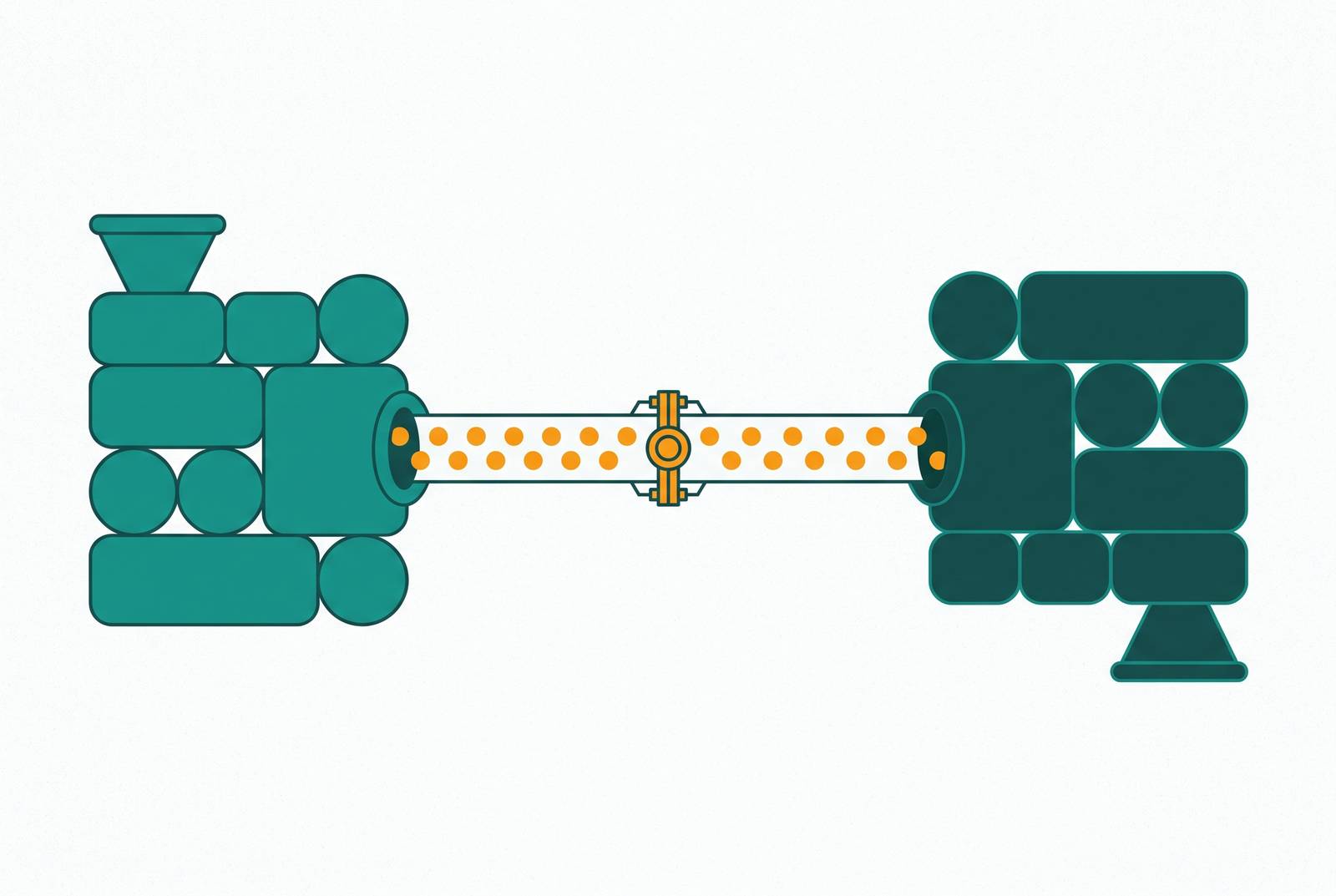
The gap between sourcing and screening isn't a data problem. It's a calibration problem: the criteria a sourcer uses to say "this person qualifies" often aren't the same criteria the screener applies five days later, so even a perfect data transfer can carry the wrong signal forward. When a 2026 survey of over 500 recruiting leaders found that fewer than half of searches (49%) start with high alignment on requirements among teams not using AI, that gap shows up long before any handoff happens. It shows up at intake, when nobody wrote down what "qualified" actually meant.
That's the practical consequence. A sourcer passes a candidate who matches the spec as written. A screener rejects that same candidate against a standard that was never put on paper. Neither side can point to what went wrong, because the disagreement was never documented in the first place. Conversion drops, and the postmortem turns into a guessing game.
Two ideas need separating early: a handoff is a single moment, a file moving from one queue to another. Calibration is the ongoing condition, the thing that decides whether that moment preserves signal or quietly erases it. Fix the handoff mechanics and the calibration problem is still sitting there underneath. Fixing this means treating "qualified" as something written down and shared, not something one person carries around in their head.
How the sourcing-screening boundary works and where the definition of "qualified" lives by default
Sourcing, in most functioning teams, ends at a specific point: the candidate has responded positively to outreach, and someone has confirmed a baseline (right experience level, open to the role type, salary expectations in range). Once that happens, the file moves to recruiting, which handles screening, interview coordination, and eventually the offer. Different skill set, different success metrics, different rhythm of work entirely.
Skipping that baseline check lets pipeline quality problems slip through, and SHRM's 2025 Talent Trends report puts the share of organizations still struggling to fill full-time roles at 69%, with a lot of that tracing back to pipeline quality rather than pipeline size. SHRM's 2025 Talent Trends report puts the share of organizations still struggling to fill full-time roles at 69%, and a lot of that traces back to pipeline quality rather than pipeline size. Teams aren't short on candidates. They're short on candidates who survive contact with the actual bar.
Add to that the fact that, per LinkedIn's Global Talent Trends research, something like 70% of the workforce is passive: not actively applying, not raising a hand. Sourcers aren't working off explicit declarations of interest or fit. They're working off inference, pattern-matching, and whatever signal a cold message and a reply generate. It's a soft science dressed up as a search function.
So where does the actual definition of "qualified" live? Usually nowhere formal. It lives in the sourcer's head, stitched together from the job description, a hiring manager's comments on an intake call three weeks ago, and whatever pattern the sourcer has picked up from past successful hires at the company. None of that gets written down in a way anyone else can reference.
The handoff is the moment that informal definition either becomes explicit and travels forward, or gets dropped on the floor. Most of the time, it gets dropped. The screener opens the job description, not the sourcer's notes, and builds their own private version of "qualified" from scratch. The candidate shows up to the next stage stripped of the context that made them interesting in the first place.
The five places a recruiting funnel leaks signal, and what each leak actually looks like in the data
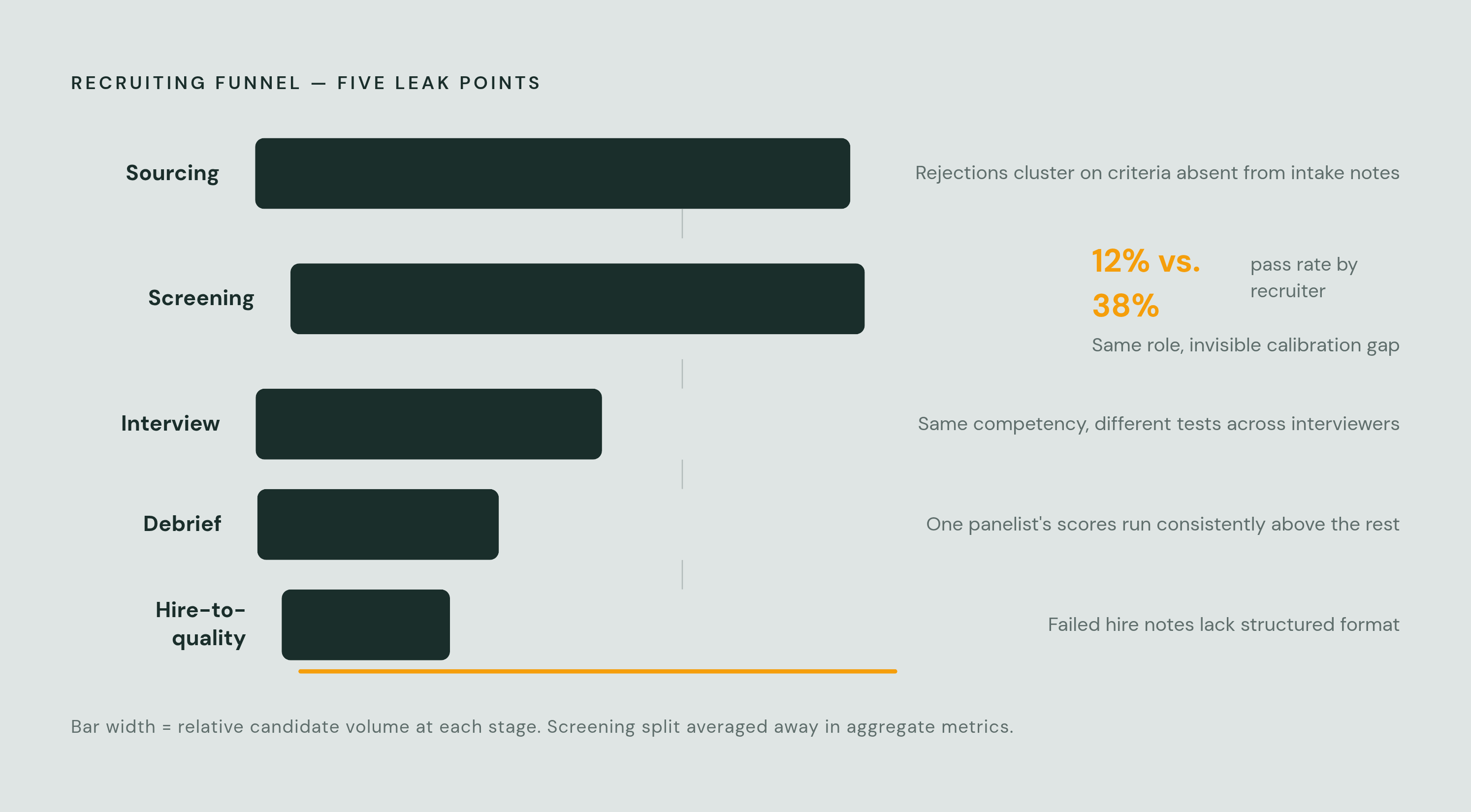
Signal doesn't vanish all at once. It leaks out at specific points, and each leak has a distinct fingerprint if anyone bothers to look.
Sourcing leak is the first issue: volume looks normal. Qualified share is below what it should be. The instinct is to blame sourcing tactics, but the actual cause is usually a mismatch between the job ad, what the recruiter is screening for, and what the hiring manager accepts once they see the candidate in a debrief. The tell: line up intake-call requirements against screen-stage rejection reasons. If rejections keep clustering around criteria that never appeared in the intake notes, the funnel isn't leaking at the source. It's leaking at the spec.
Screening leak comes next: screen-to-interview conversion looks fine as a team average, then falls apart the moment you split it by recruiter. One person converts at 12%, another at 38%, and the average papers over the gap entirely. Without a shared rubric captured on every screen call, there's no way to tell if the 38% recruiter is finding better candidates or just waving marginal ones through.
Interview leak shows up when two interviewers can sit on the same panel, believe they're assessing the same competency, and run completely different tests. One asks for a live technical demo. The other asks a behavioral question. Both walk away confident they checked the same box. The fix requires structured interview records: which questions got asked, which competency each one mapped to, how the answer got scored, not just a thumbs up or down at the end.
Debrief leak is bar drift in real time. Under pressure to close a role, hiring managers loosen their standard without announcing it, and interviewers who haven't seen a strong candidate in weeks quietly reset their own reference point downward. If one interviewer's scores run consistently above the rest of the panel on the same role, that's calibration breaking in plain sight, and it stays invisible without score distribution data tracked over time.
Hire-to-quality loop raises the question: can the team pull up panel notes for every hire in a role who didn't make it through ramp? Most teams can't, because debrief notes were never written in a structured format to begin with. That's the loop that would tell a team whether its bar was ever right, and it's closed for almost nobody.
A fifth, less obvious leak is operational continuity. If a recruiter goes on leave or leaves the company mid-process, whoever picks up the thread has no way to continue the candidate conversation without starting over. Without centralized, structured handoff data, that continuity breaks entirely. It's not a staffing problem. It's an architecture problem.
What bar drift does to the sourcing criteria over time
Bar drift is quiet by nature. Nobody sends a memo saying "we're now accepting less." Hiring managers under pressure to fill a seat lower the bar in their own head, one candidate at a time, and interviewers who've gone a while without seeing someone strong start recalibrating downward without noticing they're doing it.
For sourcing specifically, that creates this problem: sourcers are still qualifying candidates against the intake criteria from the original kickoff call, criteria that no longer describe what the hiring manager will actually sign off on. So the sourcer keeps sending people who clear the old bar. The screener keeps rejecting them against a bar that moved without telling anyone. Neither side can see the other's version of the standard, so the disagreement just repeats, hire after hire.
Drift runs in both directions, too. After a stretch of unusually strong candidates, the bar can climb, and sourcers start over-qualifying leads, shrinking a pipeline that didn't need to shrink.
One might argue this is where credentials sneak back in. When the real standard is fuzzy or moving, sourcers and screeners fall back on whatever's easiest to check: job title, school name, brand-name employer on the resume. Those are inputs. They tell you nothing about what a candidate has actually built or shipped, but they're comforting proxies when the actual bar is unclear.
The fix isn't a new field in the applicant tracking system. It's a visible, versioned statement of the standard, one that only changes when a specific person explicitly approves the change, and that gets pushed back to sourcing the moment it does. Teams that compare intake requirements against rejection reasons after every single stage catch drift within days. Teams that only look at this during a quarterly review find out about it the same week they miss a hiring target.
Why the job description is a poor foundation for handoff criteria
The job description was never built for this job. It's written to attract candidates, which makes it a marketing document, not a tool for calibrating what two different evaluators mean by "qualified."
It describes outputs in broad strokes: "own the roadmap," "drive cross-functional alignment." It says nothing about what evidence of that output should look like on a 30-minute screen call versus a technical assessment versus the final panel. Those are three different bars, and the JD flattens them into one paragraph.
This is where credentials quietly replace evidence. A line like "10 years of experience" or a degree requirement functions as a stand-in for capability, and sourcers screen against that stand-in because it's measurable, even though what actually predicts performance is what a candidate has done, not the letters attached to their name. A growing share of organizations have already dropped degree requirements from postings, and many report successfully hiring people who would have been automatically screened out under the old rule. That's not a small miss. That's the gap the credential filter was creating.
The JD problem gets worse at the handoff specifically, because the screener reads the exact same document the sourcer used and builds their own separate interpretation of what it means. Two people, same text, two different mental models. There's no shared reasoning being passed along, just shared words, and words alone don't carry judgment.
What actually needs to travel forward: qualification criteria specific to each stage, the reasoning behind each one, a compensation range grounded in current market data, and any signal the sourcer noticed and found genuinely meaningful, not just boilerplate.
What a structured qualification artifact looks like and what it must carry across stages
Start from a simple principle: "qualified" needs a definition at every stage, not one definition set at intake and reused for the rest of the process. What makes someone worth an outreach reply isn't the same bar as what makes them worth advancing past a technical assessment. Treating those as one bar is where a lot of this breaks down.
From sourcing, the artifact should carry:
- The specific signals that triggered qualification, not a vague "good match" note but the actual detail in the background that stood out
- The outreach context itself: what was said, what the candidate responded to, what they seemed genuinely interested in
- Baseline confirmations: experience level, openness to the role type, comp range, the checkpoints that mark when a lead actually becomes a candidate
At screening, the artifact gains:
- Notes structured against the same rubric the whole team uses, not a free-form paragraph summarizing "vibes"
- An explicit match or gap recorded against each criterion individually, not one overall impression
- A reason for advancing or rejecting that ties back to a specific intake criterion, so sourcing can tell whether a miss was a spec problem or an execution problem
At interview, it gains:
- A record of which questions got asked, which competency each mapped to, and how each answer got scored
- Interviewer score distributions tracked over time, so drift shows up before it quietly reshapes the debrief
Every change to the standard itself needs a timestamp and a reason attached, visible to everyone touching the process. Otherwise sourcing keeps qualifying people against a bar that assessment abandoned two weeks earlier without saying so. And there's a quieter payoff buried in all this structure: any team member can step into a candidate's process mid-stream, not just the one recruiter who happened to start the conversation.
How the intake-to-rejection feedback loop closes the gap in practice
The diagnostic here is straightforward, even if almost nobody runs it consistently: take the structured requirements from the intake call and set them side by side with the actual rejection reasons from the screen stage. Where do they line up? Where don't they? If rejections keep clustering around something that was never in the intake notes to begin with, the leak is at the spec, not at the sourcing effort.
What that comparison hands back to sourcing is genuinely useful. It shows which qualification signals are actually predictive (people who cleared them kept advancing) versus which ones are noise (people who cleared them got rejected on completely different grounds anyway). It also exposes whether a hiring manager's stated intake criteria match what they actually approve once a real candidate is in front of them.
What it hands back to assessment matters just as much: whether screeners and interviewers are evaluating against the criteria that were actually agreed on, or quietly applying their own private version. It also surfaces which competencies on a shared rubric are being interpreted consistently across the panel, and which ones are generating wide score variance between interviewers who think they're measuring the same thing.
Cadence is the whole game here. Run this comparison after every stage and calibration gaps close within days. Save it for a quarterly review and the leak only becomes visible after a hiring goal has already been missed, which is a much more expensive way to find out. Among companies that reported exceeding their hiring goals in 2026 data, 85% were already using AI somewhere in the hiring process, which points less to AI as a magic ingredient and more to the discipline of actually tracking this loop instead of skipping it.
There's a real payoff for candidates buried in this too. When a rejection is tied to a specific, named criterion instead of a vague overall impression, a candidate who doesn't fit the usual credential pattern but does meet the actual capability bar has a much better shot at surviving contact. Pattern-matching on brand names and titles tends to filter these people out quietly. A structured record forces the evaluator to say what the candidate actually did, not just what they look like on paper.
Where AI fits into handoff integrity and where it creates new calibration risks
The efficiency case for AI in sourcing isn't theoretical. A 2026 user survey from Pin found recruiters using AI-powered sourcing reclaimed roughly 12 hours a week, about a day and a half of work that used to go into manual searching. GoodTime's 2026 Hiring Insights Report, drawing on more than 500 talent acquisition leaders, found 99% had used some form of AI or automation in the past year, with 93% planning to invest further in 2026. Teams hitting at least 75% of their hiring goals were 28% more likely to adopt automated, candidate-driven interview scheduling, and 25% more likely to use AI for scheduling, according to the same report.
But what if the AI is just as good at scaling the wrong thing? That's the actual risk, and dismissing it doesn't make it go away. A sourcing or screening model trained on historical hiring data learns historical qualification patterns, which means it can automate exactly the credential-based filtering that produces false positives and quietly screens out strong, non-obvious candidates. Proxy signals like zip code, school name, or employer brand can sneak back in as back doors even after protected characteristics get formally stripped out. And a model that's fast and confident while qualifying against a bar that already drifted is just a faster way to be wrong.
The fix isn't less AI. It's making sure whatever AI touches sourcing or screening is operating against a standard that's structured, versioned, and approved by an actual person, rather than a standard the model inferred on its own from old outcomes. AI that surfaces score distributions, flags an interviewer drifting from the panel, or runs the intake-to-rejection comparison automatically strengthens calibration. AI that spits out a ranked candidate list with no visible reasoning behind it just makes the calibration gap harder to spot, not smaller.
The human role doesn't shrink here, it sharpens. Judgment about what "exceptional" actually means for a given team at a given stage of growth, approval of any change to that standard, the final call on who gets hired: none of that is process administration, and none of it should get automated away. What makes any of this work in practice is a single system holding sourcing criteria, interview rubrics, and assessment records together in one place, rather than scattered across a sourcing tool, an applicant tracking system, and a separate interview platform that don't talk to each other. That's the architecture that makes the feedback loop possible in the first place. Without it, everything described above stays a good idea nobody can actually run.