Sales Territory Design for a Growing Account Executive Team
Fixing territory design prevents unqualified reps from failing before they start.
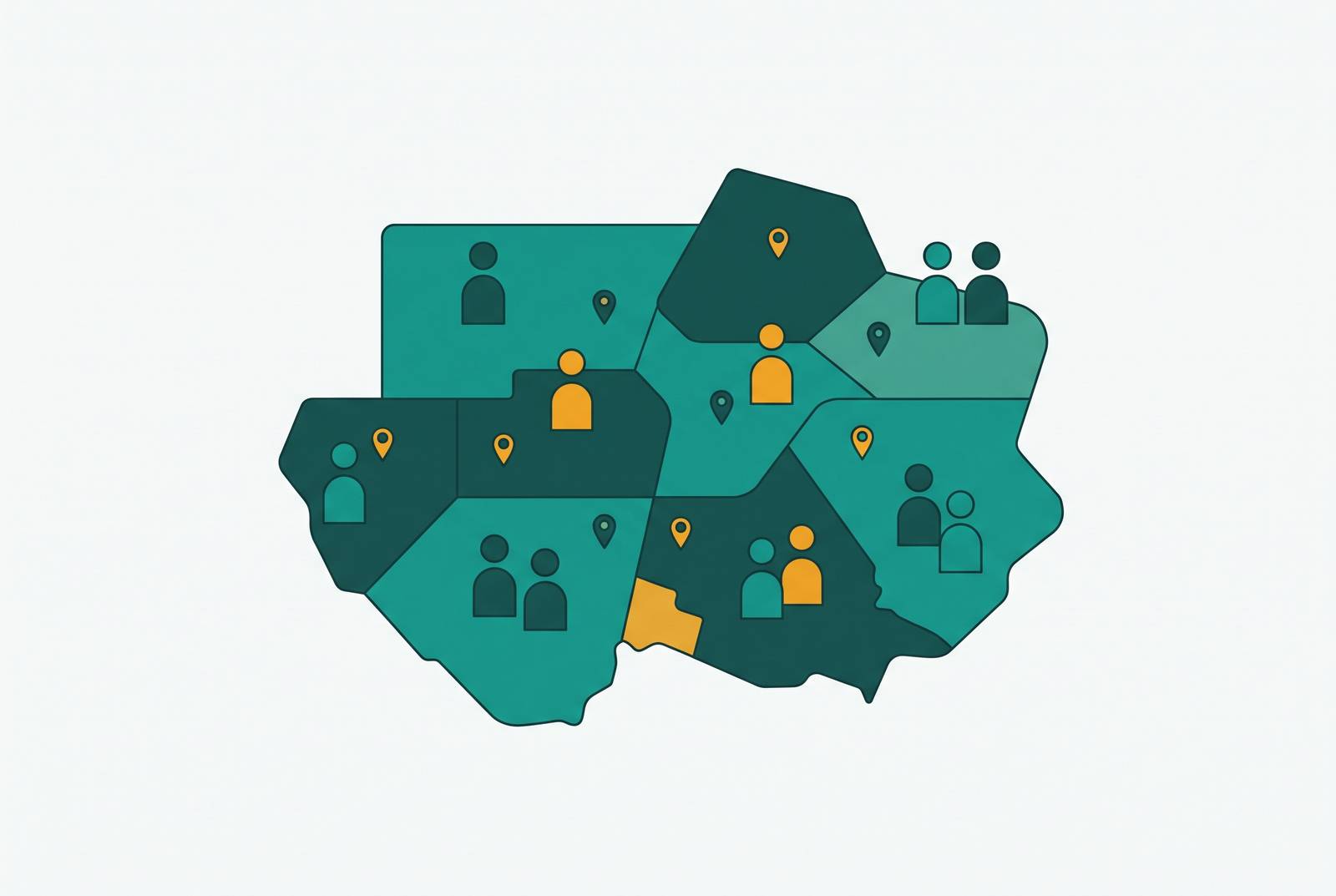
Quota attainment is decided before the first call gets dialed, and the decision gets made in a spreadsheet, not on a sales floor. Picture the cycle: January brings a fresh territory map and a round of quotas set with confidence. By March, two reps are already pulling ahead of plan while three others are falling behind, through no evident fault of their own. By June, one of the laggards has quit. By Q4, leadership is asking why the team missed its number, and the answer that gets delivered is usually about effort, coaching, or fit with the product. Then January comes back around, and the same design process repeats.
The real driver of that pattern is rarely the rep; it's the territory. If a rep covers high-potential accounts at strong average contract values, that rep starts the year with a fundamentally different shot at hitting quota than one covering fewer, smaller accounts. Assign both reps the same number, and one looks like a hero while the other looks broken, regardless of what either one actually does with a phone or a demo. Territory design sets the odds before anyone places a bet.
That is why territory design deserves treatment as a strategic lever, not an administrative task to knock out once a year. A sales leader who treats it as paperwork inherits a scoreboard that measures something other than sales skill. The rest of this piece works through how to build territories that measure the right thing.
How the traditional design process produces structurally unequal territories
The conventional approach starts with a map. Someone draws boundaries of roughly equal size, assigns reps to each one, and calls it done. The boundaries look fair because they are visually even, but visual evenness has nothing to do with revenue potential. A territory covering three dense urban zip codes can hold the same revenue potential as one that spans an entire rural state. Starting from geography instead of account revenue potential is the single most common mistake in the process, and it is the mistake that makes everything downstream unequal.
Three structural problems compound on top of that starting error. Static splits ignore where buying intent actually lives. A territory that looked balanced in January can be lopsided by April, because markets shift, reps leave, and accounts go dark in ways a map drawn once a year cannot track. Equal account counts create a second illusion of fairness: a book of 80 dormant mid-market accounts is not comparable to a book of 80 accounts actively evaluating a purchase, even though both show up as "80 accounts" on a spreadsheet. And territory changes trigger their own politics. Reps lobby to keep their best accounts, managers protect their own people, and new hires end up with whatever nobody else wanted. Seniority and negotiation end up shaping the map.
The downstream effects compound quietly. Unbalanced territories leave high-potential accounts under-covered, and neglected prospects become easy wins for any competitor willing to show up more consistently. Worse, when territory assignment swings results more than rep skill does, the performance data a company generates no longer measures rep quality; it measures territory quality instead. Coaching decisions, quota-setting, and forecasting all get built on that same flawed data, so every one of those downstream processes is unreliable before it even starts.
The business case for getting territory design right
Poor territory design costs a company in three compounding ways: lost revenue from coverage gaps, lost reps from inequity-driven attrition, and lost predictability from unreliable pipeline data. Each of those costs reaches a different part of the business, and each one is the kind of number that gets attention in a leadership meeting.
Forecasting takes the most direct hit. When territories carry wildly different mixes of enterprise and smaller accounts, revenue comes in lumpy and unpredictable, and the pattern makes it hard to trust any single quarter's pipeline review. Balanced territories produce comparable data sets across reps, which is what makes pipeline analysis tractable. Customers feel the imbalance too. Accounts sitting in under-covered territories notice the lack of attention, and they respond by churning or shifting wallet share to competitors who show up more consistently.
The upside case is just as concrete. When territories are balanced on revenue potential and real buying signals, reps spend less time chasing dead accounts and more time engaging the ones that are actually ready to buy. You see that shift directly in pipeline velocity, cycle times, and win rates. A sales leader bringing this case to leadership has three levers to point to: revenue, retention, and forecasting accuracy. None of them require a territory redesign to be framed as a nice-to-have.
What territory design should start with: revenue potential and account-level signals
Effective territory design starts with account revenue potential rather than geography, and it layers in real-time buying signals to weight which accounts represent near-term opportunity. So you map every existing customer and prospect with an estimate of its revenue potential, then you draw boundaries that balance total opportunity across territories. Geographic lines can still exist in the final design, but they should sit downstream of the opportunity data.
Three buying signals sharpen that opportunity data further. Leadership changes matter first: a new CRO or VP of Sales frequently triggers a vendor evaluation within a short window after joining, a pattern that happens roughly 70% of the time according to Cognism research. Funding events matter second, because a recently funded company has both the budget and the internal mandate to act on a purchase decision. Technology stack shifts matter third: when a target account replaces a competitor's tool or adopts something complementary to the category being sold into, that move signals active evaluation already underway.
Signal-based weighting also resolves a fallacy that geographic and account-count splits both fall into. A rep holding a smaller list of high-signal accounts can carry a territory comparable to, or better than, a rep holding a larger list at baseline signal levels. Fewer accounts doing more buying beats more accounts doing nothing.
The objection worth taking seriously is TAM risk. Shrinking an account list too aggressively, especially for a newer AE or in an immature market, can leave the rep with no fallback if the short list goes cold all at once. You score each account on current buying propensity and balance territories on that signal-weighted opportunity. A territory built this way stays small, but it stays active rather than idle, and that distinction is what keeps the TAM risk from becoming a real problem.
Choosing the right territory model for your sales motion
Territory design has more than one valid model, and no single one works across every sales motion. The right choice depends on how accounts actually buy and how reps actually sell. A territory can be built around geography, industry vertical, account size, named accounts, or some hybrid of these, and a model built for a field sales team with real travel costs will fail outright for an inside sales team running a named-account motion.
The geographic model still makes sense if travel time is a real cost. Boundaries in this model should equalize drive time and account density rather than land area, so you calculate the total estimated drive time per territory and adjust lines until that number reaches parity. A tight urban patch and a sprawling rural one can carry equivalent opportunity as long as their drive-time loads are matched.
The vertical or industry model earns its place when rep expertise meaningfully affects conversion. When a rep's background aligns with an account's industry, that creates a consultative advantage generic account distribution can't replicate. V Shred put this to the test by building industry-based territories around rep expertise, matching fitness industry veterans with supplement accounts and nutrition specialists with meal plan prospects. The team reached 340% of quota attainment in year two, with a materially shorter average sales cycle than random account distribution produced, because reps were operating as consultants in their domain rather than generic sellers working an unfamiliar list.
The named account model fits enterprise motions where each account is a significant, relationship-intensive engagement that needs deep multi-threading across stakeholders. And the hybrid model, which combines geography with firmographic or account-based data, has become a practical default for most growth-stage B2B teams selling across multiple segments at once. None of these models is universally correct. The right one is the one that matches how the specific sales motion actually closes business.
Sizing territories correctly for enterprise and mid-market AEs
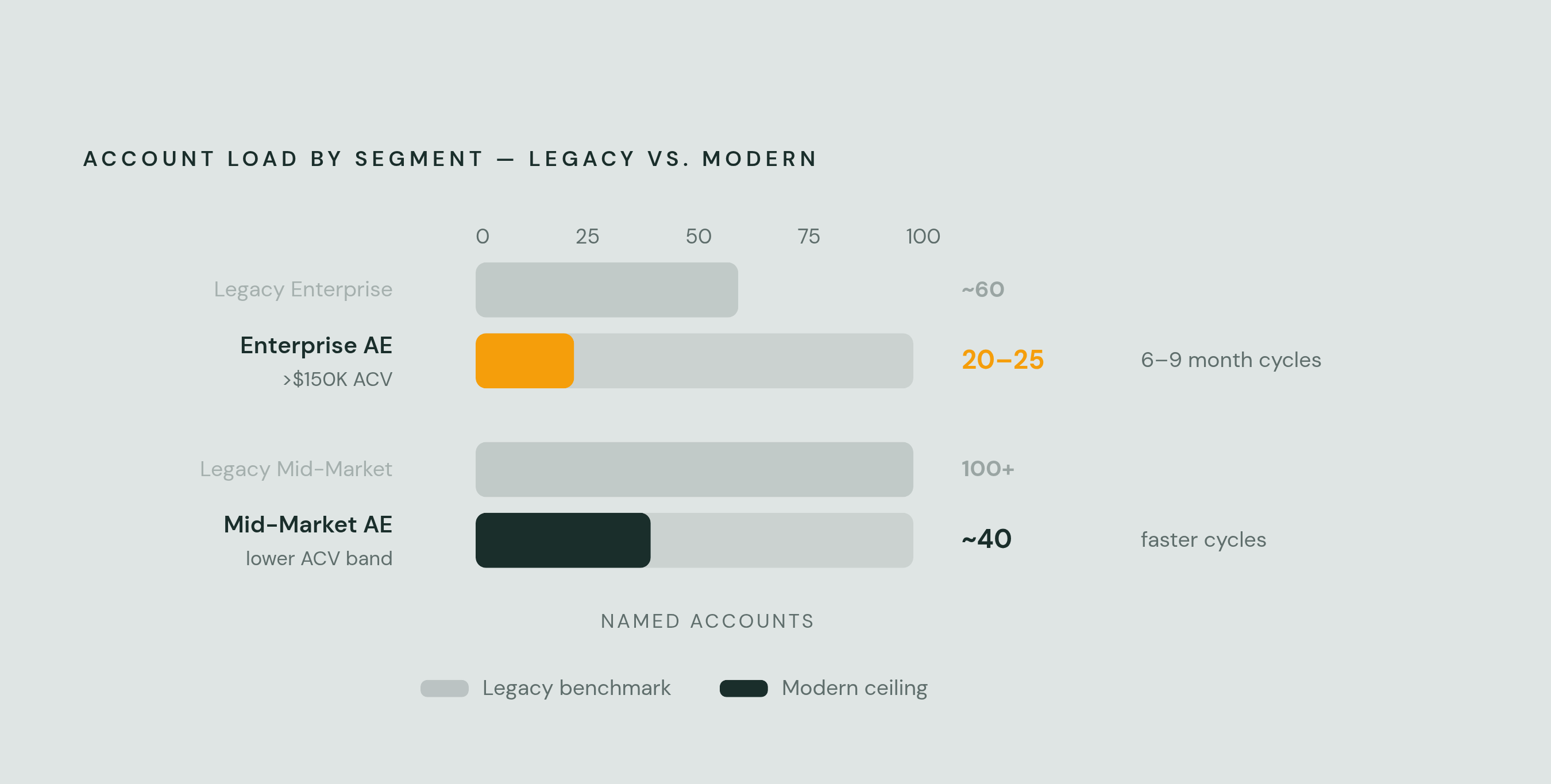
Account-load benchmarks that worked a decade ago no longer hold up, because buying committees have grown too complex for the old math to apply. The right territory size now differs sharply by segment and by average contract value, and getting this number wrong has direct consequences for how much time a rep can give to any single deal.
The old rule of allocating a hundred or more accounts to a mid-market AE assumed buying decisions moved fast and involved few people. Today's buying committees require deep personalization and multi-threading across multiple stakeholders, and that work consumes time an inflated account list simply does not leave available. Current benchmarks reflect that shift directly. Enterprise AEs working deals above $150K in annual contract value perform best with 20 to 25 named accounts. Mid-market AEs work a lower ACV band and their deals move faster than enterprise ones, but they still face a lower ceiling on account load than legacy benchmarks once suggested.
Enterprise territories carry a structural wrinkle: deal cycles running six to nine months mean a rep's first-quarter pipeline often doesn't close until the third quarter. One slipped large deal can take down an entire quarter's number on its own, so territory balance has to account for how deals are timed across the year, not just for total contract value potential sitting in the pipeline. A useful check on whether a quota is fair in the first place is the quota-to-OTE ratio. A healthy range is between 4:1 and 6:1. Once that ratio climbs above 8:1, the quota is probably structurally unfair no matter how well the territory itself was built.
Matching territory type to rep tenure and building capacity buffers
Sizing a territory correctly solves only part of the problem. Who holds that territory matters just as much, and every territory needs built-in room for new business or it eventually turns into a maintenance job.
Tenure should guide the assignment directly. Development territories built around shorter sales cycles and strong manager oversight, where accounts are clear and playbooks are already proven, suit reps in year one or two best. Reps in year three or four, typically at peak performance, belong in the highest-potential and most strategically demanding territories, the ones where relationship depth and deal complexity create a real defensible advantage. Reps in year five and beyond benefit from a territory refresh or a role change to keep them engaged, since staying in a well-known patch too long tends to produce coasting and, eventually, attrition. Pair newer reps with high-growth territories that reward hustle and fast learning, and pair veterans with complex, relationship-heavy territories that reward institutional knowledge and trust built over time.
Capacity needs its own rule, separate from tenure. Territories should be designed so that existing account management consumes no more than 60 to 70 percent of a rep's capacity, leaving the rest open for new business development. Without that buffer, a rep spends more and more time servicing existing accounts instead of hunting new ones, and the territory becomes growth-constrained. The buffer needs to be designed in from the start rather than added later once a rep's pipeline has already dried up, because that constraint builds gradually as accounts mature inside a territory.
Designing for a team that will be larger in twelve months than it is today
Territory design for a growing AE team has to account for headcount that doesn't exist yet, not just the reps already in seat. A plan optimized only for the current roster guarantees disruption the moment a new hire joins, because that hire has to come from somewhere, and carving a new territory out of an already-balanced map means touching accounts that existing reps have already built relationships around.
Building in growth from the start means treating the account universe as a pool to be redivided as headcount increases, rather than a fixed set of lines that gets redrawn under pressure each time a new rep starts. Signal-weighted opportunity data, the same data that replaces geography as the starting point for territory design, makes this redivision far less disruptive, because accounts can be reallocated based on current buying propensity. A model chosen to fit the sales motion, whether geographic, vertical, named-account, or hybrid, should also be one that scales cleanly: a vertical model built around industry expertise can absorb new reps by giving each one a slice of an existing vertical, while a named-account model has to plan explicitly for which accounts move to a new hire and which stay put.
The tenure framework and capacity buffer built earlier in this piece carry forward into growth planning. New hires need development territories from day one; a growing team has to keep a supply of shorter-cycle, lower-complexity accounts in reserve rather than handing every new rep the leftovers nobody else wanted. And the 60 to 70 percent capacity rule applies with even more force during growth, since a team scaling quickly needs its veteran reps focused on new business rather than buried in account management that a newer hire could be handling instead. A territory map built today should already have next year's reps in mind; the alternative is rebuilding the whole system under pressure, with headcount growth forcing a rushed, politics-driven redesign that produces unequal territories.
Sources
- Sales Territory Design & Optimization Guide 2026
- How to Create a Sales Territory Plan for 2026
- Sales Territory Plan: Build, Optimize & Scale in 2026
- Sales Territory Design: 2026 AE-to-Account Ratio Benchmarks
- How to Map a Sales Territory: Effective Strategies for 2026
- The Complete Guide to Sales Territory Management In 2026
- Sales Territory Design: A Practical Guide for 2026
- Master Sales Territory Planning: Best Practices for 2026