AI Recruiting Tools for Early-Stage Startup Hiring
Early-stage startups need AI recruiting tools built for capacity, not coordination.

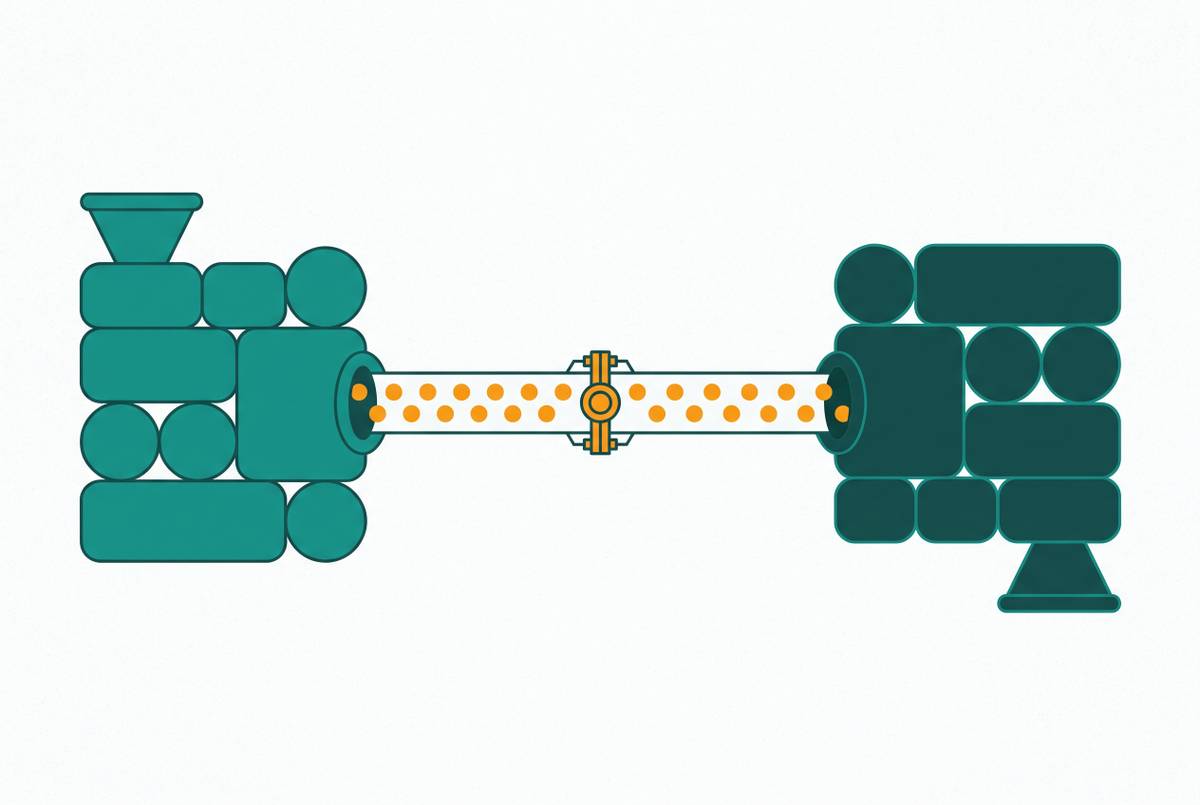
Most AI recruiting tools on the market were built for enterprise talent acquisition teams, and that origin story is the reason so many of them frustrate startup founders who try to use them. An enterprise deployment assumes four distinct roles: a sourcer finding candidates, a recruiter running the process, a hiring manager making calls, and a coordinator handling logistics. At a five-person startup, one person does all four jobs, often between customer calls and product work.
Wellfound's evaluation of the 2026 landscape draws that line clearly: an enterprise talent intelligence suite slows down a two-person recruiting team at a Series A company, while a sourcing-only tool leaves most of the actual hiring process untouched. Enterprise AI recruiting is dominated by categories like internal mobility, workforce planning, and orchestration across a large-org ATS, problems that belong to companies with thousands of employees and years of hiring history. Early-stage startups filling three to ten critical roles need speed to set up, per-position economics, and tools that replace absent headcount rather than coordinate existing headcount. It needs a tool that sets up fast, prices itself around actual hiring activity, and replaces headcount the company doesn't have rather than coordinating headcount it does.
That mismatch is the reason a generic "best AI recruiting tools" list misleads founders more often than it helps them. The tools built for large hiring committees solve a coordination problem. The tools a startup actually needs solve a capacity problem, and those are different problems with different answers.
The four capabilities that matter for a lean hiring team
Once the enterprise framing is out of the way, a different set of evaluation criteria comes into focus, four capabilities that map directly onto what a founder without a recruiting department actually lacks.
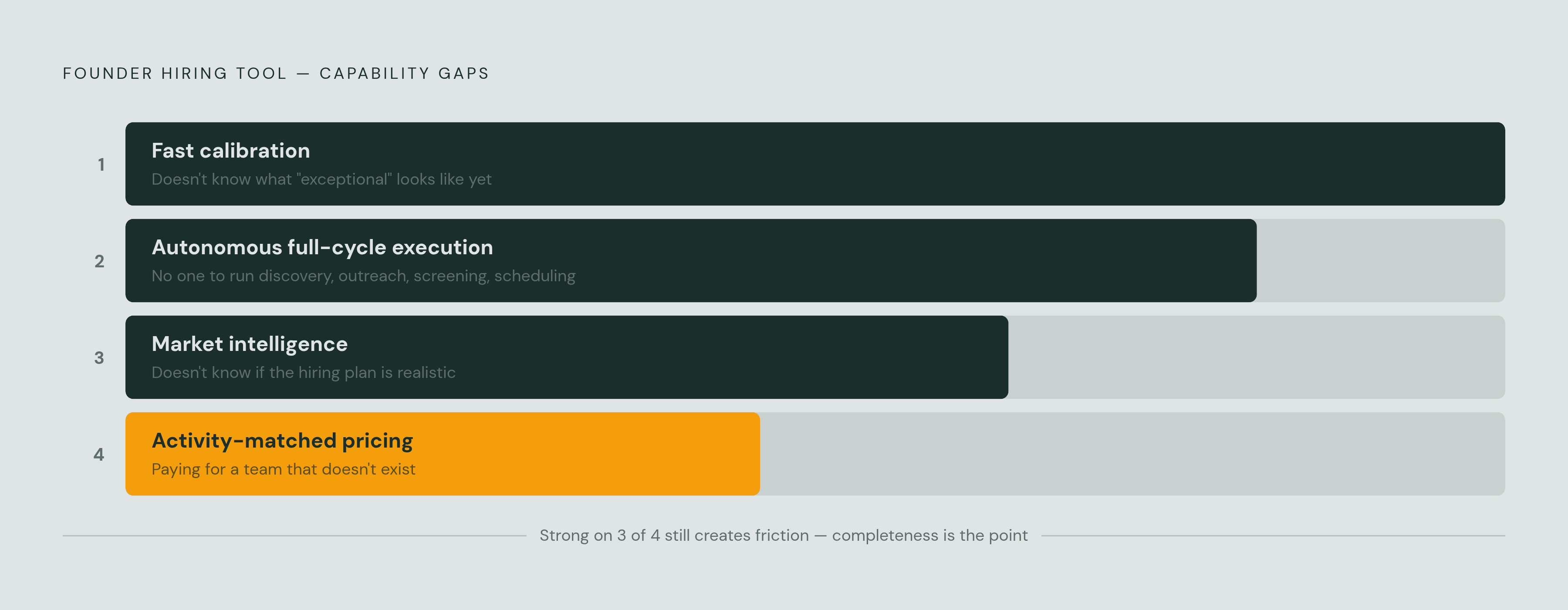
Fast calibration comes first. A tool has to learn what "exceptional" looks like for a specific team and a specific role quickly, without weeks of onboarding, because a generic keyword match can't score a bar nobody has defined yet. Autonomous full-cycle execution comes second. A founder without a dedicated sourcer needs candidate discovery, scoring, outreach, screening, and scheduling to run without constant hand-holding, because hand-holding is exactly the capacity a lean team doesn't have. Market intelligence is the third piece. Before a team spends weeks chasing a candidate profile, the tool should be able to say whether that profile exists at the salary and location the plan assumes.
Pricing that matches hiring activity is the fourth. Per-seat enterprise licensing charges for recruiter headcount a startup doesn't have, which is precisely backwards for a company trying to conserve runway. GoPerfect's 2026 guide for startup recruiting singles out per-position pricing as the model that actually lines up cost with hiring activity, rather than cost with team size.
None of these four are abstract features on a spec sheet. Each one answers a specific hole in a founder's week: not knowing what good looks like, not having anyone to run the process, not knowing if the hiring plan is realistic, and not wanting to pay for a team that doesn't exist. A tool that's strong on three of the four and weak on the fourth will still create friction somewhere in the hiring loop. Keep this in mind while evaluating any specific product, because vendors tend to lead with their strongest capability and go quiet about the rest.
Why calibration is harder than it looks
A tool cannot score fit against a bar that has not been defined, and for early-stage teams whose first five hires shape the entire culture, getting calibration wrong at the start compounds every subsequent mistake. Get calibration wrong at the start, and every hire after compounds the mistake rather than correcting it.
Wellfound's technical hiring guide notes that Wellfound's AI search enriches candidate profiles with missing skills and insights, going beyond surface-level keyword matching.
The same failure happens at the human level, in a deeper form. A recruiter who doesn't fully understand what a hiring manager values screens out strong candidates who don't look the part on paper, and passes through weak candidates who happen to carry the right credentials. That's a calibration problem specifically, not a software one, and software inherits it the moment it's handed a vague brief.
A founder might reasonably argue that a detailed job description solves this. It doesn't, not fully. A job description is a static document. It can't pressure-test itself against what the market actually looks like, and it can't sharpen itself after the third interview reveals that the team actually values something the original posting never mentioned.
Calibration-first tooling works differently. It learns the bar from the hiring manager directly, then updates that bar as interview feedback comes in, so every adjustment to the standard is visible rather than drifting silently over the course of a search. Good calibration feeds better sourcing, because the tool is chasing the right signal instead of a proxy for it. Better sourcing feeds better screening, because the candidates entering the pipeline already match what the team is actually looking for. Better screening feeds better hires. Skipping calibration, or rushing it, forces the entire chain to run on a guess instead of a defined target.
Talent market intelligence and realistic hiring targets in 2026
Knowing the internal bar solves half the problem. The other half is knowing whether someone who clears that bar exists, at the comp level, location, and timeline the hiring plan assumes.
The gap between what startups want to hire and what the market can supply is widening, especially for technical roles. Every venture-backed company wants engineers fluent with leading AI models, comfortable fine-tuning open-source options, and capable of wiring agents into production APIs. Supply hasn't caught up with that demand, so founders end up competing for a kind of talent that barely showed up on resumes five years ago. Bureau of Labor Statistics projections show data scientist employment growing at a rate that outpaces the available supply through 2034, and that scarcity is structural rather than a temporary market swing.
That's the reality a hiring plan has to be checked against, not just the general labor market. Recruiterflow's 2026 guide to recruiting tools points to Juicebox specifically for market-level insight, surfacing where candidates with a given skill set are actually located, how long they tend to stay in roles, and how deep the available pool runs at a given seniority level. That's the kind of information that tells a founder, before the search starts, whether a comp range or a location requirement is realistic.
Market intelligence works as a check before outreach begins, not a dashboard to admire after the fact. It's what keeps a startup from spending eight weeks searching for a candidate profile that simply doesn't exist in its geography at its budget. A tool that surfaces that mismatch in week one, before outreach even begins, saves a founder from the worst kind of cost: the kind that only becomes visible after the runway is already spent on it.
One might argue that market intelligence is a nice analytics layer but not a dealbreaker feature, yet it is what prevents a startup from spending eight weeks on a search for a candidate profile that does not exist in their geography at their budget. The tool that could have flagged that in week one just saved two months of runway and a demoralized team.
How credential-matching misses the builders startups need
Keyword and credential matching fails in two directions at once, and both directions cost a startup something real. The false-positive failure lets familiar titles and brand-name employers through because the tool recognizes the pattern on the resume, not because the underlying work actually matches the bar. The false-negative failure screens out a candidate who scaled infrastructure at a small, unknown company, changed industries mid-career, or took a non-linear path, because nothing on the resume trips the expected keyword.
Some tools are built specifically to close that gap by reasoning about outcomes and trajectory instead of pattern-matching on titles. Systems built around labeled patterns of career experience, rather than keyword frequency, can surface a candidate based on something like having scaled a team through a Series C round, or having driven growth in a declining market. Those are exactly the kinds of signals a keyword system has no way to parse. The more advanced versions of this approach combine sourcing with assessment and verification, so a candidate reaches a hiring manager already screened against outcome-based criteria rather than surface credentials. Wellfound's guide to technical hiring makes a related point about its own search: enriching candidate profiles with skills and context that go beyond what's written on the resume, rather than stopping at a surface-level keyword match.
None of this means AI screening is unreliable by nature. It means the evaluation question a founder should ask isn't "does this tool screen resumes." Every tool screens resumes.
The cost of getting this wrong lands harder on a small team than a large one. A bad early hire at a ten-person company reshapes the culture the next ten hires will step into, and it burns months of runway before the mistake is even visible. An enterprise absorbs one bad hire without anyone outside the team noticing.
The tools that cover the full hiring loop for teams without a dedicated recruiter
A handful of tools in 2026 are genuinely built for founders and lean teams running the full hiring loop without dedicated recruiting headcount, and they differ significantly in where they start and stop.
- Noxx is built to replace a traditional recruiting agency outright for seed-to-Series A startups hiring engineers or operators without a recruiter on staff. A founder uploads a job, and Noxx screens a large candidate pool using more than 40 AI signals, then delivers the top ranked matches within about a week.
- Truffle fits lean recruiting teams, founder-operators, and small owner-run agencies that hire the same roles repeatedly and face heavy applicant volume at the top of the funnel. It covers resume screening, one-way video interviews with AI match scoring, talent assessments, and shareable candidate summaries. Pricing runs on a credit basis with a free trial and no card required, and it carries a 5.0 rating on G2.
- Wellfound combines AI sourcing, applicant review, a free ATS, and optional managed recruiting in one platform, aimed at startup and growth-stage teams hiring software engineers, ML engineers, data scientists, and product managers. Its candidate pool is concentrated in tech and startup talent specifically. Paid plans are available, and managed sourcing requires a conversation with sales.
- Juicebox, also known as PeopleGPT, offers AI-native sourcing through plain-English search across profiles pulled from over 30 data sources. It has no built-in applicant tracking system. ATS integrations exist with more than 41 systems, but they're export-based and gated to the Business plan, so a team still needs a dedicated ATS for full candidate tracking. A free tier is available alongside paid plans, and it suits founders doing their own sourcing who want a fast search tool without built-in outreach automation.
- Manatal is an ATS with AI-powered sourcing and scoring built in. Being all-in-one means fewer tools to juggle, though its sourcing is less powerful than a dedicated AI sourcing agent. It fits early-stage startups that need an ATS with basic AI features rather than a specialized sourcing engine.
- Collective runs full-cycle, pairing an autonomous AI sourcing agent called Sherlock with multichannel outreach across WhatsApp, email, and chat, inbound job distribution across more than 25 channels, and ATS integration with over 50 systems. It surfaces candidate availability status, salary data, direct contact information, and freelance indicators, and it's used by recruiters operating at scale.
The differentiator across this list isn't quality. It's coverage. Some of these tools handle sourcing and stop there, leaving scheduling and tracking to whatever system a founder bolts on afterward. Others run the full loop from the first outreach message to the offer letter. A founder's job is to map the actual bottleneck before picking a tool. A sourcing tool solves nothing if the real friction in the process is getting candidates scheduled, and paying for sourcing depth nobody needs is money that could have gone toward the part of the loop that's actually broken.
For a team with no recruiting infrastructure at all, a rough sequence tends to work better than adopting everything at once: make the pipeline visible first, with defined stages and scorecards for each role. Standardize early screening next, using structured questions, where asynchronous video tends to make candidates easier to compare against each other. Automate scheduling and reminders last. That step usually delivers the highest return of the three, because it eliminates the calendar back-and-forth that eats more founder time than almost anything else in the process.
Where human judgment stays essential
None of this adds up to AI running hiring end to end with no human involved, and founders who treat it that way are taking on a specific, avoidable risk. The agentic shift in recruiting automates the right tasks, but the highest-stakes decisions in early-stage hiring stay irreducibly human, and founders who delegate calibration entirely to AI tools risk optimizing for the wrong bar at the worst possible moment.
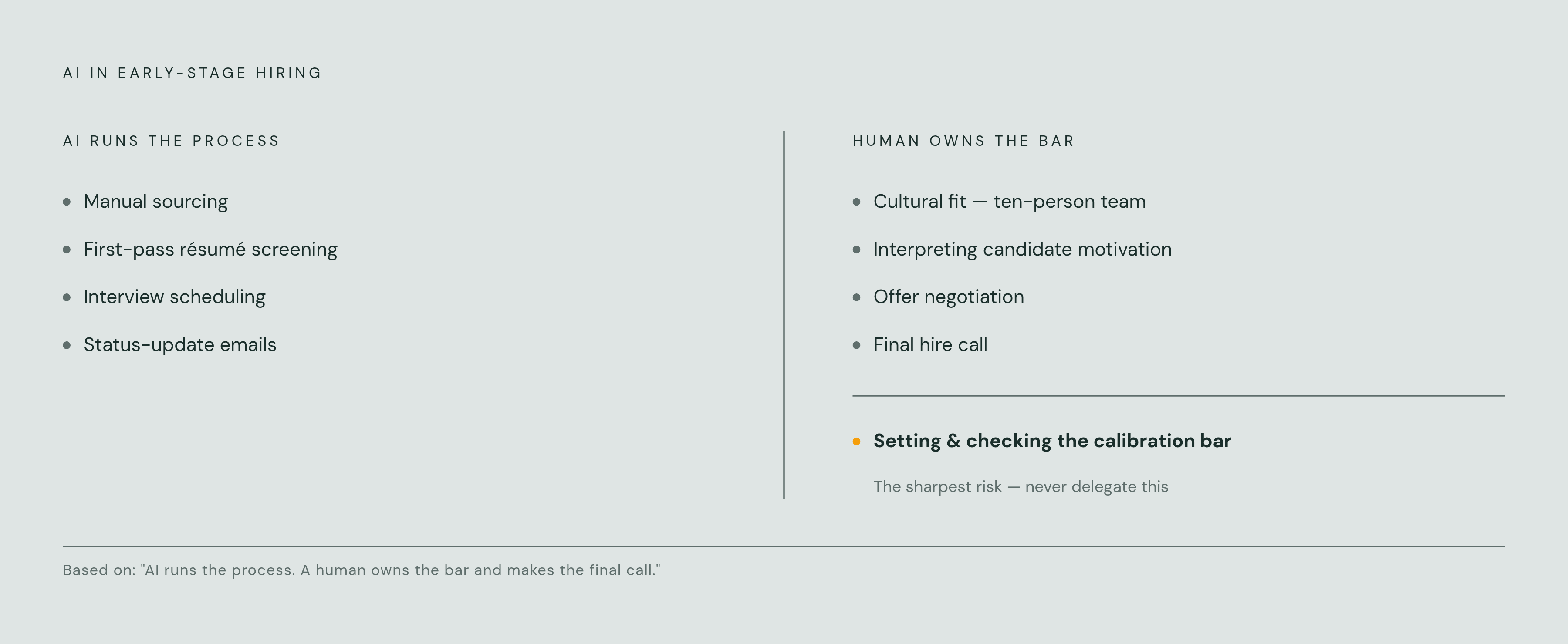
The part of the job that's genuinely automatable is well understood: manual sourcing, first-pass resume screening, interview scheduling, and status-update emails. These are tasks that eat recruiter time without ever requiring recruiter judgment. The World Economic Forum projects the share of tasks handled by humans alone to fall significantly by 2030, split between tasks that go fully automated and tasks that shift into human-machine collaboration. In recruiting specifically, the collaboration model is the one that holds up in practice, not full automation.
Certain decisions stay irreducibly human, no matter how good the tooling gets: reading cultural fit for a ten-person team, negotiating an offer, interpreting ambiguous signals about why a candidate really wants the role, and making the final call on who gets hired. No model knows what a team actually needs until a human on that team has put it into words.
The sharpest risk for an early-stage team is a founder handing calibration itself over to the tool and letting it settle on the wrong bar without anyone checking it. The first five hires at a startup carry too much weight to let that drift happen unchecked at any stage of the process. SHRM's description of 2026 as the year autonomous agents move from the margins to the mainstream is accurate as far as it goes, but the story it's telling is about agents handling execution, not agents replacing human judgment at the decision layer.
The cleanest way to frame the division: AI runs the process. A human owns the bar and makes the final call. Any tool that blurs that line, even one that executes brilliantly, is handing over a decision that was never the software's to make.
Compliance and data privacy risks lean teams overlook when adopting AI hiring tools
Speed and capability aren't the only criteria that matter when a lean team adopts one of these tools. Legal exposure follows close behind, and it tends to be the piece founders without in-house counsel think about last, usually right after a problem has already surfaced rather than before.
Hiring tools that score, rank, or filter candidates touch the same anti-discrimination protections that apply to any other hiring decision, automated or not. A screening algorithm that systematically down-ranks candidates from a protected group creates liability for the company using it, regardless of whether a human ever reviewed the individual decision. That exposure doesn't disappear because a vendor built the model. Responsibility for the hiring outcome still sits with the company making the offer.
Data privacy adds a second layer. Tools that pull candidate data from hundreds of millions of profiles, run enrichment on top of resumes, or store video interview footage are handling personal information that carries its own regulatory obligations, obligations that vary depending on where candidates are located and where the company operates. A lean team evaluating a new tool should ask what data the vendor stores, how long it's retained, and whether candidates were ever told their information would be used this way.
None of this is a reason to avoid AI recruiting tools. It's a reason to read the contract before signing it, and to ask the vendor directly how scoring decisions are made and how candidate data is handled, rather than assuming the tool's speed and polish mean the compliance questions have already been answered somewhere upstream.