Automating the Full Sales and Marketing Hiring Loop Without a Recruiter on Payroll
Agentic AI can run the hiring loop if founders define "exceptional" first.
Agentic AI can run sales and marketing sourcing, outreach, screening, assessments, and scheduling without a recruiter on payroll. The condition is a calibrated definition of “exceptional” for the role. For a startup, the workable model is an automated process with human judgment at defined handoffs, including approval of candidates, changes to hiring criteria, and the offer conversation.
Why running sales and marketing hiring without a recruiter keeps failing the same way
The account executive interviewed beautifully but could not close. The demand generation hire had every right brand on their résumé but had never owned a number. These are the failures that make founder-led hiring feel unpredictable. Presentation and credentials stood in for evidence of fit.
A founder drafts a job description, posts it, and hands it to a tool, treating a credential checklist as an actionable hiring standard. But “Account Executive” might describe inside sales at one company and predominantly field-based work at another. A recruiter historically translated those distinctions through an intake conversation. Without that translation, an autonomous system inherits the ambiguity and applies it across a larger pool.
What AI can handle sourcing, interviewing, and scheduling without a human recruiter?
Agentic AI makes this operating model plausible in 2026 because it can execute a multi-step workflow autonomously. Assistive AI speeds up a task that a person still directs. An agentic system takes a series of linked steps toward a goal and reports back. That distinction changes how much coordination a founder must supply, although it does not remove the need for approval.
AI sourcing searches profile databases and ranks candidates against a defined profile, while outreach adapts content, tone, and timing to response behavior. Voice or chat agents run structured screening, including outside business hours, and keep notes and summaries. Self-scheduling agents find times when people are free, while interview support transcribes live conversations and puts evaluation notes into a set format. These capabilities describe a workflow.
Why calibration has to happen before any automation starts
If sourcing rewards employer names while screening rewards fluency, neither stage can reliably identify someone who will succeed in the actual role. Calibration makes the hiring manager’s implicit preferences explicit enough for a system to use. It is the work of deciding which evidence distinguishes an exceptional candidate from a persuasive one.
Is the sales role fully inbound or outbound-dominant? What is the typical sales cycle, and what proof would show that someone can perform in a comparable cycle? Does the rep face a technical buyer, an economic buyer, or both? A worked example can reveal whether the candidate understands that buyer.
Early-stage roles need a further distinction. A strong closer may still be wrong for a job that includes non-sales work, requires curiosity, and changes as the business learns. Marketing has its own version of this mismatch. A Head of Demand Gen at a Series A with a modest budget does not face the same job as someone with that title at a Series C with a large budget and a team. Calibration identifies which conditions the candidate must have handled and which they can reasonably learn.
AI fluency also belongs in this conversation where it affects the job. A seller who uses AI for account research and meeting preparation without surrendering judgment offers different evidence from one who cannot. The founder must decide whether to make that difference part of the hiring standard. The output is a written profile that connects requirements to evidence, giving automation the translation layer an experienced recruiter would otherwise supply.
How talent market reality should push back on the hiring plan before sourcing starts
An internally coherent profile can still be unattainable. Before sourcing begins, a live market scan can check whether people in the target geography and function fit the profile at the pay the company has planned. Otherwise, a thin pipeline or rejected offer may expose a mismatch that was present at intake.
Pave provides live benchmarks for base, variable or bonus, and total cash from peer companies that can be filtered by funding stage and industry. Even when base pay is appropriate, variable structure, quota expectations, and equity packaging can weaken the offer. If the pool is too narrow, skills-first hiring can broaden it, but only when calibration has already defined demonstrated ability.
Running AI-powered sourcing for sales and marketing candidates without a recruiter touching it
With that groundwork done, natural-language searches across large candidate databases can find people who would be missed by a title filter. Scoring can favor someone who sold to the right buyer at a smaller company over someone from a famous employer with only adjacent experience. Existing candidate databases can also yield people who fit a new opening. Outreach then follows the same calibrated profile, with sequences that adapt to responses.
An unsuitable candidate who reaches an interview is visible, but a strong candidate excluded during sourcing may never receive a second look. If the scoring standard rewards pedigree, the marketer who built pipeline at a small company can disappear before their results are considered. The same exclusion can recur in later searches. Evidence-based scoring and periodic review of screened-out candidates are therefore safeguards against losing precisely the non-obvious people a lean team hoped AI would find.
Automated screening and AI interviews that evaluate sales and marketing fit, not presentation
A great interview can still lead to a bad hire. Sales candidates are practiced at persuasion, so fluent answers are especially weak substitutes for proof of performance. Automated screening helps only when its questions and scoring separate the two.
For sales, the useful evidence includes quota attainment in a comparable deal cycle, the actual buyer involved, and how the candidate handled a stalled or lost deal. For marketing, it includes pipeline generated, cost per lead in context, and whether the candidate built a program or inherited an established one. AI can apply the same structured criteria across candidates and preserve a consistent evidence record for the hiring manager.
Skills assessments can run in parallel with screening, but they need to reflect the actual job. Outside-hours conversations can also make participation easier for candidates with current jobs or different time zones. Neither convenience nor consistency makes the scoring inherently fair. The criteria still need to be open to audit, and people must review candidates before final rejections, as bias audits and documentation become basic legal requirements in multiple jurisdictions.
Scheduling, candidate engagement, and moving finalists through the loop without admin overhead
Once a candidate moves forward, finding a time to meet should not take up the attention needed to judge their fit. AI self-scheduling lets candidates book against real-time interviewer availability and handles rescheduling, reminders, and confirmations. Automated status updates and next-step communications can prevent the silence that causes candidates to disengage. This is a clear use for automation.
A sales candidate waiting through a week of silence may read the hiring process as evidence of how the company follows up with prospects. A marketer may read it much the same way as a sign of how the team works together. Automation can keep logistics moving, but it cannot replace the personal investment a finalist needs to feel. The founder or hiring manager still has to conduct the closing call and offer conversation.
What must stay human in a fully automated sales and marketing hiring loop
If the process runs itself, what is the founder doing? Evaluating whether the evidence supports hiring this person for this team at this moment, then building the relationship that helps the candidate choose the company. That is a different use of time from coordinating interviews. The shortlist comes with evidence attached.
Changes to the standard also require human judgment. Interview feedback may show that the role needs more PLG experience than first planned, or talks with candidates may reveal weaknesses in how the pay is set up. Those revisions should be visible, documented, and human-approved before being incorporated into scoring. At the close, the founder must explain the vision, compensation, and growth path personally. The human role has always been judgment and relationship, and automation removes the administrative noise that obscured it.
Where most DIY automated hiring setups break down and how to avoid each failure
A practical diagnosis starts with where the mismatch appears. If the shortlist looks credentialed but irrelevant, the fix is a structured intake before another search runs. If suitable candidates are scarce or offers fail to align with expectations, the profile and compensation need a live market test. Sending more outreach messages will not solve either problem. The correction belongs upstream of the symptom.
Another way the process can fail is when polished candidates pass screening without proof that they have done well in comparable work. The remedy is to probe owned outcomes and job-specific work. Rejections deserve scrutiny too. Periodic review of screened-out candidates, especially those near the threshold, can reveal whether the system is discarding strong but unfamiliar profiles. Auditable scoring logic and a human review point before rejections are finalized also address the compliance risk of leaving consequential decisions unexamined.
Fragmentation can undermine otherwise sound parts of the process. Sourcing may run in one tool, screening in another, and scheduling in a third, with no system preserving the full candidate picture. The founder then becomes the coordinator automation was supposed to replace. To avoid that failure, the calibrated profile must remain the shared standard across stages, with a clear handoff protocol and human-approved changes. The test is not how many tasks each tool automates, but whether the evidence and criteria survive the transitions.
What a founder-run hiring loop looks like when it's working end to end
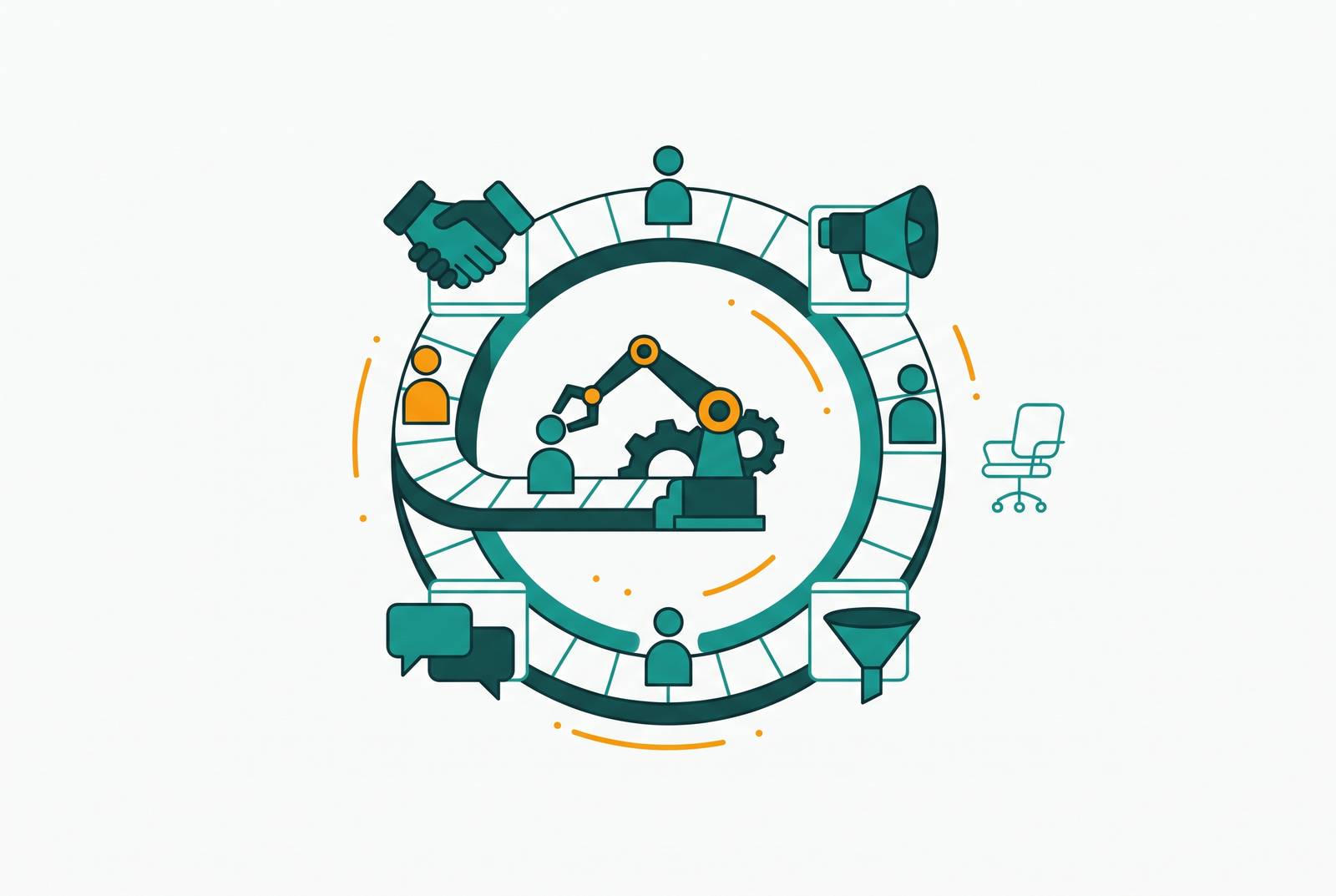
A working loop begins with a brief calibration meeting that produces a written definition of exceptional for the specific role. A market scan then tests the profile and compensation before sourcing starts. AI runs the search, outreach, structured screening, assessments, and scheduling against that standard. The founder reviews the resulting shortlist with evidence attached, approves candidates or revisits the criteria, and meets the people worth meeting.
From there, AI handles the logistics between meetings and the offer while the founder conducts the offer conversation personally. The profile should become more precise with use. A healthy loop therefore leaves the team with more than a completed hire, because it preserves what the interviews taught about success at that company. The next search begins with that knowledge.