Scoring Rubrics for Subjective Hiring Criteria Like Culture and Drive
Turning vague gut checks into measurable behaviors cuts hiring misfire costs and legal risk.
Most hiring loops treat culture fit and drive as gut checks, something an interviewer either senses in the room or doesn't. That instinct is the whole problem. Both traits break down into specific, observable behaviors, and skipping that step is the single biggest reason a hiring loop falls apart six months after the offer letter goes out.
Cowen Partners found that culturally aligned teams see 35% less turnover and 22% higher productivity than teams hired without that lens. Run the arithmetic on turnover alone: at an average cost-to-fill near $4,000, cutting attrition by 35% recovers real budget every single year, compounding across every role the rubric touches. A bad culture-fit hire carries substantial downstream costs at every level, from entry-level backfill expenses through executive search fees and severance that can far exceed the original salary.
The legal exposure is what nobody wants to put in writing. "I just didn't feel like they'd fit in" "I just didn't feel like they'd fit in" is not a hiring rationale, but an opening line for a discrimination claim. Unstructured evaluation doesn't just create legal risk in the abstract either: it systematically disadvantages candidates from underrepresented groups, because "vibe" rewards familiarity over merit almost every time someone uses it as a filter.
Call the rubric what it actually is: retention insurance, productivity insurance, and legal insurance, bundled into one document that costs almost nothing to build against what it prevents.
Culture fit versus culture add, why the framing choice shapes what you can measure
Get the definition right before anything else, because most teams get it wrong at the starting line. Culture fit means alignment with values, behavioral style, and work philosophy. It has nothing to do with personality similarity, shared hobbies, or whether a candidate laughs at the same jokes in the room, and treating it that way is how monoculture creeps into a hiring loop disguised as chemistry.
Three dimensions deserve real measurement. Values alignment asks whether a candidate's decision-making logic matches what the organization says it prioritizes, and separately, what it actually rewards day to day (those two aren't always the same thing, which makes a good direct interview question on its own). Behavioral style asks how someone acts under pressure, in conflict, or when handed autonomy with nobody checking in. Work philosophy asks whether their instincts on collaboration, accountability, and feedback match how the team actually operates, not how the handbook describes it.
Most teams pick the wrong target. Culture fit, framed as mirroring, produces teams that agree with each other fast and rarely challenge anything out loud. Culture add, framed as contributing what's missing, builds diverse, high-performing teams without giving up coherence on values. An engineering firm scoring candidates only on "teamwork" is measuring fit. The same firm adding a rubric line for "challenging perspectives in a constructive way" is measuring add, and that second line is usually where the more inclusive hiring outcome actually comes from.
McKinsey's diversity research backs this at scale: companies in the top quartile for ethnic and cultural diversity outperform bottom-quartile companies on profitability by a wide margin. Monoculture hiring, dressed up as culture fit, erodes that advantage one homogenous hire at a time, and it rarely looks like a mistake from the inside. Deloitte found that 94% of executives and 88% of employees say a distinct workplace culture matters to business success, and that belief is a starting point, not a measurement standard. The rubric is what turns it into something a hiring manager can actually defend in a debrief.
Swapping fit for add isn't semantic housekeeping. It changes what questions get written and what a high score looks like on the page, which is the entire point of making the switch.
Decomposing culture and drive into scoreable behavioral competencies
Don't lift bullet points from the job posting. Translate vague responsibilities into behaviors an interviewer can watch for and write down in real time, while the candidate is still talking.
Competencies split into three buckets. Technical skills are the hard, teachable abilities, least relevant to a culture or drive rubric. Behavioral traits cover the softer, more innate qualities: problem-solving, adaptability, communication under pressure. Cultural alignment is the messiest bucket, and the one most teams botch, because it's where "vibe" sneaks back in wearing a rigor costume.
Three behavioral traits belong in every interview, from entry-level through the C-suite. Accountability asks whether the candidate owns their work and its outcomes, including the parts that went sideways. Curiosity asks whether they're actually driven to learn something new or just saying so because it sounds good in the room. Collaboration asks whether they seek out input and make the people around them better at their jobs.
Drive decomposes into two observable indicators. Persistence appears in how someone describes overcoming a real obstacle or chasing a long-term goal despite setbacks. Achievement orientation is visible in a track record: concrete goals set and exceeded, or a clear pattern of upward movement over time.
None of this needs inventing from scratch. Instruments like the Intrinsic Motivation Inventory, the Achievement Motivation Scale, and Self-Determination Theory scales already give evidence-based behavioral benchmarks for drive, not conceptual categories floating in a slide deck. Intrinsic motivation is considered the strongest predictor of high performance, so it belongs at the center of a drive rubric, not at the edges.
What signals drive shifts by generation, too. Gen Z (47%) and Millennials (43%) report being most motivated by work that aligns with their values and sense of purpose, while Gen X (35%) and Baby Boomers (29%) weight different drivers more heavily. A rubric question might need to open a different behavioral window depending on who's sitting across the table, even while it tests the same underlying trait underneath.
Map each core value to at least two specific interview questions. That mapping forces the value to actually get tested instead of assumed. Then validate the whole list against reality: ask current top performers what actually makes someone succeed in the role, not what the handbook claims about it.
Building the scoring scale, what behavioral anchors look like in practice
A scale only works if every number means the same thing to every interviewer in the room. Pick a range, 1 to 5 works well, and define each point in behavioral terms, not adjectives like "good" or "strong," which mean whatever the reader wants them to mean that day.
Greenhouse Software's 2026 guide found that rubrics scored on defined scales, backed by concrete behavioral evidence, filter out misaligned candidates far more effectively than unstructured conversation. Concrete behavioral evidence means a specific incident, described in the candidate's own words, mapped onto a defined anchor. It is not an interviewer's impression that someone "seemed like a team player."
Take Teamwork as the example row. A 1 (Unsatisfactory) rarely collaborates or listens, interrupts frequently. A 3 (Meets Expectations) shares ideas, listens respectfully, supports group decisions even when they don't go their way. A 5 (Exceptional) actively builds consensus, mediates conflict, and elevates the people around them.
The same logic extends to culture and drive. For Accountability, a 3 might mean the candidate can describe a mistake and what they did to fix it. A 5 might mean they flagged the mistake before anyone else caught it, then changed a process so it wouldn't repeat. For Persistence, a 3 might describe sticking with a hard project to completion. A 5 might describe pursuing a goal across multiple failed attempts, adjusting the approach each time instead of repeating the one that didn't work the first time.
Anchors describe observable behavior, never inferred traits. "Described a time they reversed course after peer pushback, and explained what changed their mind" is scoreable. "Shows humility" is a conclusion wearing an observation's clothes, and two interviewers will read two completely different answers into it.
Scores sum or average into a final call: Strong Hire, Hire, or No Hire. Different seniority levels can weight certain competencies more heavily, so a senior candidate's Achievement Orientation score might carry more weight than an entry-level candidate's, since the evidence base behind it runs thicker.
Bias review belongs inside the rubric-building process itself, not tacked on after the fact. Any criterion that could disadvantage a protected group needs to get pulled before the rubric goes live, and a documented behavioral rationale survives legal scrutiny in a way "didn't feel right" never will.
Writing behavioral interview questions that feed the rubric
A rubric with no matching question is a filing cabinet with nothing in the drawers. Every culture-fit or drive question needs to be behavioral, and it needs to score against a specific rubric row, not a general impression of how the conversation went.
"Tell me about a time you disagreed strongly with your manager. What did you do?" tests something specific and produces a scoreable answer. "Would you be a culture fit here?" tests nothing at all, and it hands the candidate an easy invitation to guess what the interviewer wants to hear.
Each question ties to exactly one competency and one anchor. Interviewers should know, walking in, which question on their list maps to which row on the scoring sheet, not figure it out afterward while trying to remember what someone said forty minutes earlier.
For drive specifically, questions need to pull real examples, not hypotheticals. "What would you do if a project stalled?" invites a rehearsed, generic answer. "Tell me about a project that actually stalled, and what you did next" forces a real one out.
Culture add deserves its own question slot, kept separate from fit. At least one question per panel should ask what the candidate would bring to the team that's currently missing. That single question generates evidence on a dimension fit-only rubrics never touch.
Motivation gets tested indirectly, through how a candidate responds to obstacles, how they relate to recognition, and how they react to feedback that stings a little. Those three angles surface more honest signal than asking someone to self-report how motivated they claim to be.
STAR (Situation, Task, Action, Result) gives every behavioral answer a structure that maps cleanly onto an anchor. The scaffolding keeps a rambling answer scoreable instead of letting it wander past the point.
Assign each interviewer a defined subset of competencies rather than handing everyone the whole rubric. That stops five people from all asking about teamwork while nobody asks about persistence, and it covers the full rubric without duplicating questions and burning interview time.
Calibrating interviewers so the same standard applies to every candidate
A well-designed rubric still fails if four interviewers read it four different ways. Calibration is what separates a structured process from a structured-looking one that produces the same old inconsistency, just with a fancier spreadsheet attached.
Aptitude Research found that one in three companies aren't confident in their own interview process, and one in two say they've lost a quality hire because of it. That's half of all companies admitting the process itself cost them talent, not the market, not a thin candidate pool.
SHRM's 2025 Recruiting Benchmarking Report put average nonexecutive cost-per-hire at $5,475, and NACE's data found it takes 27 days on average from interview to offer. A broken debrief loop, where scores don't mean the same thing across the panel, sits quietly on top of every open req a company runs.
Run calibration before real candidates ever enter the loop, not after a bad hire prompts a postmortem. Give each competency a 1-to-5 scale with concrete examples of what a 3 versus a 5 looks like, written down, not just discussed once in a meeting and forgotten by Friday. Have the whole panel score the same one or two anonymized past candidates as a dry run, then reveal scores together and talk through the outliers. The goal is finding out where one interviewer's 3 quietly means another interviewer's 5, and fixing that gap before it costs a real candidate their shot. It's finding out where one interviewer's 3 quietly means another interviewer's 5, and fixing that gap before it costs a real candidate their shot.
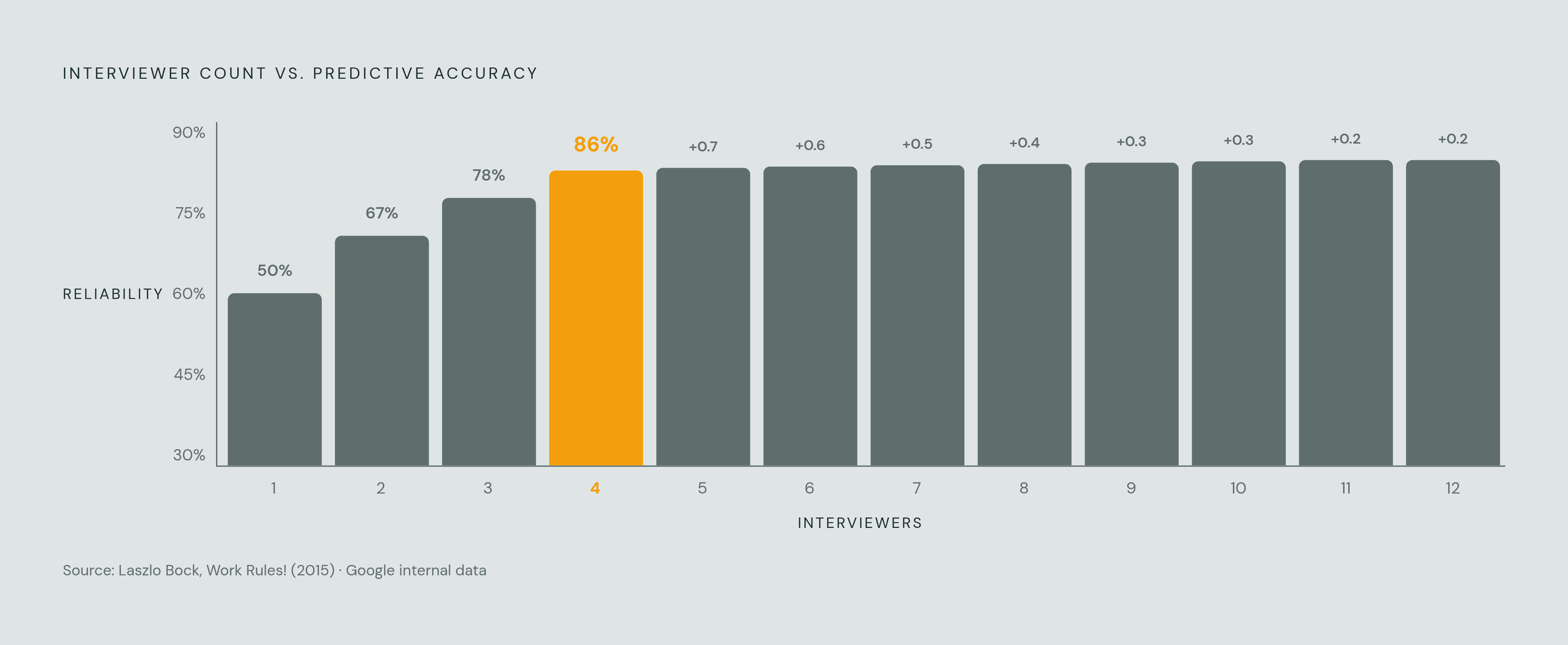
Laszlo Bock's Work Rules! (2015) documented Google's internal finding that four interviewers were enough to predict a new hire's performance with 86% reliability. Interviewers five through twelve each added less than 1% of additional accuracy. The leverage was never in adding more people to the panel. It was in getting the first four to agree on what they were actually evaluating.
Score drift is a known failure mode: after several hires in the same role family, average scores tend to inflate or compress over time, and both directions are bias signals, not evidence of a maturing process. After several hires in the same role family, average scores tend to inflate or compress over time, and both directions are bias signals, not evidence of a maturing process. Quarterly calibration sessions, where the panel re-scores a known strong past hire's interview and compares notes against the original scores, catch bar drift before it becomes the new normal. Recalibration matters most when hiring volume climbs, since a hiring manager under pressure to fill a role fast will lower the bar without ever noticing it happened.
Timing matters too. Train every panelist on the rubric before the interview, not during it, and debrief immediately after, since memory of a specific answer fades fast, often within a day. Watch for one dominant voice steering the whole panel toward consensus before quieter interviewers share their actual scores. Track inter-rater reliability over time as a rubric health metric: low agreement between scorers points to a rubric that needs refinement.
Using AI-assisted hiring tools to enforce and sharpen the rubric at scale
SHRM data shows AI use across HR functions reached 43% in 2026, up from 26% two years earlier, with recruiting the single most common use case, showing up in 27% of organizations. That curve says something plain: teams want the consistency a tool can hold that a person, running on memory and mood after the ninth interview of the week, sometimes can't.
The bigger shift for 2026 is what kind of AI gets adopted. It's what kind of AI gets adopted. Deloitte's Global Human Capital Trends report describes a move from assistive AI, the kind that suggests an action to a human, toward agentic AI that executes multi-step workflows on its own, managing entire candidate pipelines end-to-end and knowing when to hand a decision back to a person.
For rubric-based hiring, that shift lines up with a short list of real jobs. AI can capture rubric scores automatically across every interview and surface which competencies actually correlate with outcomes down the line. It can flag scoring drift before it compounds across a hiring season, catching inconsistency a quarterly human review would miss. It can run structured interviews and technical assessments against defined competency anchors, cutting out the variability that comes from different people asking different follow-up questions on different days. It can feed rubric signals back into the sourcing brief itself, since candidates who advanced share specific competency signatures and candidates who didn't share specific gaps, sharpening the funnel before the next req even opens.
That list explains why Korn Ferry's 2026 data found that 84% of talent acquisition leaders plan to use AI in 2026, with 52% planning to add AI agents to their teams. AI is saving recruiting organizations an average of 20% of the work week, over eight hours, equivalent to a full workday, freeing recruiters from process administration so that time goes toward the judgment calls and relationship-building that still need a person in the room.
None of this replaces the rubric. It enforces the one a team already built, at a scale and consistency no calendar of quarterly calibration meetings can match working alone.