The Recruiting Loop Is a Founder Distraction Until One System Owns Every Step
An AI hiring manager can cut founder handoffs, not judgment.
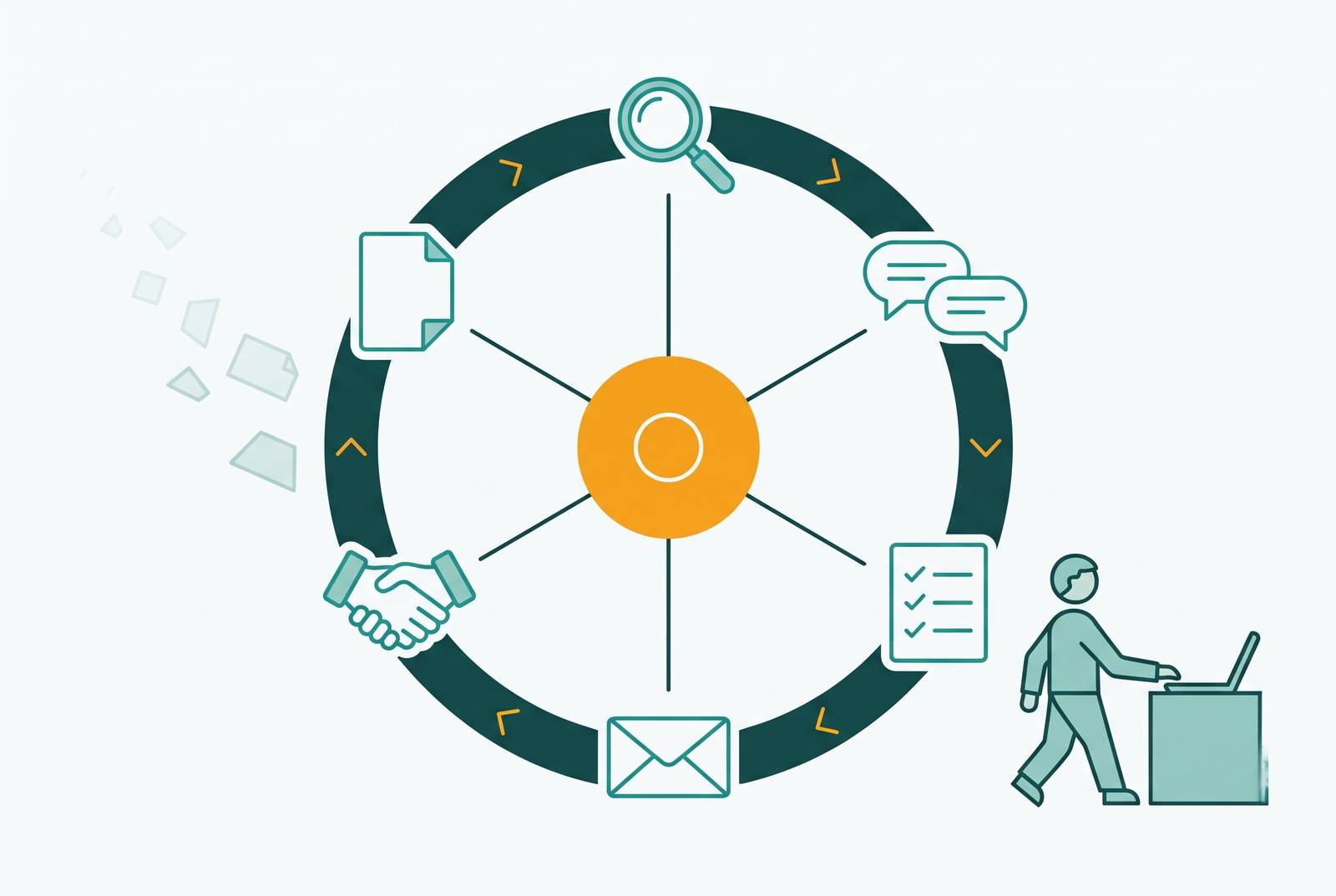
An AI hiring manager can run sourcing, screening, interviewing, scheduling and ATS updates as one system that shares hiring criteria, evidence about candidates and decisions across the full recruiting loop, while people make the calls that need careful judgment. This removes the founder’s handoff work.
Why recruiting feels like a founder tax, and what actually causes it
A Tuesday set aside for building the company becomes a Tuesday spent writing candidate notes, reformatting profiles and chasing interview slots. A promising candidate needs a summary for the interviewer. An interview has happened, but the spreadsheet still needs updating. None of this is the work of deciding who can do the job.
The cause is a chain of context resets. Intake, sourcing, screening, interviewing, calibration and offer have historically belonged to separate tools, each holding only part of the hiring story. The resume parser does not talk to the applicant tracking system, or ATS, and the ATS does not talk to the scheduler. Interview feedback sits in Slack threads while reports take days to compile. Someone has to reconstruct the whole picture.
For a startup without an HR team, that someone is often the founder. Each handoff can mean entering the same name twice as well as explaining why a candidate was chosen and what the team still needs to find out. Those explanations show how the team judged whom to hire. The next person having to recover explanations that do not travel with the candidate is a systems problem, and speeding up one isolated task leaves its cause intact.
What agentic AI actually means, and why 2026 is when it became a real option
Agentic AI describes a system that pursues a goal across multiple steps rather than waiting for a person to request each action. X0PA’s 2026 agentic AI guide explains how a perceive-reason-act-remember loop works. The agent reads the current state of the funnel, reasons toward the hiring goal, takes an action and uses the outcome to inform the next step. Memory is part of the mechanism.
This differs from both a script and a generative AI tool. A script follows a preset sequence, while generative AI supplies content such as a job description or drafted email. An agent connects decisions to actions across the workflow. Older AI might suggest a candidate who matches the role and leave it to a recruiter to make the next move. Given a hiring goal, an agent can find candidates, contact them, schedule interviews and update the ATS without a separate instruction for every step.
Why did this become a practical option in 2026? KPMG’s Q3 2025 AI Quarterly Pulse Survey found that enterprise AI-agent deployment across functions jumped sharply in six months. Korn Ferry’s 12th Annual Talent Acquisition Trends found that a majority of talent leaders planned to add autonomous agents. Those findings show that more teams are using agents or plan to, but they do not prove that every product works. The useful distinction remains whether a system can act on shared context, rather than merely offer more AI features inside disconnected tools.
How context loss breaks each stage of the recruiting loop in sequence
The first leak appears in sourcing, before anyone has spoken to a candidate. A keyword search can miss someone who “built the frontend for a Series B fintech” when the agreed criterion is “startup background”. The connection is clear to a person who understands the role, but that understanding may exist only in the searcher’s head. Titles and phrases become substitutes for evidence. The candidate pool then reflects the query more than the hiring brief.
Screening inherits that mismatch if the sourcing rationale disappears. A screener re-reads the job description and reconstructs the criteria, perhaps producing a structured score that does not reflect what the team agreed. Tableau experience may support a requirement for “data visualization” even when the résumé lacks that phrase. Recognizing the relationship requires context. Without it, a ranking can look orderly while answering the wrong question.
Scheduling adds work without adding evidence about ability. Timezone juggling, rescheduling and reminder chains consume attention simply to get the candidate into the next stage. Once the interview starts, the context is lost again if the interviewer does not have the screening note. The conversation repeats established facts and leaves unresolved what the application left open. Time has been spent twice, with little new signal.
Calibration then loses the thread across Slack, email and scorecards that do not connect to the original criteria. The team struggles to establish what its hiring bar actually was, so the next search begins with another reconstruction. Finally, decisions must be reconciled with the system of record. A one-way nightly CSV export still leaves someone moving data between systems. Across all six stages, the recurring burden is the same handoff, appearing in a different form.
What a unified hiring context actually does differently at each stage
A unified system starts with intake criteria that are written down and kept at hand throughout the search. Sourcing can then match evidence about what someone built against what the team agreed. Screening uses those same criteria. The score has an inspectable basis. A person can accept, override or question the recommendation because the evidence is attached to it.
Alex’s 2026 agentic recruiting guide describes resurfacing candidates from an existing ATS who match new roles. The same guide describes an Interview agent that handles interviews around the clock, with a large share occurring outside working hours. Candidates can therefore be shortlisted by Monday morning, clearing the weekend backlog. The gain comes from keeping the process moving without requiring a founder to initiate every transition.
With the application and screening note available, an interview agent can probe gaps in the evidence already collected. The guide describes structured, adaptive interviews as role-calibrated conversations that adjust based on responses. That is a different proposition from a chatbot with a scorecard. The conversation has a purpose defined by both the role and the evidence already collected.
After the interview, the team can base calibration on shared feedback, screening scores and how hires turn out, with those records kept for later use. Using a separate rubric for each seniority level and checking it against outcomes helps keep the hiring bar from drifting. Meanwhile, bi-directional integration lets results, scores and status changes flow between the platform and an existing ATS such as Workday, Greenhouse, Lever or Bullhorn. Consolidating context need not mean replacing that system. The ATS becomes connective tissue rather than a destination someone updates after the real work is finished.
Where the strongest objection to full-funnel automation is right, and what it means for founders
Does this mean an agent should own every interaction? No, especially at first contact. The outreach objection is substantive because human-written first-touch cold emails can outperform AI drafts on replies, while results vary by channel and AI-drafted LinkedIn messages can fare comparably or better. There is no sound basis here for treating all outreach as interchangeable. The useful division is for the agent to identify the candidate and the moment, while the recruiter or founder writes the first contact.
Speed also needs a narrower interpretation than “the whole pipeline gets faster”. The largest reported operational gain is senior engineer time recovered from first-round screens, while offer negotiation and reference checks take the time they always did. Judgment remains work that somebody must do. Aptitude Research data shows that a large majority of recruiters want final decision authority over AI recommendations. Human approval is part of the design.
For founders, the lesson is to agree the hiring criteria and rubric before asking an agent to apply them. A team that does not use structured interviews cannot start doing them just by buying an AI interview tool. It risks structured interview theatre instead. Unified context can make human judgment better informed, but it cannot supply agreement that the team has never reached.
Why compliance is now a structural reason to consolidate, not just a legal checkbox
The EU AI Act classifies AI used in recruitment and employment decisions as high-risk under Annex III, Section 4. That brings transparency, human oversight and documentation obligations into the architecture of a hiring system. A disconnected stack creates more separate components to account for and more boundaries across which evidence must be reconstructed. Consolidation makes a continuous decision record easier to produce and examine.
The timing requires care because the obligations do not all begin together. The Digital Omnibus on AI entered into force on July 27, 2026, and moved the heaviest compliance requirements from August 2, 2026 to December 2, 2027. These include risk management systems, technical documentation, conformity assessments and formal registration. However, candidate-facing AI transparency requirements have been in force since August 2, 2026, and staff AI literacy requirements since February 2, 2025. GDPR Article 22 automated-decision protections run in parallel and were not deferred.
What does an audit trail mean in a hiring conversation? It means being able to open a candidate’s record, see the evidence behind a score, identify the agent’s actions and reconstruct the decision chain. The agentic loop can make those records a byproduct of normal operation, with actions logged and scores explained. Slack threads and nightly exports do not, by themselves, provide that continuity. A unified system still has to demonstrate that it does.
Founders who plan to hire into EU markets therefore need to make documentation part of how they work before a later legal review. Agents should never silently reject a candidate. Every cut should be explainable through evidence a person can open and read, keeping oversight practical.
How can a startup tell whether an AI can replace its recruiting stack?
A founder looking at a full-loop AI hiring manager should ask how the agreed criteria, the sourcing rationale and the scores for those on the shortlist get to the interview stage. Does that happen automatically, or does someone paste them in? Copy-paste exposes the seam. A common logo does not turn separate workflows into one hiring process.
Explainability is the next test because shared data is not necessarily shared reasoning. Can a recruiter open a score and see specific evidence from the candidate’s background mapped to the agreed criteria? A number alone is insufficient. The ATS test is similarly concrete, asking whether results, scores and status changes flow in both directions or leave the team reconciling nightly exports. These questions distinguish a functioning handoff from a claim of integration.
Where does a person approve the shortlist, challenge a recommendation or retain the final hiring decision? The checkpoint must be visible in the workflow. The team should also be able to show that its criteria are documented, agreed and reviewable, rather than inferred from historical data without explanation. A criterion hidden inside a black box cannot be meaningfully challenged or improved.
For an early-stage startup with no HR team, a semi-agentic workflow can therefore be the right fit if its oversight is genuine and its context is continuous. The goal is to stop making people rebuild the hiring story at each boundary. When recorded decisions remain connected to criteria, evidence and outcomes, they help make the next search faster and the hiring bar clearer.