The Hidden Coordination Tax Founders Pay When ATS Sourcing and Scheduling Live in Separate Tabs
Founders lose hiring judgment to tab-switching, and shared context fixes it.
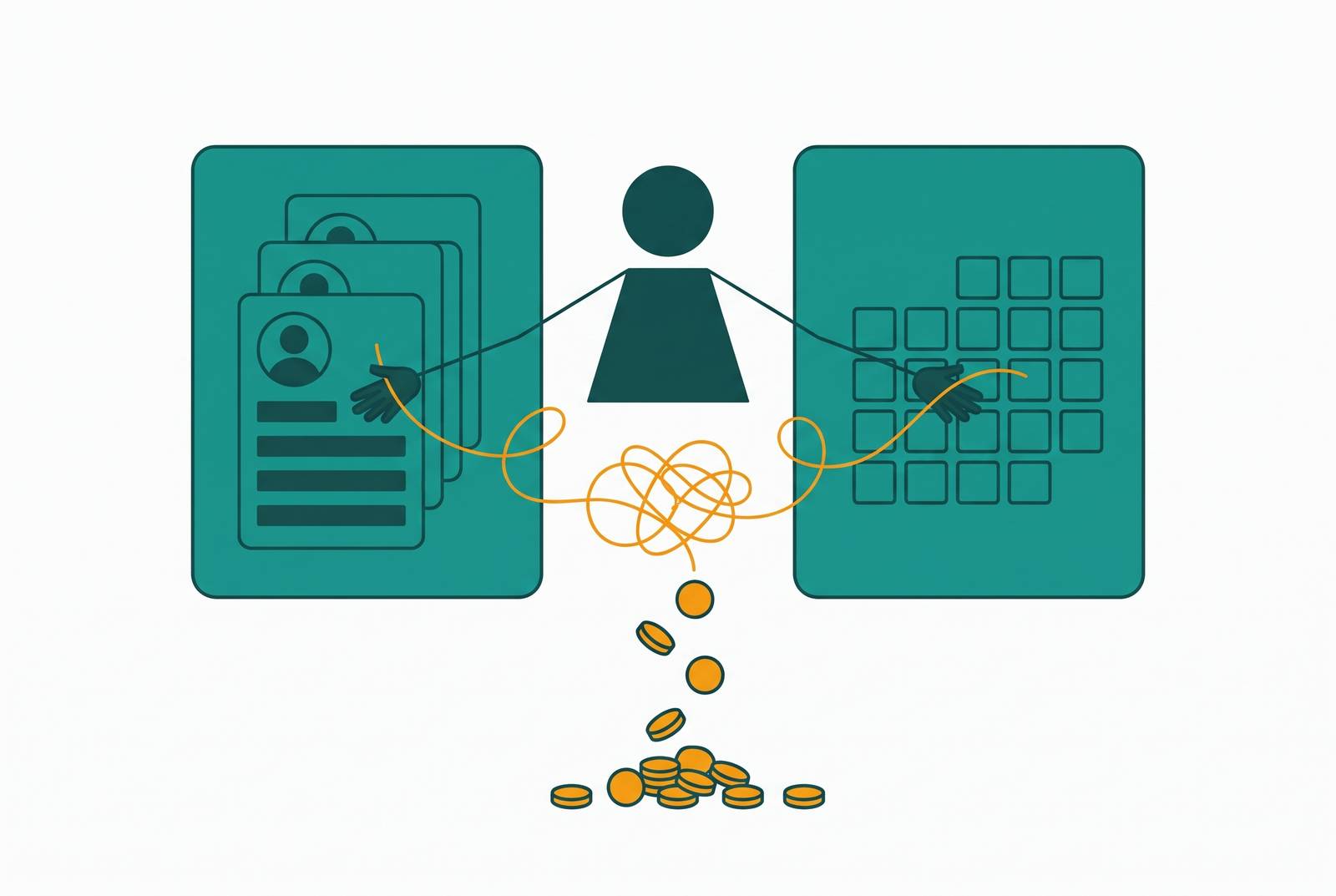
For early-stage companies replacing a fragmented ATS, sourcing, and scheduling stack, the goal is shared hiring context across one or more platforms. The hidden coordination tax arises when founders and recruiters must move candidate information and reconstruct decisions between tools. Closing those handoffs can preserve an existing ATS while freeing skilled people from shuttling records to judge candidates.
How recruiting stacks grow into coordination problems
On Monday morning, a founder opens several browser tabs to pick up a search where they left off. A promising candidate sits in the sourcing tool, but their details have not reached the ATS. The calendar is open elsewhere, waiting for an interview that cannot yet be booked. Each tool serves a useful purpose. The gap is between them, where someone must remember what happened and decide what information needs to move next.
That gap grows through purchases that make sense individually. An ATS provides a system of record when hiring volume grows, a sourcing tool helps find people who have not applied, and a scheduler reduces calendar coordination. An onboarding platform then addresses the handoff to HR. None of these choices has to be bad for the resulting workflow to become expensive. The architectural failure is that adoption happens one bottleneck at a time, while integration requires a view of the whole process.
But isn't integration already solved by APIs and native connectors? A connection can transfer a candidate's name without transferring the reasoning behind their selection. Hiring judgment includes the evidence gathered, the criteria applied, and the questions still unanswered. Those do not follow automatically because two products exchange fields.
Where the recruiter becomes the integration layer
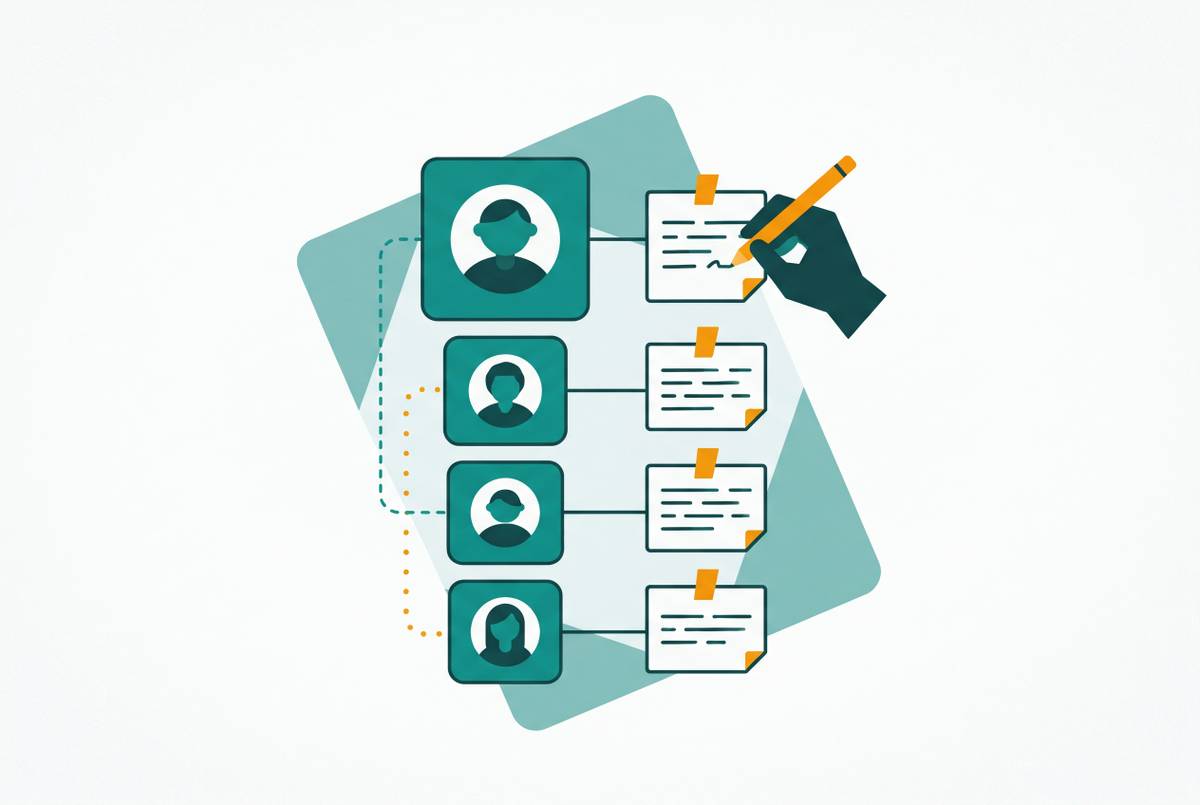
The first tab contains the candidate profile. The recruiter copies it into the outreach tool, then moves screening notes into the ATS after a conversation. Next comes the scheduling tab, where a link is generated and emailed by hand. Once the candidate confirms, the recruiter returns to the ATS to update the stage. The person has become the missing connection between systems.
A scheduler may have enough information to send an invitation but none of the evaluation notes that explain why the candidate was selected. Those notes remain in another tab. Without them, the next step can proceed administratively while losing the open questions that should shape the interview. Moving the candidate forward is not the same as moving the evaluation forward.
Other breaks appear around this same chain. Duplicate profiles require reconciliation, stage-based tasks can trigger at the wrong time, and follow-up slows when several people work on the same requisition. After an offer, manual onboarding handoffs create another gap, while conflicting definitions make dashboards unreliable. These are places where the recruiter's judgment, the most valuable input in the process, is being consumed by data entry and repair.
Where the coordination tax actually accrues
The first cost is cognitive. Switching tabs interrupts work that depends on sustained attention, including evaluating a borderline candidate or writing outreach that earns a reply. The loss extends beyond the time needed to copy a field. Tool fatigue also encourages partial use and manual workarounds, leaving paid capabilities unused while the original problem persists. A license can remain active long after the workflow around it has become mostly manual.
Candidates experience the cost of the team's handoffs as a process that asks them to repeat application steps, use separate portals, and wait without an answer. Candidates with other options can accept a faster-moving process before the slower team finishes coordinating its next step.
The third cost is criteria that never travel. An intake meeting may produce agreement, yet the sourcing query, screening rubric, and interview notes can still reflect different implicit standards. This loss is harder to spot because it appears as an inconsistent pipeline, obscuring the system failure. It also compounds the other costs, since unclear criteria invite more clarification, more switching, and more delay for candidates. Subscription spend is visible, but this operational drag recurs with every role opened.
Why lean founding teams absorb this cost faster than anyone
A team devoted to recruiting can share the work of coordination among specialists. A lean founding team concentrates it on the person responsible for the hire, who may also be writing code or closing customers. The interruption therefore reaches beyond the recruiting workflow. Time spent repairing candidate records displaces work that the same person must do elsewhere.
Consider a founder who sources a candidate, screens them, schedules the interview, and later makes the offer. Between those steps, the founder must reconstruct their own reasoning from separate tools. No colleague needs a handoff, yet the software still creates one. If the screening notes never reach the interview context, the founder is effectively handing work back to themselves without the explanation. Keeping all responsibility with one person does not remove fragmentation.
Startups can also accumulate tools quickly because hiring needs spike. A funded quarter can prompt purchases of sourcing, scheduling, and assessment tools in rapid succession, each aimed at an immediate constraint. Integration then competes with the hiring those purchases were meant to accelerate. For a small team, the stack becomes one more thing to look after, with no one assigned to own it. Every unnecessary day inside the pipeline delays the capacity the team was trying to add.
What integration actually requires — and what it doesn't
The role criteria, evidence gathered so far, and unanswered questions remain available as sourcing becomes screening and screening becomes an interview. A shallow connection transfers a name and email to a scheduler. A deeper connection preserves why the interview is happening and what it should probe.
How can a team tell which kind it has? The practical test is whether the sourcer, screener, and scheduler work from the same agreed criteria or maintain separate local copies. A candidate record can be perfectly synchronized while those copies disagree. Shared context also needs governance, including one source of truth for candidate stage, consistent field definitions, and automatic logging. Without that governance, connecting more tools can spread information that disagrees faster.
For teams applying this standard, the existing ATS can remain the system of record. The tools above it need to share context rather than duplicate it, so replacing everything is not a prerequisite. The most useful starting points are frequent handoffs such as scheduling and calendar sync, email capture into the ATS, and job distribution and inbound applications. These offer a way to reduce rework before tackling more complex downstream connections.
How teams are actually closing these handoffs in 2026
Chipotle's deployment of Paradox illustrates the approach for high-volume, in-restaurant hiring. It cut time-to-hire to roughly four days and substantially increased application completion. Inline scheduling let candidates go straight from applying to booking an interview. Speed was part of the workflow itself. Teams evaluating this model can compare how quickly candidates complete the next step and how long they wait for someone to move their details.
Eightfold AI Interviewer takes a different approach for teams that use Oracle Fusion Cloud Recruiting. Its May 2026 integration embedded structured screening, functional, coding, soft-skills, and language interviews in the recruiting workflow, placing interview outputs with the requisition and candidate record and eliminating the need for export and reimport. Recruiters receive transcripts and summaries for review. Eightfold does not analyze facial expressions, tone of voice, or accent, or use biometric analysis. The mechanism here is continuity between interview evidence and the record used to evaluate it.
LinkedIn Hiring Assistant addresses the earlier part of the process. Generally available at the end of September 2025, it runs intake, search, applicant evaluation, drafted outreach, and pre-screening inside LinkedIn's member graph. That design brings several sourcing-related steps into one surface. It is a relevant comparison for teams whose fragmentation begins before candidates enter the interview process. It does not, on the evidence here, establish an end-to-end replacement for every recruiting function.
Workable and Greenhouse illustrate the route for teams retaining their ATS. Workable shipped its MCP server in May 2026, and Greenhouse introduced MCP in open beta in July 2026, exposing ATS data to external orchestration agents. These connections allow downstream tools to read from and write to shared hiring state. Across these examples, teams can compare which handoff each product eliminates.
The compliance dimension that makes fragmentation a liability, not just an inconvenience
The EU AI Act's Annex III classifies AI systems used for recruitment, candidate screening, and evaluation of job applicants as high-risk. Systems in that class must meet requirements for conformity assessment, technical documentation, human oversight, and logging. The European Commission's AI Act FAQ states that providers must subject high-risk systems to a conformity assessment before placing them on the EU market or putting them into service. A hiring workflow must support an account of what the AI did and how people oversaw it.
The Council of the EU gave final approval on June 29, 2026 to defer Annex III high-risk obligations from August 2, 2026 to December 2, 2027 under the Digital Omnibus on AI. The deadline shifted, but the obligations did not shrink. Conformity assessments, human oversight design, bias monitoring, and documentation remain part of the work. Auditing the stack, renegotiating vendor contracts, and training hiring teams can take a year or more. For teams hiring in EU markets, that preparation needs to begin before the deadline becomes an immediate constraint.
Fragmentation makes this work harder even when individual tools provide useful records. Reconstructing an evaluation may require gathering activity from five platforms, with no shared audit trail to connect the steps. A tidy final candidate profile cannot fill in records that are missing. A shared hiring context and unified log instead make it possible to retrieve what happened, when, and why without manually stitching the process together.
Human oversight must also be part of the design. AI that shows evidence and scores for a person to decide helps meet that requirement, while silent filtering makes it harder to see how a decision was made. Neither an integration nor a human approval step alone establishes full legal compliance. But the architecture needed for reliable coordination is also the architecture needed for tractable oversight. In that practical sense, good architecture and compliant architecture are the same architecture.
How do founders close the seams without replacing the stack?
Teams can start by identifying where a person moves information or reconstructs judgment between tools. Scheduling and calendar sync come first, followed by email and messaging capture into the ATS, then job distribution and inbound applications. These frequent handoffs offer the quickest reduction in rework with the least integration overhead. More complex downstream connections can follow.
New tools should be judged against that same standard. Do they read from and write to the hiring context already in use, or require someone to ferry information to the next step? Agreed criteria also need one shared home so they reach sourcing queries, screening rubrics, and interview structure. A meeting transcript is not enough. The systems that carry out the upstream decision must still be able to use it.
An existing Greenhouse, Lever, Workday, or other ATS can remain in place when connected tools preserve its role as the system of record. That route keeps the company's data safe and cuts the cost of switching without making a seed-stage founder rebuild the stack. A single platform may cut handoffs, but the number of tools alone cannot show whether it works. For the connection to work, the next step must know what the previous step learned without asking a founder or recruiter to explain it again.